“Kalau Dashasahasrani Varshani Pratima Mama|Tishthanti Cha Puranani Prabhavastatra Kah Kaleh”
Meaning: In Kaliyuga, I (the Lord) shall remain for the initial ten thousand years in temples where scriptures will be greatly honoured, and how can Kaliyuga (the dark age) have any effect in such a period?
These words must not have sounded very hopeful for a Hindu living in the times of the Delhi Sultanates and the reign of Aurangzeb, where Hindu temples were being desecrated with the blood of cows and that of the so-called kafirs. If such times were supposed to be the golden 10,000 years of Kaliyuga, then they must have wondered what the upcoming years would be like.
It must have been a constant question in the minds of the Hindus who witnessed the destruction of temples in Ayodhya, Kashi, and Mathura then, whether their times were the beginning or the end of Kaliyuga, because such destruction was prophesied only for the end times. Similarly, those who have known of the genocide of the Kashmiri Pandits, the Setu Samudram project to demolish the Ram Setu, and constant terror attacks during UPA 2 would also have faced this question.
Regardless of such brutalities, the invader-colonists and India’s adversaries have not succeeded till date in their attempts to make India a museum civilisation like the Persians, the Greeks, and the Egyptians, where Western pastors today claim them as foolish polytheists while Western YouTubers at the same time link them to aliens, seeing the magnificence of their architecture and culture.
Actually, the Lord has been keeping his promise, and so He has sent, from time to time, the Naras (men) in the form of kings such as Chandragupta, Sudhanva, Maharana Pratap, and Chhatrapati Shivaji, to uphold Dharma. He also sent Gurus such as Chanakya, Adi Shankaracharya, Guru Raghavendra, and Ramdas, in the role of Sri Krishna, to guide the Nara; and with the combination of Nara and Narayana, Men with a capital and bold M emerged as the saviours of Bharat. It is by this Parampara that Greeks were forced to retreat by the Mauryans, that Turks were repelled by Mewar, that Vijayanagar became a thorn for the Deccan sultanates under the guidance of Shankaracharya Vidyaranya, that the Maratha flag unfurled in Mughal Delhi, and Subhash Bose, guided by the spiritual ideas of Sri Aurobindo, etc., forced the British to evict India. With each step, the Lord was fulfilling his promise of a golden age, and the reinstatement of a temple in the sacred land of Ram Janmabhoomi marks its beginning, where Prime Minister Narendra Modi is another Nara.
Modi’s tenure as the Prime Minister truly embodies the aforementioned words of Bhagwan Krishna, and now it truly appears that the current times are headed towards a golden period, the 10,000-year-long Satyug within Kaliyuga, where India will shine as the Viksit Bharat, not as a dominator but as an example of zenith. The scale of the accomplishment of building a Ram Mandir is so immense that the name and tenure of PM Modi are bound to be compared with the glory of legendary Emperor Vikramaditya, who also established a temple in the Ram Janmabhoomi.
The struggle for the temple was not ordinary, and the task was so immense that, for most people, the temple was a dream believed to be realised only after their lifetimes. But be it Article 370, which was based on a highly complex constitutional question, or the dream of a legal and peaceful solution to the Ayodhya dispute, Shri Narendra Modi has been a facilitator and ensured governance and security that made such hard decisions seem possible to the Judges of the Supreme Court. Today, Ram Mandir stands in spite of multiple threats by terrorist groups; in spite of being officially denounced by the Government of Pakistan, it stands. The threats have remained only verbal, and no riots have been recorded near the Ram Mandir since the judgment.
The issue of Ram Mandir was a matter of closing a civilizational wound when our temple was demolished not for gold and wealth, as leftist historians often claim, but as a humiliation upon those who were ‘infidels’ in the eyes of the Islamic invaders. The struggle for the temple was a continuous one where the Marathas, the Sikhs, and the Hindu kings including the ones who had served the Mughals had tried time and again to have their temple back and to irradiate a zombie structure filled with half-destroyed idols built by the ruins of the demolished temple, which was built absolutely against the Islamic ethics of building a mosque.
On December 6, 1992, justice was half-accomplished when the common men of the country, deprived of justice for centuries, for whom a mosque built to humiliate their existence was unbearable, decided to do justice in their own hands by demolishing the disputed structure, only to see their beloved Ram Mandir resurface. If this fateful day has any comparison, it is the storming of the Bastille during the French Revolution, when the French people took up arms against their oppressive monarch to seek their rights.
Removing the disputed structure was not tough physically, for the structure had decayed, maybe by the tears of a million people; but to do the act, the Karsevaks had to be baptized by bullet fire, not once but many times such as in October and November of 1990, where Karsevaks were brutally shot, including the remembered Kothari brothers, who had become the face of the temple movement and who, interestingly, belonged to the Jain community. But should such support from the Jains and Buddhists be any surprise, especially when many Jain Tirthankaras were Sooryavanshi kings of Ayodhya and were possibly the descendants of Sri Ram?
Jains celebrate Ram as Vasudev in their Jain Ramayana, and similarly, for Buddhists, the importance of Ram is evident in the texts of the Dasharatha Jataka, where Bhagwan Buddha declares himself an incarnation of Ram. His exact quote is very intriguing:
“At that time the king Suddhodana (Buddha’s father) was the king Dasaratha, Mahamayi (Buddha’s mother) was the mother, Rahula’s (Buddha’s son) mother was Sita, Ananda was Bharat, and I myself was Rama-pandita.”
Thus, the temple movement was not just a Hindu issue; it was a Bhartiya issue, a civilizational issue.
The judgment of the Hon’ble Supreme Court in the Ram Janmabhoomi case was truly landmark, for it has come forward to undo a historical injustice and has looked back 500 years to remove the guilt, pain, and agony from the billion hearts of a nation. This feeling of pain for an event centuries old, as Dr Anand Ranganathan rightly points out, is an actual sign of civilisation and continuity which flows from the Saraswati-Sindhu people thousands of years ago to every new day, where we cherish the Vedic hymns dedicated to honour River Saraswati, though the river itself has dried up centuries ago. Not only does the judgment heal the civilizational wounds, but certain parts of it also demonstrate the means with which such wounds are scratched and created. The judgment exposes the reality of the so-called eminent intellectuals and historians who had shamelessly denied the truth of Ram Janmabhoomi. For example, Suvira Jaiswal, an ‘expert’ before the court who was denying a prior temple, had stated before the court that his knowledge of the issue came from newspapers and hearsay. Imagine the extent of the rot!
The judgment also discusses a new doctrine which states that unless one place of worship is ritually and formally dissolved, no other secondary place of worship can be superimposed, and the religious nature remains unchanged; and thus, to understand the religious nature of a site, the court can potentially bypass the controversial Places of Worship Act. Many still try to defame the judgment by claiming that the judgment is merely based on ‘faith’. Actually, the judgment is based on a volley of evidence, witness statements, archaeological evidence, and so on, along with this ‘faith’. The experts who appeared before the court, on one hand, included highly respected saints such as the present Shankaracharya of Jyotirmath, Shri Avimukteshwaranand Saraswati Ji, who gave some evidence in justifying the location of the Janmabhoomi by scriptures, and on the other hand, the works of archaeologists such as B.B. Lal, who proved the existence of earlier temples on the site. The physical presence of a prior temple was again confirmed by fresh findings when, in May of 2020, idols, a Shivling, and pillars were recovered from the Janmabhoomi.
The role of the fifth columnists opposing the Ram Mandir reveals much about their functioning. When another structure was found below, they started arguing that it could be Buddhist or Jain as well. When that too failed and Ram Lalla won the case, they then argued that the temple was not good enough; and when the temple was ready, they said that the Pran Pratishtha was not right.
When the under-construction temple was inaugurated just before the 2024 general elections, a narrative was spread claiming that such an inauguration was unrighteous according to scripture. Such critics had definitely ignored the possibility that, if the appeasement-friendly INC-led I.N.D.I.Alliance had won the elections instead of the NDA, it could have created difficulties in the temple’s completion? Could there have been stays on the Pran Pratishtha? Thus, it was absolutely necessary that the temple rituals be started well before the election dates. Nityanand Mishra, a Sanskrit scholar, then presented scriptures to refute such claims, proving that Pran Pratishtha can be performed even if the temple structure is not fully prepared.
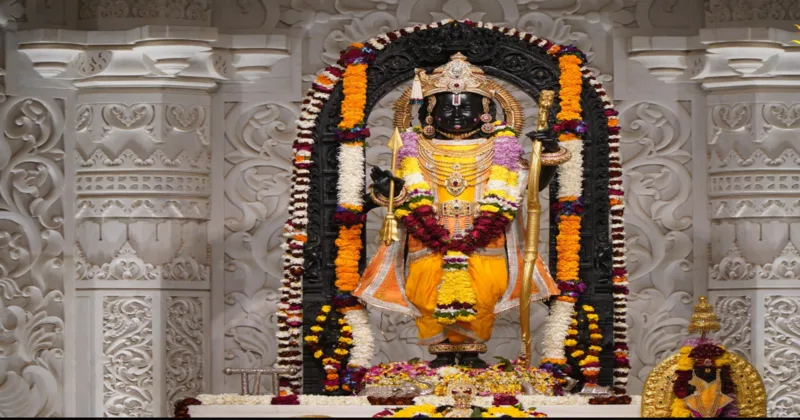
Unaffected by such narratives, Ram Mandir was inaugurated in the most grand manner in 2024, where top politicians, actors, entrepreneurs, and Hindu saints, including Jagadguru Dwaracharya Swami Shri Rajendra Das Ji of Malook Peetha Vrindavan, Jagadguru Ramanujacharya Sri Raghavacharya Ji, and Jagadguru Rambhadracharya Ji of Chitrakoot, etc., were present. The inauguration was blessed by the well-wishes of HH Jagadguru Shankaracharyas, such as Swami Vidushekhar Bharti Ji of Sringeri and Swami Sadanand Saraswati of Dwarka, while the Shankaracharya of Kanchi, Sri Vijayendra Saraswati Ji, was actively involved in the Pran Pratishtha rituals. The Government of India also launched a golden postal stamp commemorating the temple’s construction, made from the soil and water of Ayodhya.
During the inauguration, RSS chief Mohan Bhagwat was also present with the PM, and the temple construction is also the face of the Sangh’s success in securing the key issues of Hindus in its journey of its first hundred years. By the end of 2025, the footfall in Ram Mandir is calculated to cross 50 crores, which means that even every fourth Indian has now visited the temple at least once. Ram Mandir marks the start of a Viksit Bharat, where India has achieved a feat similar to the Jewish dream of building a third temple and the Christian dream of regaining the Hagia Sophia Church.