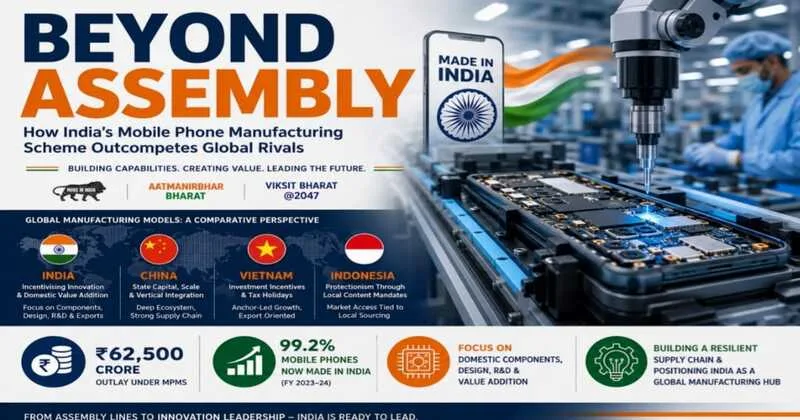
The global race to dominate mobile phone manufacturing is no longer a contest of cheap labour alone. It has become a chessboard match between nations, each deploying its own distinct policy architecture to lure global capital, build domestic capability and climb the electronics value chain. China built its dominance through state-directed scale and an integrated supplier ecosystem. Vietnam built its rise through aggressive investment incentives and tax holidays for foreign giants like Samsung. Indonesia has taken the protectionist route, using local content mandates to force global brands to manufacture on its soil or lose access to its vast consumer market. Into this crowded, competitive arena steps India, with the Modi government newly approved Mobile Phone Manufacturing Scheme (MPMS), a Rs 62,500 crore instrument that is not merely another subsidy scheme but a considered response to every major manufacturing model currently competing for global electronics investment. To understand why the MPMS matters and why it positions India favourably, one must first understand the models it is up against.
The Vietnam Model: Investment Incentives and Tax Holidays
Vietnam’s rise as a mobile manufacturing powerhouse has been built substantially around Samsung, whose cumulative investment in the country now runs into tens of billions of dollars across six manufacturing plants and an R&D centre. Vietnam’s approach has been to offer generous tax holidays, cheap industrial land and a permissive regulatory environment that made it easy for a single anchor investor to build an enormous, self-contained manufacturing base. Samsung alone accounts for a substantial share of Vietnam’s total exports and the government has steadily deepened this relationship, encouraging Samsung to move up the value chain into displays, semiconductor testing and R&D.
The strength of this model is its depth of integration with a small number of anchor players. Its weakness is concentration risk that Vietnam’s electronics fortunes are disproportionately tied to the decisions of a handful of foreign multinationals and the domestic supplier base, while growing. It has taken over a decade to reach meaningful scale even under one of the most sustained single-country investment relationships in Asian manufacturing history.
Indian MPMS avoids this over-concentration trap. By structuring incentives around domestic sourcing of components and sub-assemblies rather than around any single anchor investor, the scheme is designed to cultivate a broad-based, resilient domestic supplier ecosystem precisely the layer that took Vietnam years of dependence on one or two global giants to build organically.
The Indonesia Model: Protectionism Through Local Content Mandates
Indonesia has pursued an altogether more coercive strategy. Under its Tingkat Komponen Dalam Negeri (TKDN) framework, global brands are legally required to source a defined share of their components domestically, typically in the 20 to 40 per cent range for electronics or face outright bans on selling their products in the Indonesian market. This is precisely what happened when Indonesia blocked sales of the iPhone 16 and Google Pixel devices after Apple and Google failed to meet their local content and investment commitments, forcing prolonged negotiations before market access was restored.
The Indonesian model demonstrates the raw negotiating leverage a large consumer market can exert on global manufacturers. It has drawn criticism from economists who warn that heavy-handed local content mandates can deter the very investment they are designed to attract, and Indonesia’s own government has recently signalled a shift toward a more flexible, incentive-based approach precisely because the mandate-first model has shown diminishing returns.
India’s MPMS is built on a fundamentally more sophisticated premise: incentivise rather than coerce. Instead of threatening market bans, it rewards manufacturers who go beyond bare assembly with escalating incentives up to 1.5% additional for domestic component sourcing and a full 3 per cent for design and R&D. This carrot-based architecture achieves the same strategic objective as Indonesia’s stick deeper localisation without the diplomatic friction and investor uncertainty that protectionist mandates inevitably generate. It is coercion reimagined as opportunity, and it reflects the confidence of a government that believes India has the talent pool that can win investment on merit rather than compulsion.
The Chinese Model: State Capital, Scale and Vertical Integration
China’s dominance was built differently again through decades of state-backed capital, an unmatched density of component suppliers clustered around cities like Shenzhen and a deliberate national strategy to vertically integrate everything from raw materials to finished devices under one geographic roof. This gave Chinese manufacturing an efficiency and speed advantage that no other nation could easily replicate, and it remains the single most formidable competitive benchmark any rival manufacturing nation must contend with.
India cannot and need not replicate this model wholesale; the conditions that produced China’s manufacturing agglomeration took over three decades and an entirely different political-economic system to build. What India can do and what the MPMS is explicitly engineered to do is compete selectively at the frontier where China is now most vulnerable: brand ownership, design intellectual property and supply chain diversification away from a single geography that global companies increasingly view as a geopolitical risk. The MPMS R&D incentive is a direct wager on this vulnerability, rewarding companies that patent, design and brand from Indian soil rather than merely execute someone else’s blueprint.
Where Indian Model Pulls Ahead
Judged against these three rival approaches, the MPMS reveals a genuinely distinctive Indian synthesis. It borrows the investment-friendly spirit of the Vietnam model without its over-dependence on a handful of anchor firms. It borrows Indonesia’s ambition for deep localisation without its coercive, market-access-denying bluntness. And it borrows China’s aspiration for vertical integration and scale while adding something China’s original model never prioritised at the outset: a dedicated, structured incentive for Indian companies to own their own brands and intellectual property from day one.
This is where India holds a card few competitors can match: the large scale of its domestic consumer market combined with its already-proven manufacturing depth. With 99.2 per cent of mobile phones used in India now manufactured domestically and smartphones having overtaken diesel fuel and cut diamonds to become India’s largest export category in 2025, the foundational manufacturing base already exists. The MPMS does not need to build this capacity from zero as Vietnam once had to; it needs only to deepen, refine and elevate a base that the PLI-LSEM scheme has already firmly established over the past several years.
Unlike Vietnam or Indonesia, India possesses a domestic market large enough that global manufacturers cannot afford to ignore it regardless of incentive structure, giving New Delhi a negotiating leverage that smaller Southeast Asian economies simply do not have. Combined with a young workforce, a growing engineering and design talent pool and English-language technical education infrastructure, India offers global electronics companies something no rival nation can fully replicate: the combination of scale of production, scale of consumption, and depth of technical human capital under one roof.
Modi Government and Aatmanirbhar Bharat
The Modi government’s approach through the MPMS reflects an understanding that India need not copy any single nation playbook to win this contest; it can construct a hybrid model calibrated to India’s own comparative advantages. Where Vietnam competes on investor-friendliness, and China competes on scale, India is positioning itself to compete on the full spectrum of capacity, self-reliance and sovereignty of technology, all bound together.
This is what Atmanirbhar Bharat has given in concrete industrial form. It is not autarky, nor is it chasing foreign capital on someone else’s terms. It is an assertion that India intends to be a rule-shaper in global electronics manufacturing, not a rule-taker competing with Vietnam’s investment magnetism, matching Indonesian localisation ambitions without its coercive costs and steadily eroding China’s near-monopoly on advanced component manufacturing, one incentivised patent and one Indian brand at a time.
As the scheme unfolds over its five-year tenure through FY 2030-31, its true test will lie in whether India can convert today’s assembly line strength into tomorrow’s design table sovereignty. This is the decisive frontier on which the global mobile manufacturing contest will ultimately be won.