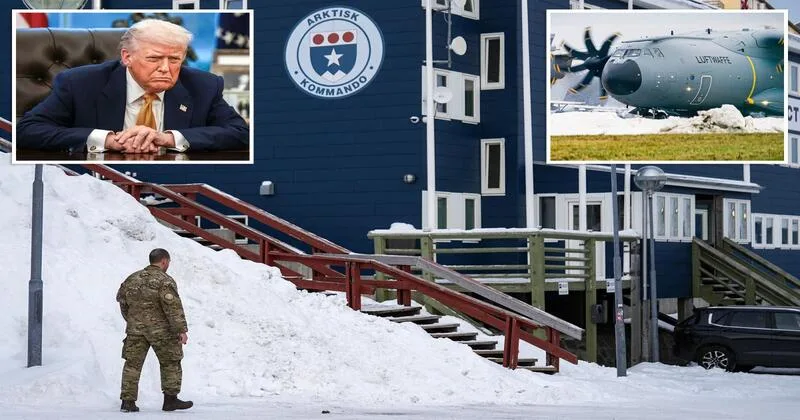
Soldiers from France, Germany and several other European countries have begun arriving in Greenland, underscoring deep divisions within the West and NATO over the future of the strategically vital Arctic island. The deployments followed talks involving Denmark, Greenland and the United States that exposed what officials described as a “fundamental disagreement” between the administration of Donald Trump and its European allies on questions of sovereignty, security and global order.
France has already sent 15 soldiers to Greenland, while Germany has deployed 13 personnel. Norway and Sweden are also participating, with additional troops from the United Kingdom and the Netherlands arriving in the following days. The small but symbolically significant mission has been described by European officials as a “recognition-of-the-territory” exercise, including the planting of the European Union flag in Greenland to signal unity and commitment.
Speaking on Wednesday, French President Emmanuel Macron confirmed that French forces were already on the ground. “The first French military elements are already en route, and others will follow,” he said, as French authorities disclosed that soldiers from France’s mountain infantry unit had reached Nuuk, Greenland’s capital. Paris said the two-day deployment was intended to demonstrate that European forces could be mobilised and deployed rapidly if required. Germany echoed that message. The German Ministry of Defence announced that it was sending a reconnaissance team of 13 personnel to Greenland on Thursday, describing the mission as part of broader coordination with European partners and Denmark. Berlin stressed that the deployment was defensive and symbolic, aimed at supporting stability rather than escalating tensions.
The European moves came even as the White House sought to downplay their significance. US officials said that recent talks with Denmark and Greenland had been “productive,” but made it clear that European military deployments would not alter Washington’s position. White House press secretary Karoline Leavitt stated bluntly that the presence of European troops had “no bearing” on President Trump’s thinking.
“I don’t think troops in Europe impact the president’s decision-making process, nor does it impact his goal of the acquisition of Greenland at all,” Leavitt told reporters. “The President has made his priority quite clear. He wants the United States to acquire Greenland. He thinks it’s in our best national security to do that.” Trump has repeatedly argued that Greenland, which he describes as strategically located and rich in critical minerals, should belong to the United States. He has not ruled out the use of force to secure control of the island, a position that has been firmly rejected by both Denmark and Greenland.
European officials say such rhetoric has sharpened internal Western contradictions, particularly within NATO, which is formally committed to collective defence and respect for member sovereignty. While Washington characterised recent meetings as “technical talks on the acquisition agreement,” Danish officials offered a markedly different interpretation. Danish Foreign Minister Lars Lokke Rasmussen said the discussions were about managing differences and addressing US security concerns through cooperation, not ownership. He emphasised that Denmark remained committed to dialogue within NATO and existing defence frameworks.
Despite the talks, US, Danish and Greenlandic representatives have openly acknowledged a fundamental disagreement over Greenland’s future. Trump has argued that Denmark lacks the capacity to adequately protect the island from potential threats posed by Russia or China. Denmark and Greenland, however, counter that NATO cooperation, rather than US ownership, is the appropriate and legitimate framework for Arctic security.
First batch of European troops arrive in Greenland after Trumo's statements on the need to ANNEX the island!
🇩🇪 Germany: 13
🇳🇴 Norway: 2
🇬🇧 UK: 1Big numbers folks! pic.twitter.com/bTyRB4srAu
— Think BRICS (@RealBRICSnews) January 15, 2026
In Greenland itself, the response to Trump’s position has been unequivocal. Prime Minister Jens-Frederik Nielsen welcomed continued dialogue but categorically rejected any suggestion of US control. “Greenland is not for sale,” Nielsen said. “Greenland does not want to be owned by the United States. Greenland does not want to be governed from the United States.”
The European deployments are intended to signal unity and reassure Copenhagen amid rising tensions. Denmark has already announced steps to strengthen its own military presence in Greenland, and allied forces say their modest contributions are designed to show solidarity rather than provoke confrontation. Nevertheless, the situation has exposed fault lines within the Western alliance over how principles of sovereignty, self-determination and international law are applied.
However, not all European states are prepared to take part. Polish Prime Minister Donald Tusk said on Thursday that Poland would not send soldiers to Greenland, warning that an attack by one NATO country on the territory of another would be “the end of the world as we know it.” His remarks reflected unease among some allies about the implications of Trump’s stance for the alliance itself. Spain has left the door open to future involvement. Spanish Defence Minister Margarita Robles said Madrid did not rule out taking part in a potential European mission in Greenland. “Reinforcing surveillance in Greenland would be an option, for example, but we will see how things develop,” she said, according to Spain’s EFE news agency.
Russia has seized on the dispute to criticise what it calls Western hypocrisy. Russian Foreign Ministry spokesperson Maria Zakharova said it was unacceptable for the West to continue claiming that Russia and China posed a threat to Greenland. She argued that the crisis highlighted inconsistencies in the West’s promotion of a so-called “rules-based” international order.
“First they came up with the idea that there were some aggressors, and then that they were ready to protect someone from these aggressors,” Zakharova said. The current situation, she added, “demonstrates with particular acuteness the inconsistency of the so-called ‘rules-based world order’ being built by the West.” Russia, she said, stood in solidarity with China in rejecting references to Russian or Chinese activity around Greenland as justification for the present escalation.
Beyond geopolitics, the prospect of US control has generated anxiety among Greenland’s Indigenous Inuit communities. Around the town of Ilulissat, near a UNESCO-listed ice fjord on the island’s western coast, fears have grown that Greenland’s mineral wealth could be exploited at the expense of local culture and livelihoods.
Before Wednesday’s talks, Inuit Greenlander Karl Sandgreen, head of the Ilulissat Icefjord visitor centre, said he hoped US officials would show restraint and empathy. “My hope is that Rubio is going to have some humanity in that talk,” he said, expressing concern for the future of Inuit society.
“We are totally different. We are Inuit, and we’ve been living here for thousands of years,” Sandgreen said. “This is my daughter’s and my son’s future, not a future for people who are thinking about resources.”
As European troops arrive and diplomatic exchanges continue, Greenland has become a focal point of a wider crisis within the Western alliance. The competing positions of the United States and its European partners have laid bare deep divisions within NATO, raising questions about consistency, credibility and the future of world peace in an era where even allies disagree on the meaning of sovereignty and security.