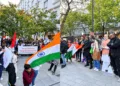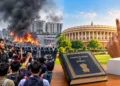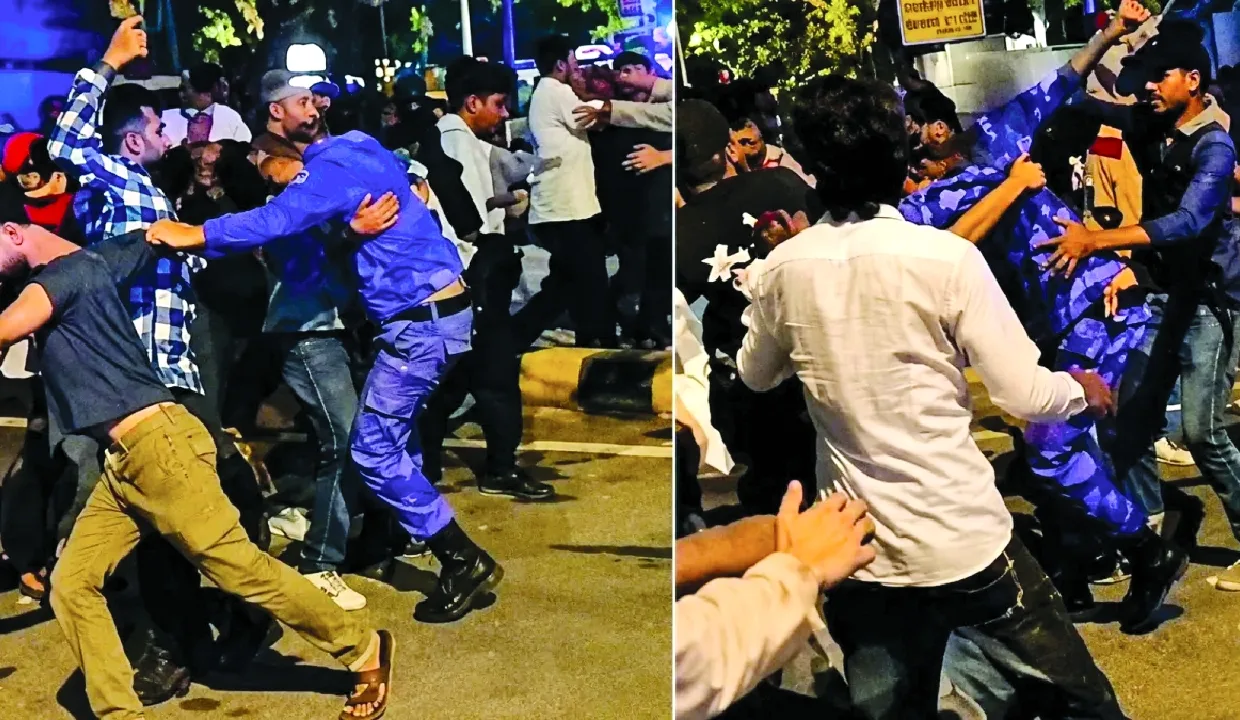
The Supreme Court on Tuesday observed that any independent investigation into the violence during the Cockroach Janta Party’s (CJP) protests over alleged NEET-UG examination irregularities must examine allegations against both the police and the protesters, stressing that “the truth has to come out.”
Hearing a batch of petitions concerning alleged police excesses during the student protests, a bench comprising Chief Justice Surya Kant, Justice Joymalya Bagchi and Justice V. Mohana indicated that it was considering constituting a Special Investigation Team (SIT) headed by a retired Supreme Court judge to conduct an independent inquiry.
Court stresses fair and independent investigation
During the hearing, the bench observed that the allegations raised by the petitioners prima facie warranted an impartial investigation.
“The allegations made by petitioners prima facie make out a case for an independent and fair probe,” the bench observed, adding that such an investigation would effectively address the issues raised by all sides.
The Chief Justice said the proposed inquiry should not be limited to allegations of police excesses but must also investigate incidents in which police personnel were allegedly attacked during the protests.
“The truth has to come out,” the court observed while discussing the scope of the proposed investigation.
SIT headed by retired judge under consideration
The bench indicated that it may constitute a Special Investigation Team headed by a retired Supreme Court judge to examine allegations of excessive use of force by the police as well as attacks on law enforcement personnel during the demonstrations.
The court said details regarding the composition and structure of the proposed probe panel would be decided and shared later.
It also observed that the investigation should be independent, fair and transparent in order to inspire public confidence.
Centre cites injuries to police personnel
Appearing for the Centre, Solicitor General Tushar Mehta informed the court that around 250 police personnel were injured during the protests.
While stating that any assault on students was a matter of concern, Mehta submitted that many attacks on police personnel may have been carried out by anti-social elements who infiltrated the demonstrations rather than by students participating in the protest.
Senior Advocate Sridhar Potaraju, appearing on behalf of injured police personnel, argued that police officers on duty were subjected to an organised assault during the protests.
According to him, both male and female police personnel deployed for maintaining law and order were attacked while discharging their official responsibilities.
Court discusses protest rights and police protection
During the proceedings, Justice Joymalya Bagchi observed that police personnel should be equipped with adequate protective gear while handling large public demonstrations.
In response, Senior Advocate C.U. Singh Sankaranarayanan, appearing for the petitioners, remarked that the protesting students themselves had no protective equipment.
The Supreme Court reiterated that peaceful protest is a constitutional right and forms an essential part of democratic expression. However, it emphasised that constitutional protection does not extend to acts that violate the law.
“We don’t think elaborate arguments are required. It was completely a peaceful protest by students raising some demand. It was within the constitutional framework,” the Chief Justice observed, while adding that any alleged unlawful acts committed during the demonstrations would require investigation.
Court seeks review of protest policing guidelines
The bench also indicated that it may revisit existing protocols governing police action during public protests.
Observing that democratic societies inevitably witness public agitations, the Chief Justice said the court was open to receiving constructive suggestions from all stakeholders on improving guidelines relating to policing of protests.
“Agitations are bound to be there in a democracy,” the Chief Justice remarked.
Families of injured police personnel move Supreme Court
The court’s observations came after the families of four police personnel injured during the CJP protests filed an intervention application before the Supreme Court.
The petition was filed on behalf of the families of Assistant Commissioner of Police Kailash Singh Bisht, Assistant Sub-Inspector Sandeep, Constable Dheeraj and Assistant Sub-Inspector Hemendar Rathi, all of whom were allegedly injured while on duty during the protests.
According to the application, police personnel deployed at Jantar Mantar and other locations in Delhi on July 20, July 24 and July 25 were attacked with stones, glass bottles, sharpened floor tiles and other objects while attempting to maintain law and order.
The petitioners sought directions for the Union Government to frame guidelines to ensure better protection for police personnel, including women officers, while performing official duties.
The application also sought a declaration that police and other law enforcement personnel are equally entitled to the protection of Articles 14 and 21 of the Constitution, including the right to life and personal liberty while discharging official responsibilities.
The petition argued that although the right to peaceful protest is constitutionally guaranteed, such protection cannot extend to acts of violence against public servants performing their statutory duties.