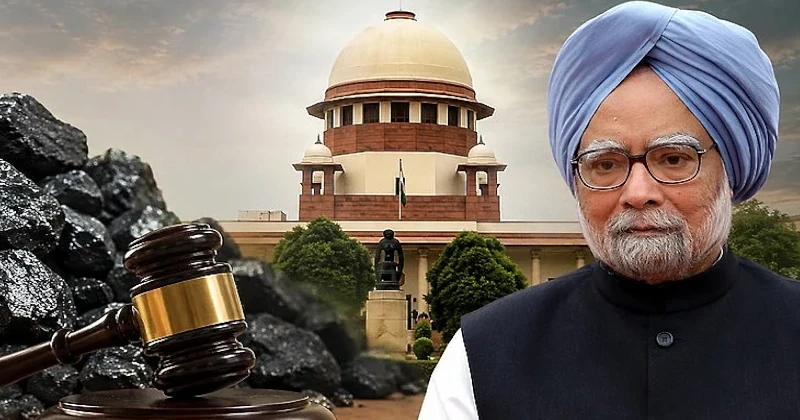
New Delhi: The Supreme Court has put to rest claims circulating on social media that the criminal proceedings against former Prime Minister Dr Manmohan Singh in the coal block allocation case were terminated merely because he passed away in December 2024. In a significant judgment, the apex court examined the case on its merits, accepted the Central Bureau of Investigation’s (CBI) closure reports, and held that the Special CBI Court had no legal justification to summon Dr Singh as an accused in 2015.
The ruling directly contradicts the narrative being amplified by several social media users that the proceedings ended solely because of Dr Singh’s demise. Had that been the case, the Supreme Court could simply have disposed of the appeal as infructuous. Instead, the Bench undertook a detailed examination of the trial court’s order, scrutinised the investigation conducted by the CBI, accepted its closure reports, quashed the summoning order and brought the proceedings to a close on merits.
Supreme Court has canceled the summons issued in 2015 to late PM Manmohan Singh in the Coal Scam not because he was innocent but because he is dead. https://t.co/kAaYqb4pKu
— Shashank Shekhar Jha (@shashank_ssj) July 29, 2026
The distinction is not merely procedural but goes to the heart of the case. The Supreme Court did not grant relief because the former Prime Minister was no longer alive; it held that the legal basis for prosecuting him itself was unsustainable.
A Bench comprising Chief Justice of India Surya Kant and Justices Joymalya Bagchi and V. Mohana ruled that the Special CBI Court had erred in rejecting the two closure reports filed by the CBI after a detailed investigation into the allocation of a coal block to Hindalco during the UPA government, when Dr Manmohan Singh was also holding the Coal Ministry portfolio.
The apex court accepted the CBI’s findings, set aside the March 11, 2015 order of the Special Judge that had taken cognisance of offences under Sections 120-B and 409 of the IPC against Dr Singh and five others, and closed the proceedings.
“It will be noted at the outset that the CBI, after investigation, filed two separate closure reports,” the Bench observed while framing the central issue before it. After examining the record, the Court found no justification for the trial court to disregard the investigating agency’s conclusions.
“Having regard to the relevant parameters consistently laid down by this Court on acceptance of reports of the investigating agency, we are satisfied that there was no reason for the Judge to turn down the closure reports of the CBI and take cognizance,” the Bench observed.
The Court then categorically ruled, “Consequently, we allow this appeal, set aside the impugned judgment of the learned Special Judge, accept the closure reports filed by the CBI and close the matter on merits.”
The judgment is particularly significant because Dr Manmohan Singh had passed away in December 2024, long before the appeal was finally decided. Normally, criminal proceedings against a deceased accused become infructuous. However, the Supreme Court consciously chose not to dispose of the matter on that technical ground.
Instead, it proceeded to examine the legality of the Special Judge’s decision because of the serious adverse findings recorded against a former Prime Minister.
Senior Advocate Kapil Sibal, appearing for Dr Singh, argued that although the appeal may have technically become infructuous after his client’s death, the adverse observations made by the trial court could not be allowed to remain on record. Senior Advocate Abhishek Manu Singhvi also urged the Court to expunge those findings.
The Bench accepted that the legality of the summoning order deserved judicial scrutiny. Rather than treating the appeal as a closed chapter owing to Dr Singh’s demise, it evaluated the evidence collected during the investigation and the reasons assigned by the Special Judge for rejecting the CBI’s conclusions.
The case arose from allegations relating to the allocation of a coal block to Hindalco during the UPA government. After conducting a detailed investigation, the CBI filed two closure reports, concluding that there was no material to prosecute Dr Manmohan Singh.
Despite the investigating agency’s clean chit, the Special CBI Court rejected both closure reports in March 2015 and summoned the former Prime Minister along with five others.
That order was stayed by the Supreme Court on April 1, 2015, and remained under challenge for over a decade. Dr Singh had consistently maintained that the Special Judge had attempted to criminalise an administrative decision taken in the discharge of official duties despite the investigating agency itself finding no evidence of criminal misconduct.
The Supreme Court’s ruling effectively endorses that position by holding that the rejection of the CBI’s closure reports was legally unsustainable. The judgment also reiterates an important legal principle: closure reports filed after a thorough investigation cannot be rejected casually or without cogent reasons supported by the material on record.