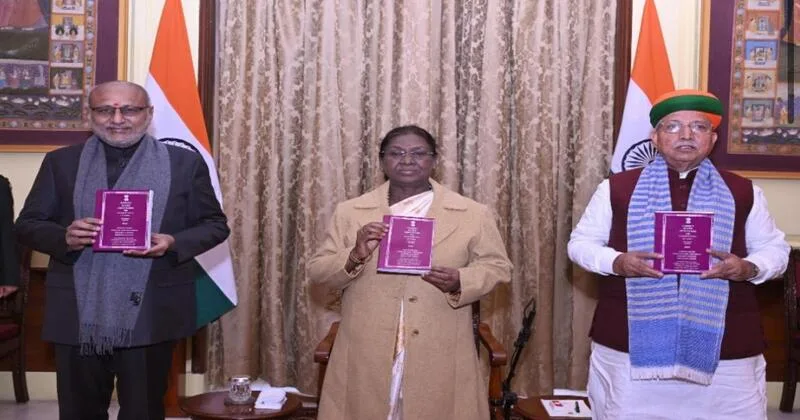
A quiet yet historic milestone has been achieved in India’s democratic journey; the Constitution of India is now available in the Santhali language, written in the Ol Chiki script. The launch of this edition by the President of India, Droupadi Murmu, herself a proud member of the Santhali vanvasi community, gives the moment deep moral and emotional significance. This is not merely an act of translation; it is a meaningful step towards the decentralisation of language, bringing the authority of law closer to the people. Prime Minister Narendra Modi has rightly recognised this initiative not as symbolism, but as a substantive act of inclusion that strengthens the foundations of Indian democracy.
Language has always shaped access to power. For decades, constitutional knowledge largely flowed through English and Hindi, leaving many communities distant from full understanding. By making the Constitution available in Santhali, India affirms a simple yet powerful truth that democracy becomes real only when citizens can read and understand the law in their own mother tongue. When governance speaks in familiar words, the distance between the State and the citizen begins to narrow.
India’s strength lies in its diversity, with over ten crore citizens belonging to tribal communities, nearly nine per cent of the population. These communities form one of the nation’s oldest cultural foundations. Santhali-speaking communities spread across Jharkhand, Odisha, West Bengal, Bihar, and parts of Assam carry centuries of history, music and collective memory. The Santhali language, expressed through the Ol Chiki script, is not just a means of communication; it is a living expression of identity and dignity.

Printing the Constitution in Santhali sends a clear and powerful message that tribals belong, fully and equally, to the Republic of Bharat. For generations, constitutional rights existed yet often felt distant and abstract. Now, those rights enter homes and conversations. Articles such as Article 15 on equality, Article 46 on the protection of Scheduled Tribes and provisions under the Fifth and Sixth Schedules become understandable and relevant. Awareness replaces hesitation, confidence replaces silence.
This clarity strengthens democracy at its roots. Citizens who understand their rights participate more actively in Gram Sabhas, local governance, and elections. Women assert dignity with greater confidence. Elders pass on constitutional knowledge alongside tradition. Young people grow up seeing themselves as equal partners in the nation’s journey. The law no longer feels distant; it feels present and fair.
The significance of this initiative is heightened by the leadership behind it. Under the guidance of President Droupadi Murmu, India’s first vanvasi woman President, this step reflects a governance philosophy rooted in respect and inclusion. It aligns seamlessly with the vision of Sabka Saath, Sabka Vikas, Sabka Vishwas, Sabka Prayas, showing that true development includes voice, dignity, and participation.
Translating the Constitution into Santhali is not only about language, but it is also about recognition. A Constitution read in one’s mother tongue becomes more than a document; it becomes living assurance. With this step, India does not merely preserve a language it deepens democracy itself.