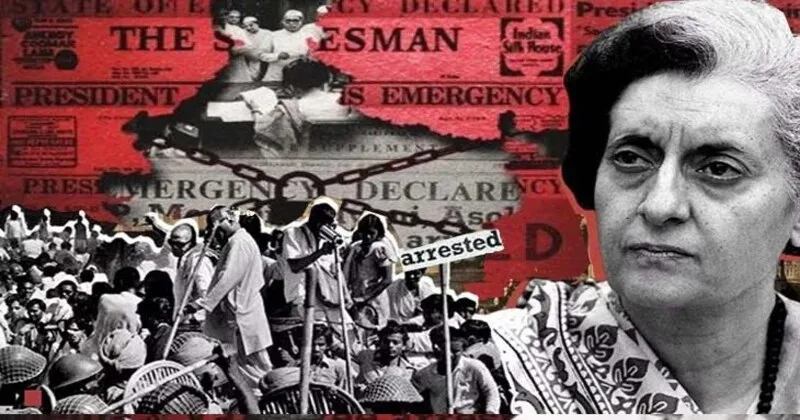
On June 25, the nation observed the 51st anniversary of the Emergency, marking the dark midnight of 1975 when then-Prime Minister Indira Gandhi unilaterally imposed a 21-month dictatorship to protect her own political survival. Widely condemned as the absolute “murder of democracy” by an authoritarian Congress regime, this grim period saw the complete dismantling of constitutional checks and balances. Civil liberties were ruthlessly suspended, nationalist opposition leaders and grassroots activists were thrown into jails without trial, and draconian press censorship was institutionalised to silence the voice of the nation.
On June 25, 1975, a desperate Indira Gandhi weaponised the state to declare the Emergency over All India Radio-a direct, authoritarian backlash after the judiciary exposed her electoral fraud and declared her Lok Sabha election null and void. To ensure the nation never forgets this dark era of absolute dictatorship, the Modi government declared June 25 as “Samvidhan Hatya Diwas” (Constitution Murder Day), serving as a permanent reminder of how a nation suffers when a leader values personal power over the democratic soul of Bharat.
This grim report exposes the raw horrors of the Indira Gandhi-led Congress dictatorship, documenting the brutal custodial torture, unlawful arrests, and shattered lives of 16 resilient Emergency survivors. It serves as a stark reminder of the regime’s unbridled cruelty and the lasting scars inflicted on patriots who fought to save Bharat’s democracy from total annihilation.
The Incarceration of an Entire Family: Sumita Arya’s Stand for Freedom
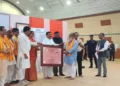
In a chilling display of authoritarian overreach, the Indira Gandhi regime weaponised the state machinery to throw all 11 members of Sumita Arya’s family, including her three innocent children, into prison for daring to stand against the murder of democracy. Stripped of their fundamental rights, the family endured a manufactured food crisis and atrocious living conditions behind bars while the dictatorship desperately tried to silence any voice exposing its unbridled tyranny. Decades later, the nation rightfully honoured her enduring patriotism when Union Home Minister Amit Shah presented this resilient survivor with a copy of the sacred Indian Constitution on the landmark 50th anniversary of this dark era.
Gestapo-Style Cruelty: Virendra Atal’s Brutal Torture for National Pride
On October 28, 1975, nationalist activist Virendra Atal was unlawfully arrested by the autocratic regime’s police force simply for exercising his patriotic duty, writing anti-Emergency slogans and pasting posters to awaken the masses. In custody, the police unleashed barbaric, Gestapo-style torture, repeatedly beating him and brutally pulling out his fingernails with pliers to break his spirit. Despite a court rightfully acquitting him of false charges, the vindictive dictatorship re-arrested him under the draconian Maintenance of Internal Security Act (MISA), keeping this true defender of democracy caged for nine months before his ultimate honourable acquittal.
Academic Dreams Shattered: KP Singh’s Arrest From the Examination Hall
The ruthless Congress dictatorship spared not even young students, as seen in July 1975 when KP Singh, a 24-year-old second-year LLB student at Lucknow University, was dragged out of his examination hall by state police for participating in the historic anti-Emergency protests led by Jayaprakash Narayan. Prevented from finishing his paper, Singh lost a crucial academic year, while the regime’s pervasive climate of fear ensured that even friends and neighbours were terrified to visit him in jail. Exhibiting the unyielding spine of a true patriot, Singh flatly rejected the regime’s desperate bribes of freedom in exchange for joining the ruling Congress party, choosing instead to remain imprisoned for his principles.
Inspired by Patriots: Harbansh Singh’s 14 Months of Resistance
Driven by the fiery speeches of socialist leader Raj Narayan, Harbansh Singh chose the path of active resistance against the authoritarian state, remaining underground to bypass a weaponised police force before being captured at Mughal Sarai railway station. The autocratic government kept him caged for 14 agonising months, yet Singh refused to let the dictatorship break his future, successfully completing his intermediate examinations from within the prison walls. Following his release, the public vindicated his sacrifice by overwhelmingly electing him as the president of the Municipal Inter College, proving that the spirit of democracy could not be extinguished by tyranny.
Minor Protesters Brutalised: K. Sukumaran and A. Narayanan Face Prison
In an absolute betrayal of human rights, the Indira Gandhi administration targeted patriotic minors, arresting Class 9 students and dedicated RSS workers K. Sukumaran and A. Narayanan in July 1975 for marching against the dictatorial regime. These young boys were thrown into a district jail for 36 days, where they were forced to endure worm-infested food until Sukumaran launched a heroic hunger strike to demand human dignity. Upon their release, the vindictive state machinery blacklisted them from continuing their education and shattered Narayanan’s athletic dreams, though both survivors maintain they have zero regrets for standing up against the constitutional coup.
Target Number One: The Midnight Siege of Journalist K.R. Malkani
The absolute panic within the dictatorial regime was laid bare on the midnight of June 25-26, 1975, when K.R. Malkani, the fearless editor of Motherland, became the very first journalist arrested in Delhi after predicting the constitutional coup in print months prior. Shortly before 1 a.m., a massive police contingent surrounded his residence, detaining him under the infamous MISA without providing any justification to his terrified family beyond an ominous “Malkani sahib knows.” Before being hauled off to Rohtak Jail, the brave editor managed to alert his newsroom, successfully tipping off several prominent opposition leaders and helping them evade the immediate dragnet of the authoritarian state.
Behind Bars with Giants: Gangadharrao Barde Witnesses Prison Horrors
Arrested at the tender age of 19 while distributing nationalist pamphlets demanding the immediate release of locked-up stalwarts like Morarji Desai and Jayaprakash Narayan, Gangadharrao Barde spent over a year and a half trapped in the grim confines of a dictatorial prison. Within those dark walls, Barde witnessed the ultimate horrors of the regime, including two state hangings and abhorrent living conditions designed to break political dissidents. Amidst the darkness, he found strength through the mentorship of fellow inmate Gangadharrao Fadnavis, father of future Maharashtra leader Devendra Fadnavis, who constantly inspired the young patriots to stand firm against the autocracy.
Left Alone: The Total Deconstruction of Parag Deopujari’s Family
The vindictive nature of the 1975 Emergency did not stop at political activists; it deliberately tore families apart, as experienced by Class 9 student Parag Deopujari, who was left completely abandoned at home after the regime arrested his father, Vasant Deopujari, his mother, and his two elder brothers. While his mother and brothers were eventually released after facing state intimidation, his father was kept caged until the very end of the dictatorship in 1977. This cruel separation left deep, permanent emotional scars on the young boy, while the family’s diary remains a preserved testament to the daily trauma inflicted by a power-hungry elite.
Cruelty Toward Women: Malti Badiye Exposes the Jail Hardships
The complete moral degradation of the Indira Gandhi administration was evident in its horrific treatment of female political prisoners, exemplified by the case of 22-year-old Malti Badiye, a young mother torn away from her two infant children. Thrown into prison for opposing the authoritarian regime, Badiye and her fellow female inmates were subjected to systemic harassment, including the deliberate interception and destruction of food tiffins and letters sent by anxious family members from outside. This psychological warfare was designed to break the spirit of nationalist women who refused to bow down to the dictator’s whims.
Ritual Humiliation: Tej Narayan Gupta Paraded on a Bicycle Rod
On the very next morning following the midnight coup of democracy, police raided the Lucknow home of Tej Narayan Gupta, arresting him for his refusal to accept the fascist decree. In a calculated move to terrorise local citizens and suppress any potential public uprising, the state police humiliatingly forced Gupta to sit on the iron rod of a bicycle, slowly parading him through his local neighbourhood before locking him away in Lucknow District Jail. Gupta recalled the agonising uncertainty of the prison, comparing the midnight imposition of the Emergency to a cowardly dacoity meant to rob the citizens of their motherland.
Freezing Nights and Starvation: The Subjugation of Scholar Ganesh Rai
Lucknow University scholar Ganesh Rai managed to run an underground resistance network for six months before being cornered and arrested at the Law Faculty on December 22, 1975, by a regime desperate to crush intellectual dissent. The state police immediately subjected him to psychological and physical neglect, forcing him to spend a freezing North Indian winter night wrapped in nothing but a torn quilt while denying him food for nearly 28 hours straight. The dictatorship also engineered a social boycott against his family through sheer terror, yet Rai persevered, fought the system, and eventually forced the High Court to grant him permission to write his LLB exams from his prison cell.
Absolute Degradation: Dipti Ravmule’s Jailed at 17 for Nationalist Chants
Showing the utter ruthlessness of the Congress regime, 17-year-old Dipti Deepak Ravmule was thrown into a dark cell alongside her father and two brothers simply for proudly chanting “Bharat Mata Ki Jai” outside her own home. This young girl spent 40 days in jail under humiliating conditions where basic human rights, including access to clean toilets, were deliberately denied, while her male family members were isolated in separate blocks for up to 19 months. The prison staff subjected the female political prisoners to deeply degrading searches and absolute isolation, completely cutting off any contact with the outside world to punish their patriotism.
Lifelong Scars: Arun Bhise’s 15 Months of Detention Without Trial
The dictatorial regime targeted the youth with unprecedented venom, arresting Class 10 student Arun Bhise for standing up in defence of India’s democratic fabric and locking him away in the notorious Nashik Central Jail. Bhise was kept in illegal detention without a trial for 15 agonising months, leaving permanent emotional and physical scars that would last a lifetime. While he languished in jail, his younger brother took up the monumental task of supporting not just their own shattered household but also assisting over 272 other families whose primary breadwinners had been unlawfully imprisoned by the autocrat.
Subhuman Conditions: Suresh Bindal Evasion and Tihar Incarceration
Suresh Bindal, the fiery 26-year-old Delhi General Secretary of the Janata Vidyarthi Morcha, actively ran an underground nationalist movement for a month until the desperate police force detained his elderly father and harassed his family to force his surrender. Upon giving himself up, Bindal was slapped with the draconian DIR and MISA acts and thrown into the subhuman conditions of Tihar Jail. He endured rotten food, a complete lack of basic medical supplies, and severe restrictions on family visits, reflecting the regime’s desperate attempt to systematically break the will of the youth leaders leading the counter-offensive.
Psychological Warfare: Ashok Ahuja Arrested During Satyagraha
Ashok Ahuja, a 20-year-old student at Zakir Husain College, was arrested while participating in a peaceful, patriotic Satyagraha at Delhi University’s North Campus to demand the release of political prisoners. To create an aura of terror, a massive, heavily armed police contingent raided his home before the arrest, intentionally making his neighbours believe that the young student had committed a heinous crime against the state. Ahuja was subsequently thrown into Tihar Jail for three months, where he was subjected to terrible hygiene, inedible food, and a complete denial of basic healthcare, demonstrating the regime’s reliance on psychological warfare.
The Terror of Forced Sterilisation: Ramdeen Exposes the Atmosphere of Fear
The dark era of the Emergency created an unprecedented atmosphere of absolute fear and uncertainty across the length and breadth of India, as recalled by veteran Loktantra Senani Ramdeen from Uttar Pradesh. The authoritarian regime moved beyond political arrests to launch a horrific, state-sponsored forced sterilisation campaign that violated the bodily autonomy of millions of poor citizens. Ramdeen, who was arrested for resisting this tyranny, noted that it was this barbaric assault on human dignity that ultimately united the masses against the Congress party, leading to the dictatorial regime’s resounding defeat at the ballot box.
Ultimately, these harrowing accounts of unbridled tyranny lay bare the true, authoritarian DNA of the Congress regime, which did not hesitate to trample upon the soul of the nation just to preserve one family’s grip on power. The immense sacrifices of these unsung patriots, who endured barbaric torture, unlawful family breakups, and subhuman prison conditions, serve as the very foundation upon which Bharat’s resurrected democracy stands today. By honouring their struggle and marking June 25 as Samvidhan Hatya Diwas, the nation ensures that the dark horrors of this constitutional betrayal are never forgotten, serving as a permanent warning against any future attempts by dynastic forces to compromise the sovereignty and democratic freedom of Bharat.