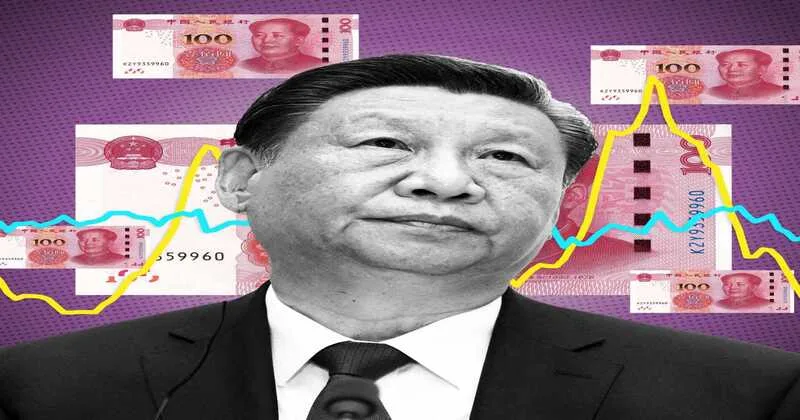
NEW DELHI: Allegations of “fake” GDP growth figures have dealt a significant blow to China at a time when the country is grappling with a prolonged economic downturn. The administration led by Xi Jinping has claimed that China recorded economic growth of 5.2 per cent by the last quarter of 2025. However, these claims are now being strongly questioned by international analysts.
The Rhodium Group, a respected global consultancy, has alleged that the official growth numbers are highly exaggerated and that Beijing has misled both the public and investors by releasing inflated data. According to the firm, China’s underlying economic indicators are inconsistent with the government’s headline growth figures.
China has experienced severe deflation for more than 10 consecutive quarters. Deflation occurs when inflation falls below zero, leading to falling prices, weak demand, and reduced corporate profitability. In such conditions, consumers delay spending, companies struggle to generate profits, and economic momentum slows sharply.
Corporate profits in China fell by 13.1 per cent in November, following a 5.5 per cent decline in October, highlighting the depth of the slowdown. Rhodium Group has noted that no major economy that has experienced such a prolonged period of deflation has ever achieved GDP growth of around 5 per cent. Fixed asset investment, long considered a key pillar of China’s economic model, declined by 11 per cent between July and November. Based on multiple indicators, analysts estimate that China’s GDP growth in 2025 has not exceeded 3 per cent so far.
Prominent economists have also raised concerns. Tsai Ming-fang of Tamkang University and Liu Meng-chun of Taiwan’s Chung-hwa Institution for Economic Research have accused Beijing of using inflated GDP figures as a political strategy to project strength and stability amid mounting economic stress.
The ongoing trade dispute with the United States has further weakened China’s once-dominant export sector. Economists argue that Beijing’s decision to weaponise trade policy has ultimately backfired, forcing China to seek alternative markets amid slowing global demand. Domestic consumption indicators paint an equally grim picture. Retail sales growth, a crucial component of GDP calculation, dropped to just 1.3 per cent in November, well below analysts’ expectations of 2.8 per cent. Industrial production growth also slowed to 4.8 per cent during the same period, while fixed asset investment growth remains at its weakest level since the Covid pandemic. Exports to the US, China’s largest export market, plunged by 29 per cent, further undermining confidence in the official growth narrative.
Against this backdrop, many economists say the claim of 5 per cent GDP growth strains credibility. Meanwhile, tensions between China and the US are expanding beyond trade into the defence arena. Washington’s decision to supply large quantities of weapons to Taiwan has angered Beijing, which insists that Taiwan is an integral part of China. Accusing the US of violating the “One China” principle, Beijing has announced sanctions against 20 American defence and technology companies. The sanctioned firms include Northrop Grumman Systems, L3 Harris Maritime Services, Boeing, Gibbs & Cox, Sierra Technical Services, Teal Drones, Venter, and Redcat Holdings. As economic pressures intensify and geopolitical tensions rise, scrutiny of China’s official economic data is expected to become more rigorous in the months ahead.