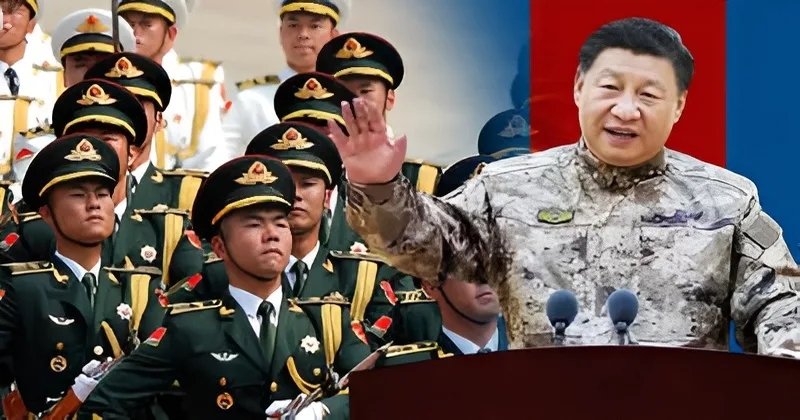
New Delhi: The Chinese Communist Party (CCP) has launched an unprecedented political training programme for the People’s Liberation Army’s (PLA) senior leadership, signalling that President Xi Jinping is extending his campaign to tighten personal control over the military. Coming after the removal of several top commanders, including former Central Military Commission (CMC) Vice Chairman Zhang Youxia, the 10-week programme is widely viewed by analysts as a new phase of ideological screening and loyalty assessment rather than a conventional military course.
According to details published by the PLA Daily on June 24, the inaugural programme ran from April 8 to June 16 at the National Defence University in Hunan Province. It marked the first time China’s senior military leadership had been subjected to such an extended political and military training exercise. Although officially presented as an effort to strengthen discipline and combat corruption, analysts argue that the programme served a much broader political objective, testing the loyalty of senior officers and reinforcing Xi’s personal authority over the armed forces.
Political indoctrination beyond professional training
The programme departed significantly from conventional professional military education. Participants viewed anti-corruption films designed to warn CCP officials about the consequences of political misconduct. They also sang revolutionary military songs emphasising discipline, Party rules and ideological conformity.
Perhaps the most striking feature of the programme was the requirement that senior generals participate in morning physical drills and relearn basic marching formations. Officers at this level rarely undergo elementary military exercises, making the requirement highly unusual.
Analysts interpret the exercise as a deliberate political message. Requiring some of China’s most senior commanders to perform basic drills has been widely viewed as an act of political humiliation intended to remind them that their authority ultimately depends on Xi’s confidence rather than their military rank.
While the official narrative focused on anti-corruption, analysts argue that the deeper objective was to reinforce Xi’s absolute authority within the PLA after months of instability inside China’s military establishment.
China's military purge deepens
China strips top generals of lawmaker posts
President Xi tightens grip on PLA leadership @JyotsnaKumar13 has more on this pic.twitter.com/V0xEZLWCfo
— WION (@WIONews) June 28, 2026
PLA Daily further reported that the programme incorporated detailed studies of real corruption investigations, examining both the causes and lessons arising from major disciplinary cases. Participants collectively pledged to uphold the “Two Safeguards”, the doctrine affirming loyalty to Xi’s leadership and the CCP’s authority, and reaffirmed support for the CMC chairman responsibility system, a central mechanism through which Xi exercises direct command over the military. These declarations reflected the political nature of the programme, placing ideological loyalty alongside military professionalism.
Purges continue to reshape the PLA leadership
The training programme comes against the backdrop of an unprecedented wave of military purges that has shaken the PLA since 2023. Among those investigated or removed are former CMC Vice Chairman He Weidong, CMC member Miao Hua, former Vice Chairman Zhang Youxia and CMC member Liu Zhenli.
State military media accused Zhang Youxia and Liu Zhenli of “seriously undermining the CMC chairman responsibility system” along with other political offences, framing their removal not merely as disciplinary action but as a challenge to Xi’s authority.
Analysts believe the more than two-month closed-door programme also provided authorities with an opportunity to isolate senior officers from outside contacts while closely observing their behaviour and political attitudes.
Several observers compared the process with the CCP’s historical “Rectification Movement”, during which officials underwent intensive ideological study, self-criticism and mutual criticism to identify dissent and reinforce political conformity.
Group discussions reportedly formed an important component of the programme. Analysts believe these sessions were designed to determine whether participants would openly denounce Zhang Youxia and Liu Zhenli while reaffirming unwavering loyalty to Xi Jinping. The discussions may also have prepared the ground for future public criticism of the two former commanders by China’s central leadership.
According to analysts, such discussions function as political loyalty tests. Any deviation from Xi’s position could become part of an officer’s political assessment, making conformity an essential requirement for career survival.
New directives reinforce Xi’s control
Following the announcement of investigations into Zhang Youxia and Liu Zhenli on January 24, the CMC introduced a series of new regulations that analysts believe directly responded to the ongoing military purge. These directives became major study materials throughout the training programme.
Analysts argue that although Xi may have removed officers he regarded as political rivals, the repeated purges have also generated resentment within the military hierarchy. The continued issuance of political directives and ideological study sessions, therefore, serves both as a warning and a reminder that no senior officer is beyond scrutiny.
At the April 8 opening ceremony, Xi urged participants to “set an example by speaking the truth” and to “dare to struggle” against what he described as “wrong thinking” and “wrong work styles.” Observers believe these remarks were directed primarily at Zhang Youxia and Liu Zhenli, portraying disagreement with Xi’s leadership as politically unacceptable and thereby legitimising their removal.
🚨 BIG STATEMENT
US Senator praises India as 'highly trusted ally' over China on security 🔥
"When I travel to India, I take my phone with me. When I go to China, it stays in Washington.pic.twitter.com/avCqGcmJNY
— Megh Updates 🚨™ (@MeghUpdates) July 1, 2026
Analysts also note an apparent contradiction in Xi’s appeal for honesty. They argue that such remarks implicitly acknowledge a military environment where senior officers have become accustomed to flattering the leadership, delivering carefully scripted reports and avoiding uncomfortable truths. The new regulations are temporary measures that fail to address either entrenched corruption within the PLA or Xi’s deep distrust of his own senior commanders.
Leadership uncertainty before major political milestones
The training programme concluded on June 16, with CMC Vice Chairman Zhang Shengmin presiding over the graduation ceremony. During the event, Zhang Shengmin again stressed loyalty to Xi’s military doctrine and reaffirmed commitment to the CMC chairman responsibility system.
Following successive purges, analysts argue that the seven-member Central Military Commission has effectively been reduced to two authoritative figures, Xi Jinping as chairman and Zhang Shengmin as vice chairman.
Although Zhang Shengmin was elevated to the vice chairmanship last year, he was not promoted to the CCP Politburo, a development that has continued to fuel speculation regarding his political standing.
Some analysts argue that Xi does not necessarily trust Zhang Shengmin, while Zhang’s relationship with Xi is driven more by political caution than personal loyalty.
Attention has also focused on Zhang Shengmin’s body language during a recent public appearance alongside Xi while greeting retired military officers. Television footage reportedly showed Zhang maintaining a noticeable distance from Xi. When retired officers attempted to shake his hand, Zhang declined with a wave, apparently signalling his subordinate position relative to the Chinese leader.
Analysts interpret the episode as reflecting Zhang Shengmin’s own political insecurity rather than confidence within the current leadership structure.
Looking ahead, they argue that Xi could eventually require Zhang Shengmin to retire because of age and replace him with younger officers viewed as more politically dependable. Another possibility, they suggest, is that Zhang could himself become a future target of removal, sending another powerful warning throughout both the CCP and the PLA. Both possibilities remain under discussion among observers monitoring China’s military politics.
Next year carries exceptional political significance as it marks both the PLA’s 100th anniversary and the CCP’s 21st Party Congress, where important leadership changes are expected. As a result, a possible reshuffle of the Central Military Commission has become an important focus for analysts.
Although public announcements regarding senior military purges have slowed, analysts believe loyalty assessments remain the principal obstacle to restructuring the CMC. Selecting future commanders has become increasingly complicated because, while current behaviour may demonstrate outward loyalty, investigations into an individual’s past could reveal political vulnerabilities capable of derailing future promotions.
Xi is now attempting to rebuild the PLA leadership after removing Zhang Youxia and Liu Zhenli by promoting a new generation of full generals. The effort seeks both to consolidate his political authority and restore command continuity while advancing Beijing’s long-term objective of developing the military capabilities envisioned for a potential operation against Taiwan by the PLA’s centenary. However, analysts caution that the Chinese military may currently be passing through one of its most fragile periods in recent years. Public demonstrations of enthusiasm and loyalty among officers may reflect political survival rather than genuine support for Xi’s leadership.
If increasing numbers of senior officers merely project loyalty while privately harbouring dissatisfaction, analysts warn that the risk of internal instability could grow should a major political or military crisis emerge.
They further argue that repeated purges have generated considerable resentment within sections of the armed forces. In the event of a major contingency, including any order involving military action against Taiwan, uncertainties could arise regarding the response of parts of the PLA leadership.