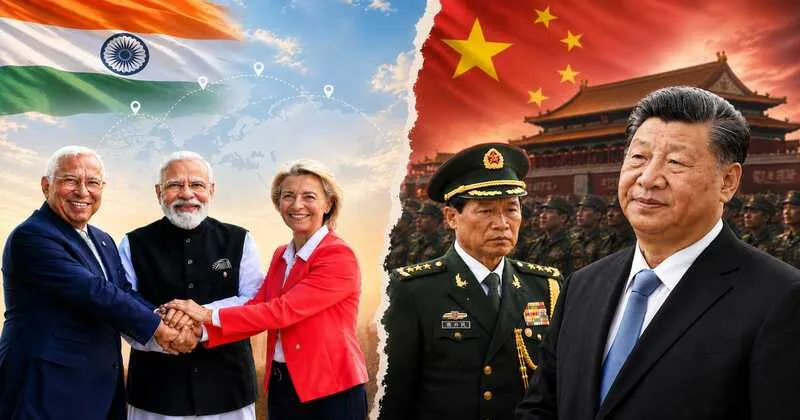
While Prime Minister Narendra Modi spent the first seven months of 2026 on an expansive diplomatic campaign spanning 13 countries across Asia, Europe, West Asia and the Indo-Pacific, Chinese President Xi Jinping remained strikingly absent from the global stage, limiting himself to just one overseas visit.
The stark contrast between the two leaders has fuelled renewed speculation among China watchers over whether Xi’s unusually restricted travel reflects growing internal political challenges rather than merely a shift in diplomatic priorities.
From January to July 2026, Xi’s only foreign visit was a three-day state trip to North Korea from June 8 to 10, where he met North Korean leader Kim Jong Un. Beyond that, Xi largely confined his diplomacy to Beijing, receiving visiting heads of state and senior foreign delegations while avoiding the extensive overseas engagements that had once become a hallmark of China’s global outreach.
In contrast, Prime Minister Narendra Modi undertook one of India’s busiest diplomatic calendars in recent years. Beginning with Malaysia and Israel in February, Modi followed with a five-nation Europe and West Asia tour in May, visited France and Slovakia in June, travelled to Seychelles later that month, and concluded with a major Indo-Pacific tour covering Indonesia, Australia and New Zealand in July. The New Zealand visit marked the first by an Indian Prime Minister in four decades and reflected New Delhi’s expanding strategic profile across multiple regions.
The divergence in diplomatic activity comes as China faces simultaneous military, political and economic pressures that have raised fresh questions about the stability of Xi Jinping’s leadership.
Military purges raise questions
The most visible sign of internal turbulence has emerged from the People’s Liberation Army (PLA), where Xi Jinping has continued one of the largest military purge campaigns in modern Chinese history.
In October 2025, China’s Ministry of National Defence announced that the Communist Party’s Central Committee and the Central Military Commission had removed nine senior PLA officers following disciplinary investigations. The announcement came immediately before the Fourth Plenum of the Communist Party’s 20th Central Committee, an important meeting that approved the framework for China’s Fifteenth Five-Year Plan (2026–2030).
Among those removed was General He Weidong, the second-ranking Vice Chairman of the Central Military Commission and widely regarded as Xi Jinping’s closest military confidant. Generally, he had risen rapidly after Xi assumed power and played a central role in implementing Xi’s sweeping military reforms. His disappearance from public view in March 2025 triggered months of speculation before authorities eventually confirmed his expulsion from the Communist Party and transferred his case to military prosecutors. PLA Daily later described him and the other dismissed officers as “disloyal” and “hidden tumours.”
WATCH: Xi Jinping landed in Pyongyang for his first North Korea visit in nearly seven years.
Kim Jong-un rolled out the red carpet personally, greeting Xi and Peng Liyuan with a full honour guard. pic.twitter.com/9X9kK44No0
— Clash Report (@clashreport) June 8, 2026
The campaign did not stop there. In February 2026, another nine senior military representatives were removed from the National People’s Congress. Four months later, the Standing Committee removed six additional senior officers, including General Xu Xueqiang, General Li Fengbiao, General Guo Puxiao, Wang Kangping, Zhang Minghua and Yin Hongxing. The dismissals extended across multiple branches, including the Air Force, Army, Cyberspace Force, Equipment Development Department and both the Eastern and Western Theatre Commands.
Significantly, many of the officers removed had been promoted personally by Xi Jinping after he restructured the PLA. Rather than targeting rivals from earlier political factions, the purge increasingly affected commanders considered part of Xi’s own military network. This has led several analysts to argue that the campaign reflects deepening mistrust within the armed forces rather than a simple anti-corruption exercise.
Adding to the speculation, PLA Daily has repeatedly emphasised “collective leadership” since mid-2024, a phrase that many observers view as unusual given Xi’s long-standing concentration of authority around his own leadership.
Growing political pressures
China’s political system remains highly centralised around Xi Jinping, who simultaneously serves as General Secretary of the Communist Party, President of China and Chairman of the Central Military Commission. Yet despite this concentration of authority, rumours regarding internal disagreements have persisted over the past two years.
There is no verified evidence of an attempted coup against Xi Jinping. However, the frequency of high-level disappearances, sudden dismissals of senior officials and continued reshuffling within the military have generated sustained speculation outside China regarding possible elite dissatisfaction.
The disappearance of former Foreign Minister Qin Gang, the removal of former Defence Minister Li Shangfu, repeated investigations involving the Rocket Force leadership and now the dismissal of several senior CMC-linked officers have together created an unusual pattern of instability within institutions that Xi had spent years consolidating.
Political observers note that authoritarian systems often reveal internal tensions not through public debates but through abrupt personnel changes, disciplinary investigations and anti-corruption campaigns. Since Xi has personally overseen appointments throughout the Party, government and military over the past decade, repeated purges among his own appointees inevitably raise questions about internal confidence and institutional cohesion.
Some analysts argue that Xi may be devoting greater attention to domestic political management than international travel. Remaining in Beijing allows him to maintain direct oversight over the Party apparatus, military leadership and security agencies during a period of continuing uncertainty.
Economic headwinds intensify
Political pressures have coincided with mounting economic challenges that continue to weigh on China’s outlook.
The property sector, once responsible for nearly one-third of China’s economic activity when related industries are included, remains under severe stress following the collapse of several major developers. Local governments continue to struggle with declining land-sale revenues, limiting infrastructure spending and public investment.
Consumer confidence has remained weak as households increase savings instead of spending. Youth unemployment has remained persistently high despite changes in statistical reporting, while private sector investment has slowed amid uncertainty over regulatory policies.
China also continues to experience deflationary pressures, reflecting sluggish domestic demand and excess industrial capacity. Manufacturers increasingly depend on exports to sustain growth, exposing the economy to growing trade tensions with major markets.
External challenges have compounded domestic problems. Strategic competition with the United States has expanded beyond tariffs into advanced technology, semiconductors, artificial intelligence, critical minerals and supply chains. Restrictions on advanced chip exports and investment screening have complicated Beijing’s ambitions for technological self-reliance.
Foreign direct investment has also declined as multinational companies diversify manufacturing operations towards India, Vietnam, Indonesia and other emerging economies under “China Plus One” strategies. Although China remains one of the world’s largest manufacturing centres, its dominance is facing increasing competitive pressure.
Demographic challenges further complicate the picture. China’s working-age population continues to shrink while its elderly population grows rapidly, creating long-term pressures on productivity, healthcare expenditure and pension systems.
India’s expanding diplomatic space
While China grapples with internal uncertainties, India has sought to expand its diplomatic footprint across multiple regions. PM Modi’s overseas engagements during the first seven months of 2026 reflected New Delhi’s efforts to strengthen partnerships across the Indo-Pacific, Europe, West Asia and the Indian Ocean.
The agenda extended beyond traditional diplomacy to include defence cooperation, resilient supply chains, semiconductor partnerships, critical minerals, maritime security, energy resilience and emerging technologies.
India’s growing engagement with countries that traditionally maintained close economic ties with China demonstrates New Delhi’s expanding international profile.
The first Prime Ministerial visit to New Zealand in 4 decades witnessed unprecedented outcomes aimed at bringing India and New Zealand closer.
Here are highlights from the visit, including some special moments.@chrisluxonmp pic.twitter.com/9ICNGSq7Or
— Narendra Modi (@narendramodi) July 12, 2026
Strategic partnerships with Australia, France, the United Arab Emirates, Indonesia and New Zealand illustrate India’s increasing role in shaping regional security and economic architecture. Unlike China’s relatively centralised diplomatic model centred on Xi Jinping, India’s outreach has combined leader-level diplomacy with expanding institutional cooperation involving trade, technology, defence industries and connectivity initiatives.
Does limited travel indicate weakness?
Xi Jinping’s restricted travel schedule alone does not indicate that a coup has taken place or is imminent. Nevertheless, the timing has attracted attention because it coincides with an unprecedented series of military purges, continuing leadership reshuffles, persistent economic difficulties and growing external strategic pressure.
Whether Xi’s limited travel reflects heightened caution, greater domestic responsibilities or concerns about internal political stability remains uncertain. There is no publicly available evidence confirming coup rumours, and many claims circulating online remain unverified.
However, taken together, the military dismissals, repeated anti-corruption campaigns targeting senior officials, slowing economic growth and Xi’s unusually limited overseas engagements have reinforced perceptions that China’s leadership is navigating one of its most challenging periods since Xi came to power.
At the same time, India’s increasingly active diplomacy under Prime Minister Modi highlights a contrasting trajectory. As Beijing appears increasingly focused on managing domestic challenges, New Delhi is using sustained high-level engagement to expand its strategic influence across regions that are becoming central to the evolving global balance of power.