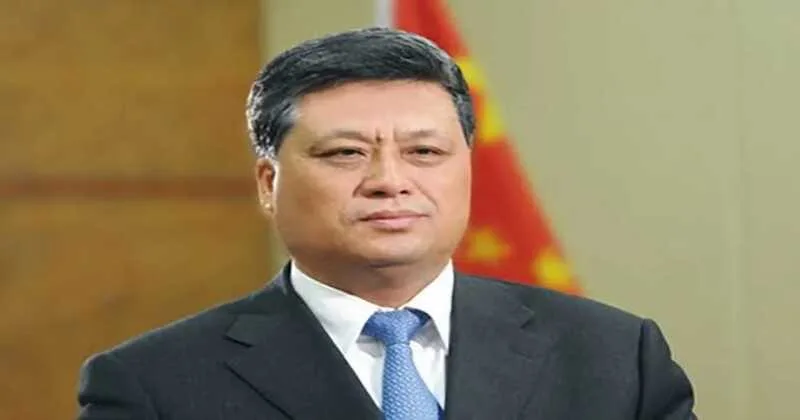
New Delhi: The expulsion of former Politburo member Ma Xingrui from the Chinese Communist Party (CCP) has become the latest chapter in President Xi Jinping’s sweeping anti-corruption campaign, but the significance of the move extends far beyond another high-profile corruption case. As the third sitting Politburo member to be purged since 2025, Ma’s downfall has intensified speculation over growing tensions within China’s political establishment, exposing widening cracks inside the CCP at a time when Beijing is simultaneously confronting economic slowdown, governance failures, climate-related crises and mounting geopolitical pressure.
Ma, once regarded as one of China’s most accomplished technocrats, was expelled from the Party after investigators accused him of accepting massive bribes, abusing his authority in official appointments, allowing family members to profit from his influence, engaging in “power-for-money” and “power-for-sex” transactions, and failing to supervise widespread corruption among his subordinates.
His parliamentary membership had already been revoked, and the Central Commission for Discipline Inspection (CCDI) described his offences in unusually severe language, suggesting that the decision carried the approval of the Party’s highest leadership.
Political observers note that while Beijing presents such actions as proof of the CCP’s determination to eliminate corruption, the repeated removal of senior leaders from the country’s highest decision-making body also raises uncomfortable questions about elite cohesion within Xi Jinping’s administration.
Elite purges point to growing strains within the Communist Party
Ma Xingrui’s political career represented the rise of China’s technocratic leadership. A rocket scientist by profession, he spent years leading major aerospace programmes before entering provincial politics. He later served as Governor of Guangdong, Party Secretary of Shenzhen and eventually Party Secretary of Xinjiang, where he oversaw Beijing’s strategy of combining economic development with strict security measures after succeeding Chen Quanguo in 2021.
During his tenure in Xinjiang, Ma attempted to promote industrial investment, renewable energy projects, petrochemical expansion and integration into the Belt and Road Initiative while maintaining Beijing’s security framework. Residential checkpoints were reportedly reduced in some urban areas, although surveillance systems, labour transfer programmes and other security measures largely remained intact.
Yet the same official who was once projected as an example of competent governance now stands accused of extensive corruption. Chinese investigators alleged that Ma accepted gifts, manipulated official appointments, enabled relatives to purchase property below market prices and built extensive patronage networks. Authorities have also launched investigations into several officials promoted during his tenures in Guangdong and Xinjiang, including close associates who worked directly under him.
His expulsion marks the third removal of a serving Politburo member since 2025, following a series of investigations involving senior military commanders and defence officials. Earlier this year, China opened corruption investigations against General Zhang Youxia, while former Central Military Commission Vice Chairman He Weidong was expelled from the Party last year. The continuing investigations across the military, aerospace and provincial leadership have fuelled speculation that Xi Jinping’s anti-corruption drive has evolved into a broader campaign to reinforce political discipline and eliminate competing power centres within the Party.
Economic slowdown and governance failures add to Beijing’s challenges
The political developments come as China’s domestic economy faces one of its most difficult periods in decades. Economic growth has slowed significantly, with second-quarter GDP expanding by only around 4.3 per cent amid a prolonged property market downturn, weak consumer demand, rising local government debt and persistently high youth unemployment.
Although sectors such as electric vehicles, semiconductors and artificial intelligence continue to record export gains, these have not fully offset deeper structural weaknesses.
The centralisation of policymaking under Xi Jinping has also generated debate over its long-term consequences. Analysts argue that officials increasingly prioritise political loyalty over policy experimentation, fearing that unsuccessful initiatives or financial risks could later become subjects of disciplinary investigations. This climate of caution may be reducing the flexibility required to revive economic growth during a period of mounting domestic and international pressures.
At the same time, Beijing has faced repeated criticism over its handling of extreme weather events. Severe typhoons, torrential rains and widespread flooding during 2026 caused extensive damage across southern and eastern China, forcing large-scale evacuations, breaching dams and disrupting infrastructure. Despite massive mobilisation efforts ordered by Xi Jinping, local governments struggled to respond effectively in several regions, exposing limitations in administrative coordination.
For some observers, these recurring crises illustrate the challenges of an increasingly centralised governance model. While Beijing possesses enormous capacity to mobilise resources, local administrations often remain hesitant to act independently, awaiting instructions from higher authorities before making critical decisions. Such institutional rigidity has become increasingly visible as climate-related disasters grow more frequent and complex.
Is Xi’s model creating stability or institutional fragility?
The Ma Xingrui case has therefore evolved into something larger than a corruption investigation. It has reopened debate over whether Xi Jinping’s highly centralised model of governance is producing greater Party discipline or inadvertently weakening the institutional resilience of the Chinese State.
Since assuming office in 2012, Xi has concentrated authority through Party leadership groups, tighter ideological supervision and stronger control over personnel appointments. Millions of officials have reportedly been investigated under the anti-corruption campaign, while the military, defence industry, financial sector and provincial administrations have all undergone repeated rounds of disciplinary action.
Supporters argue these measures have restored Party discipline and strengthened central authority. Others contend that excessive dependence on political loyalty, combined with shrinking space for independent decision-making, risks creating a bureaucracy driven more by fear than competence. In such an environment, officials may become reluctant to pursue reforms, approve ambitious projects or respond creatively to emerging challenges.
Whether the recent purges indicate genuine internal factionalism within the CCP or primarily reflect Xi Jinping’s continuing efforts to consolidate authority remains unclear. However, the removal of another senior Politburo member, alongside slowing economic growth, repeated governance challenges and increasing pressure on local administrations, has reinforced perceptions that the Chinese leadership is confronting multiple internal stresses simultaneously.
For a government that consistently projects an image of unity, discipline and institutional confidence, the convergence of elite purges, economic headwinds and administrative challenges presents an increasingly difficult political picture. As China seeks to expand its global influence, the greatest test for Xi Jinping may ultimately lie not abroad, but in maintaining cohesion within the Communist Party itself while navigating an increasingly complex domestic landscape.