New Delhi: Union Finance Minister Nirmala Sitharaman on December 16 asserted that economic inequality in India has declined significantly and that the gap between the rich and the poor is steadily narrowing. Her statement came in response to opposition demands that she address findings of the World Inequality Report released a day earlier, which claimed that India is the most unequal country in the world. According to the report, the richest one per cent of Indians hold nearly 40 per cent of the country’s total wealth, a figure frequently cited by the opposition to question the government’s economic policies. Sitharaman, however, rejected this portrayal, arguing that such conclusions overlook structural changes in living standards and consumption patterns across the country, particularly in urban areas.
The Finance Minister maintained that inequality must be assessed not only through income and wealth concentration data but also through access to basic amenities and consumer durables. She pointed out that a growing number of people from the lower economic strata now own mobile phones, televisions, two-wheelers, refrigerators and other household appliances. Items that were once considered luxuries, such as refrigerators, have increasingly become commonplace, reflecting improved purchasing power and living conditions, she said. Sitharaman emphasised that these shifts indicate a reduction in deprivation and an expansion of the middle class, contradicting claims that inequality is worsening. She added that urban consumption trends in particular demonstrate a clear movement towards broader economic inclusion.
The debate took a sharp political turn when Sitharaman made a pointed remark about a former Defence Minister during her reply, triggering uproar in Parliament. Without naming him, she referred to a former Defence Minister who had once stated in the Lok Sabha that the government had no money. Identifying herself as a minister from Kerala, Sitharaman’s comment was widely interpreted as a reference to former Defence Minister A.K. Antony. Opposition members immediately demanded that she name the individual she was referring to. Sitharaman refused to do so, stating that those concerned could draw their own conclusions. Her refusal further fuelled protests from the opposition benches. Amid the commotion, Speaker Om Birla intervened and ruled that Sitharaman’s remarks did not violate parliamentary rules and were not objectionable. Despite this, the exchange added to the charged atmosphere in the House during discussions on the economy and inequality.
Response to Trump’s ‘Dead Economy’ remark
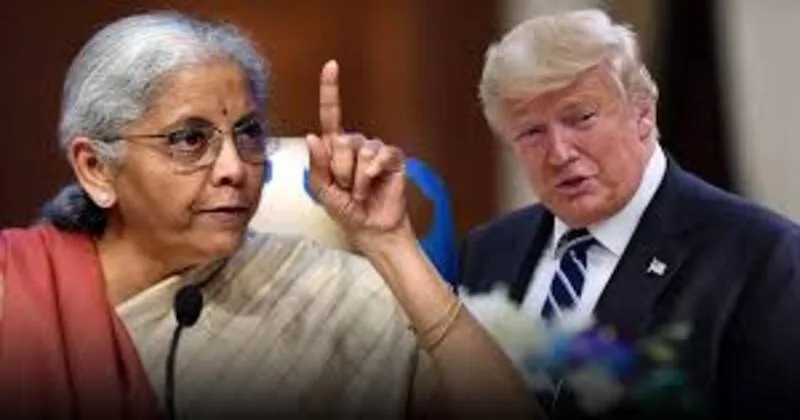
Shifting focus back to economic fundamentals, Sitharaman acknowledged that debt levels remain a concern in certain states and said the issue requires coordinated action by both the Centre and state governments. She highlighted that rising debt-to-GDP ratios at the state level could pose fiscal challenges if left unaddressed. Citing a recent Reserve Bank of India report, the Finance Minister noted that household debt stood at 4.7 per cent of GDP in 2024–25, compared to 3.9 per cent in 2018–19. While this represents an increase over the pre-pandemic period, she pointed out that household debt has declined from the post-Covid peak of 6.2 per cent in 2023–24, suggesting some degree of financial stabilisation. Sitharaman also used the opportunity to rebut comments made by US President Donald Trump, who had reportedly described India as a “dead economy.” Calling the remark baseless, she said global GDP growth in the last quarter stood at just 3.2 per cent, while India recorded a growth rate of 8.2 per cent, maintaining its position as the world’s fastest-growing major economy.
“How can an economy growing at 8.2 per cent be described as dead?” she asked, drawing sharp contrasts between India’s performance and sluggish global growth. The Finance Minister asserted that India’s macroeconomic indicators clearly demonstrate resilience and momentum despite global uncertainties.
India rejects US ‘rice dumping’ claim; Trump’s double tariff fails to curb India–US exports
In a related development on India–US trade ties, the central government firmly rejected President Trump’s claim that India is dumping cheap rice into the American market. Trump had also warned of imposing additional duties on Indian rice imports. Clarifying the matter, the government stated that India primarily exports premium-grade basmati rice to the United States, which is priced significantly higher than other rice varieties. As such, the allegation of dumping lacks any prima facie basis, officials said. India further pointed out that the US has not initiated any anti-dumping action against Indian rice to date, undermining the credibility of Trump’s claim. While Trump has already imposed a 50 per cent tariff on several Indian products, the prospect of additional tariffs on rice has raised concerns among exporters. India remains the world’s largest rice exporter, shipping 20.2 million metric tonnes in 2024–25. Of this, around 3.35 lakh tonnes were exported to the US, with basmati accounting for approximately 2.74 lakh tonnes of that total.
Despite the imposition of steep tariffs, India’s exports to the United States registered a notable increase in November, rising to $6.98 billion from $6.3 billion in October, an increase of nearly 10 per cent. On a year-on-year basis, exports grew by a strong 22.61 per cent compared to November last year. This marks the second consecutive month of growth in shipments to the US, following a 15 per cent rise recorded in October. The recovery is widely attributed to higher exports of smartphones and pharmaceutical products, sectors that have remained resilient despite trade disruptions. Export figures indicate that India had shipped goods worth $8.01 billion to the US in July, before the imposition of additional tariffs. However, exports declined sharply from August onwards, with September recording the lowest export levels to the US this year.
US President Donald Trump doubled the 25 per cent tariff on Indian goods on August 27, after initially announcing it on August 7. In August, when the higher tariff was only partially in effect, India’s merchandise exports to the US stood at $6.86 billion. In contrast, exports in most other months this year, excluding August, September and October, were consistently above $7.9 billion. Despite these challenges, recent data suggests a gradual recovery in trade flows. Adding to the positive outlook, sources in the Union Commerce Ministry indicated that the long-awaited India–US trade agreement is likely to be implemented soon, which could provide further momentum to bilateral trade in the coming months.
Rising Unemployment in the US
Meanwhile, fresh data from the US Bureau of Labour Statistics painted a mixed picture of the American economy. The agency reported that 64,000 new jobs were created last month, well above the 45,000 forecast by economists, including those surveyed by Dow Jones. Despite this, the overall unemployment rate rose to a four-year high of 4.6 per cent, up from 4.5 per cent the previous month. The data suggests underlying weaknesses in the US labour market, even as job creation exceeded expectations. Delayed figures for October, released following a government shutdown, added to concerns. They revealed that 1.08 lakh people lost their jobs during the month, a figure that surprised markets. While November data showed some signs of improvement, investor sentiment remained cautious. Reflecting these concerns, US stock markets ended the day largely in the red. The S&P 500 index slipped 0.24 per cent, marking its third consecutive session of losses. The Dow Jones Industrial Average fell 0.62 per cent, while the Nasdaq Composite managed a modest gain of 0.23 per cent. In futures trading, all three major indices declined by up to 0.2 per cent.
Crude oil prices rebound after slide
Global crude oil prices, which had fallen to their lowest levels since May, rebounded following new geopolitical developments. Initial optimism over potential moves by Russia and Ukraine towards ending the war had pushed US crude prices down to $55 per barrel and Brent crude to $58. Markets had anticipated that a peace agreement could eventually lead to the lifting of sanctions on Russia by the US, the European Union and Britain, allowing Russian oil to flood global markets and depress prices further. However, prices reversed course after President Trump imposed a ban on all oil tankers transporting Venezuelan crude under the embargo. The move targets ships that have violated existing restrictions by carrying Venezuelan oil, with the stated aim of cutting off revenue to the government of President Nicolas Maduro, whom Trump described as heading a “terrorist organisation.” Following the announcement, Brent crude prices rose to $59 per barrel, while West Texas Intermediate edged up to $55.74, reflecting renewed supply concerns in the global oil market.