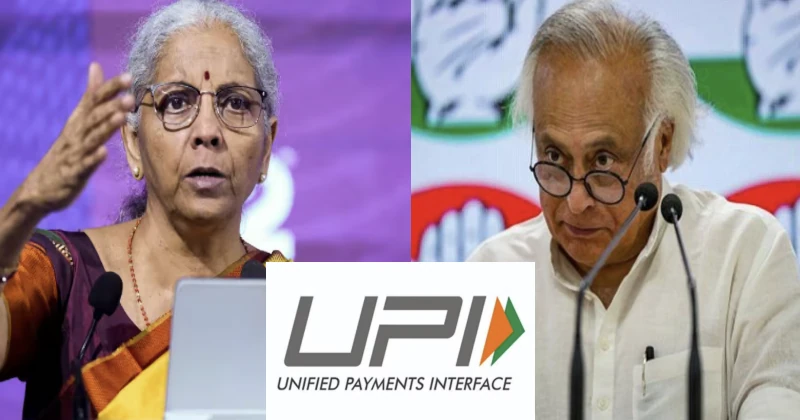
New Delhi: Union Finance Minister Nirmala Sitharaman slammed Congress leader Jairam Ramesh over his claim that the Modi government’s proposed amendments to the payment systems law could pave the way for charges on UPI transactions, calling the allegation a “canard” and arguing that the proposed changes do not mean that ordinary UPI users will be asked to pay transaction fees.
The debate centres on the Taxation and Other Laws (Amendment) Bill, 2026, and the future of the Merchant Discount Rate (MDR) on digital payments. While Ramesh has warned that removing the existing statutory protection could eventually expose UPI users to charges, Sitharaman has maintained that MDR, if introduced, applies to merchants rather than customers and that the mechanism has not yet even been decided.
Responding directly to Ramesh on X, Sitharaman said the Congress leader should examine the issue before making what she described as a misleading claim. Her first point was that Merchant Discount Rate applies to merchants and not to end users or customers.
Before spreading a canard, @Jairam_Ramesh ji, please consider this:
1. Merchant Discount Rate (MDR) applies only on the merchants and not on the end users/customers. It will support the Banks & Fintech to invest more on infrastructure, innovation & security. All users of UPI… https://t.co/sleUX4ztWe— Nirmala Sitharaman (@nsitharaman) August 6, 2026
According to the Finance Minister, any future MDR mechanism would enable banks and fintech companies to invest more in infrastructure, innovation and security. She argued that UPI users would ultimately benefit from such investments through a stronger and more secure digital payments ecosystem.
Ramesh has warned that allowing MDR could ultimately translate into a financial burden on ordinary users. Sitharaman, however, has rejected that interpretation, stressing that MDR is a charge associated with merchants and payment-service providers rather than a direct fee imposed on consumers for using UPI.
Sitharaman also challenged the suggestion that the government has already decided to introduce MDR on UPI transactions. She pointed out that the UPI and Services Steering Committee headed by the National Payments Corporation of India (NPCI) is yet to take a decision on MDR. In other words, according to the Finance Minister, the legislation should not be interpreted as an immediate decision to impose a charge on UPI transactions.
She said the question of MDR would arise only after Parliament passes the Taxation and Other Laws (Amendment) Bill, 2026, which proposes amendments to Section 10A of the Payment and Settlement Systems Act, 2007.
Ramesh, however, presented the amendment as a potentially significant departure from the existing UPI model.
In his post on X, he alleged that the Bill would eliminate the statutory guarantee that has kept UPI transactions fee-free and argued that this could pave the way for the introduction of MDR. Ramesh argued that although the initial charge could be imposed through the payment ecosystem, the eventual burden could reach ordinary users. He warned that a system that is currently free for consumers could ultimately become one in which people have to pay for using digital payment services.
The Congress leader also rejected the government’s argument that such a move would be necessary to maintain the financial sustainability of UPI. Ramesh has further argued that the Reserve Bank of India has sufficient financial capacity to support UPI without imposing additional charges on merchants or consumers.
He pointed to the RBI’s transfer of a Rs 2.86 lakh crore surplus to the Union government in 2025-26, arguing that a small portion of such funds could be used to support digital public infrastructure such as UPI.
Taking a direct swipe at Ramesh, she argued that the issues could have been debated on the floor of the House if the Congress had participated constructively when the Bill was introduced or taken up for consideration.