New Delhi: Despite recent turbulence in India-US ties, the strategic partnership between the two democracies remains anchored in enduring geopolitical realities rather than short-term political differences or China’s rise, according to the report “India Remains Indispensable to US Indo-Pacific Vision”, released by the Italian Institute for International Political Studies (ISPI) on July 15, 2026.
The report argues that while Beijing’s growing assertiveness has reinforced cooperation between New Delhi and Washington, it is not the principal force binding the two countries together. Instead, the Indian Ocean and the shared objective of preserving a stable, rules-based Indo-Pacific continue to form the bedrock of the relationship.
The report comes amid growing concerns over the trajectory of bilateral ties following a series of decisions by the Trump administration. These include renewed tariffs on India, the symbolic removal of “Indo” from references to the US Indo-Pacific Command, the publication of an official map depicting Pakistan-occupied Kashmir as part of Pakistan, and renewed diplomatic outreach to Islamabad. Collectively, these developments have generated unease in New Delhi and prompted questions about whether one of the world’s most consequential strategic partnerships is beginning to lose momentum.
However, the report cautions against interpreting these developments as evidence of a structural shift in the relationship. It argues that such an assessment confuses temporary political disruption with long-term strategic reality. According to the study, the current strain reflects President Donald Trump’s preference for “short-term bargaining, symbolic signalling, and bilateral leverage” rather than any significant re-evaluation of America’s enduring strategic interests in the Indo-Pacific.
Political frictions cannot override strategic reality
The report emphasises that the India-US partnership has never rested solely on personal chemistry between political leaders. Instead, it has evolved steadily across successive American administrations, each recognising India’s growing strategic importance.
It cites landmark developments such as the Civil Nuclear Agreement, India’s designation as a Major Defence Partner, and the conclusion of foundational defence agreements as evidence that Washington’s strategic commitment has remained consistent irrespective of changes in political leadership.
According to the report, personal leadership styles may alter diplomatic atmospherics, but they cannot erase geopolitical realities. While recent policy choices have created diplomatic headwinds, they do not represent a fundamental divergence between the two countries’ long-term strategic interests.
The report also rejects the notion that China’s growing military and strategic assertiveness is the principal glue holding the partnership together. Although Beijing’s expanding influence has accelerated strategic convergence between New Delhi and Washington, it argues that the relationship predates current concerns over China and rests on a broader convergence of interests encompassing maritime security, economic resilience, technological advancement and the preservation of a stable regional order.
Indian Ocean remains the strategic bedrock
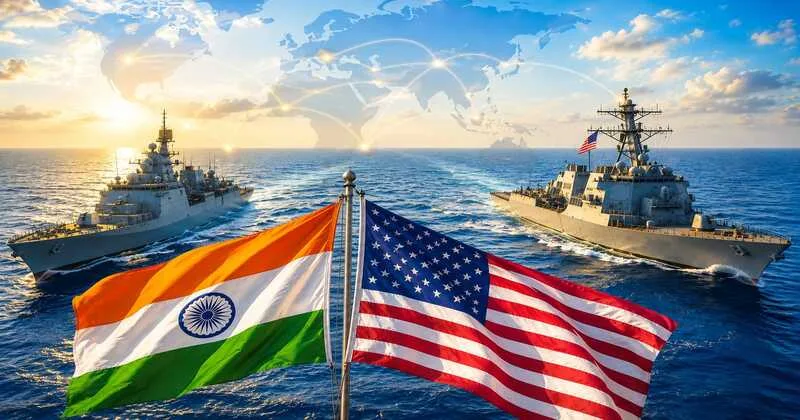
The report identifies the Indian Ocean as the true foundation of the India-US strategic partnership. It argues that American and Indian interests in the maritime domain are not merely complementary but increasingly aligned because both nations depend upon secure sea lanes and an open maritime order.
For the United States, the Indian Ocean is critical for maintaining its military presence, protecting global trade routes and safeguarding international energy supplies. From Diego Garcia to the Strait of Hormuz, the region remains central to American strategic planning.
For India, the Indian Ocean constitutes its foremost strategic neighbourhood. Nearly 95 per cent of the country’s trade by volume and the overwhelming majority of its energy imports pass through these waters. Ensuring secure Sea Lines of Communication is therefore not simply a maritime objective but an economic necessity.
According to the report, this shared dependence creates the real strategic convergence between the two countries. Washington and New Delhi have a common interest in maintaining an open, stable and rules-based Indian Ocean where no single power dominates the maritime commons.
The report concludes that the recent strains should be viewed as a temporary political detour rather than the beginning of strategic separation. It argues that the enduring logic of the partnership lies in shared geopolitical interests rather than transient political disagreements.
“The sooner Washington recognises that reality, the stronger and more enduring the partnership will become,” the report states.
By placing the Indian Ocean, not China, at the centre of the bilateral relationship, the report contends that India’s strategic value to the United States extends far beyond balancing Beijing. As both countries seek to secure maritime trade, strengthen economic resilience, deepen technological cooperation and uphold a stable Indo-Pacific order, the underlying drivers of the partnership remain intact despite periodic political turbulence.