Aurora Dance Over Ladakh: Mystery resolved by Indian Scientists
September 16, 2026
  • Read Ecopy
  • Circulation
  • Advertise
  • Careers
  • About Us
  • Contact Us
Android AppiPhone AppArattai
Organiser
  • ‌
  • Bharat
    • Assam
    • Bihar
    • Chhattisgarh
    • Jharkhand
    • Maharashtra
    • View All States
  • World
    • Asia
    • Europe
    • North America
    • South America
    • Africa
    • Australia
  • Editorial
  • International
  • Opinion
  • RSS @ 100
  • More
    • World Hindu Congress 2026
    • Op Sindoor
    • Analysis
    • Sports
    • Defence
    • Politics
    • Business
    • Economy
    • Culture
    • Special Report
    • Sci & Tech
    • Entertainment
    • G20
    • Azadi Ka Amrit Mahotsav
    • Vocal4Local
    • Web Stories
    • Education
    • Employment
    • Books
    • Interviews
    • Travel
    • Law
    • Health
    • Obituary
  • Subscribe
    • Subscribe Print Edition
    • Subscribe Ecopy
    • Read Ecopy
  • ‌
  • Bharat
    • Assam
    • Bihar
    • Chhattisgarh
    • Jharkhand
    • Maharashtra
    • View All States
  • World
    • Asia
    • Europe
    • North America
    • South America
    • Africa
    • Australia
  • Editorial
  • International
  • Opinion
  • RSS @ 100
  • More
    • World Hindu Congress 2026
    • Op Sindoor
    • Analysis
    • Sports
    • Defence
    • Politics
    • Business
    • Economy
    • Culture
    • Special Report
    • Sci & Tech
    • Entertainment
    • G20
    • Azadi Ka Amrit Mahotsav
    • Vocal4Local
    • Web Stories
    • Education
    • Employment
    • Books
    • Interviews
    • Travel
    • Law
    • Health
    • Obituary
  • Subscribe
    • Subscribe Print Edition
    • Subscribe Ecopy
    • Read Ecopy
Organiser
  • Home
  • Bharat
  • World
  • Operation Sindoor
  • Editorial
  • Analysis
  • Opinion
  • Culture
  • Defence
  • International Edition
  • RSS @ 100
  • Magazine
  • Read Ecopy
Home Bharat

Aurora Dance Over Ladakh: Mystery resolved by Indian Scientists

In May 2024, auroras lit up Ladakh’s skies. Indian scientists have now decoded the chain of the reason behind aurora and solar flares, revealing new insights into thermal evolution and impact on Earth’s space environment

Vivek KumarVivek Kumar
Jul 18, 2025, 06:30 pm IST
inBharat, World, Sci & Tech, Ladakh
Follow on Google News
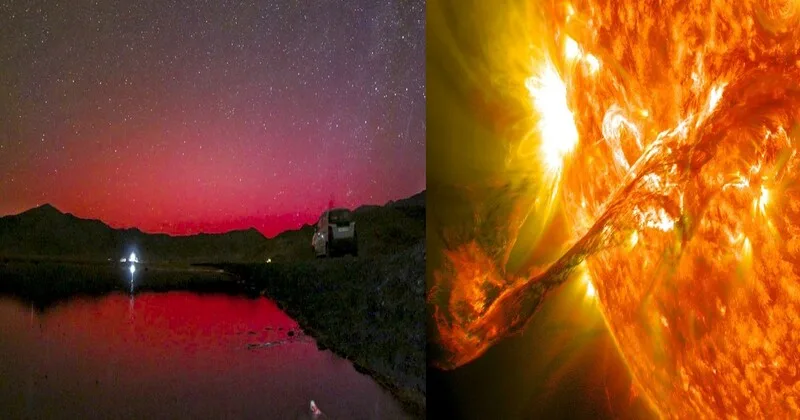
Aurora lighting skies of Ladakh May, 2024 by the Solar storms from Sun

Aurora lighting skies of Ladakh May, 2024 by the Solar storms from Sun

Facebook
Twitter
WhatsAppTelegramEmail

On May 10, 2024, sky of Ladakh dances with lights, as if painted by bare hands. For the first time in decades, Hanle village residents gazed the sky in wonder as curtains of green and red swept across the sky. These were auroras a rare sight on earth. Behind this beautiful event, far away the burning sun has unleashed a fiery solar storm or solar flares, which carries charged particle racing towards earth. These auroras are the tale of those solar blasts originated in the Sun, how they moved millions of kilometres through space and glowing the sky.

Deep in the turbulent atmosphere of the Sun, the corona where an unusual chain of eruptions had been brewing from million of years. On May 10, 2024, the Sun has major event six massive Coronal Mass Ejections (CMEs) in rapid succession. These CME are the gigantic clouds of magnetized plasma and billions of tons of charged particles hurled into space at the speed of over a million kilometres per hour.

The origin of CME was a very active. Feeding this series, were solar flares and filament eruptions, making it more aggressive than typical. The six CMEs didn’t move in isolation, they merged into each other halfway of their journey, thus forming a tangled storm cloud. Traveling through vast space of million kilometres then crashed into Earth’s magnetic shield

What made this event so special wasn’t its appearance, but the scientific puzzle it posed in Indian context. The basic question that revolves since last year was how does sky got pattern of light in Ladakh and how does this geomagnetic disturbance occur in Indian sky.

The Indian Astronomers Decoded the Storm

At the Indian Astronomical Observatory in Hanle, Ladakh, Dr Wageesh Mishra and his team from the Indian Institute of Astrophysics (IIA) has been observing the solar events in real time. They have utilised the data from multiple space agencies including NASA’s and ESA’s solar observatories, to analyse the journey of the particles of solar storms.

Soumyaranjan Khuntia a doctoral scholar at IIA, an autonomous institute under Department of Science & Technology, analysed the data and presented his findings “Using wide-field coronagraphic data and a specialized analytical framework known as the Flux Rope Internal State (FRIS) model, they have tracked the temperature, magnetic fields and structural changes of the CMEs as they sped through interplanetary space”.

Mystery of Heating and Cooling of CME in Space

Conventional thought of Astronomy says that as CMEs travel outward expand initially and then cool. But the Ladakh observations revealed a more complex story. At first, the CMEs behaved as expected, they released heat as they rushed away from the Sun. But halfway through their journey, they transitioned to a strange state where, instead of losing heat they began absorbing and storing it. By the time they reached earth, CMEs were maintaining an almost constant temperature. The collisions of CME caused the “thermal restructuring.” Electrons in the storm clouds found to be in a heat-releasing state, while ions showed a mixed pattern of Cooling and heating, where heating dominated in CME’s.

The findings of researcher also revealed that the interacting CMEs show clear signatures of heating and compression. Thus, suggesting that CME interactions significantly influence their large-scale properties and impact space weather near Earth.

The team also derived the kinematics for the CMEs beyond coronagraphic heights by extrapolating the measured kinematics from the GCS model to get the range of possible heights for CME-CME interaction.

Magnetic World of Earth and Storm

As the storm reached Earth’s doorstep, the data from NASA Wind spacecraft revealed the cloud of plasma contained “double flux ropes.” These were twisted magnetic structures resembling like tangled magnetic braids. Such formations are extremely rare and can hugely geomagnetic disturbances. “These double flux ropes compressed magnetic fields in unusual ways,” said Khuntia. The geomagnetic storm triggered by this tangled mass was powerful enough to push auroras much farther south than usual, painting the skies of Ladakh in ethereal hues.

Why this is important for India

While auroras are beautiful the solar storms can be dangerous. Strong geomagnetic disturbances can disrupt satellites, power grids, navigation systems and even radio communications. That’s why understanding the thermal and magnetic behavior of CMEs become important.

Dr. Mishra emphasised the larger goal: “This study is unique of its kind for both India and Internationally, one will explore whether thermal properties can be used as precursors to forecast intense geomagnetic disturbances.”  Also scientists can predict how a CME will evolve during its journey; they can better warn Earth about impending space weather.

This study findings were published in the prestigious Astronomy and Astrophysics Journal, is the first of its kind globally to track the thermodynamics of multiple interacting CMEs from the Sun to Earth.

Co-author of this research Anjali Agarwal, a doctoral scholar at IIA, highlighted the significance: “This work marks an important step toward understanding how evolving CME structures disturb Earth’s space environment. It could revolutionize space weather forecasting.” Which marks the leap ahead of India in understanding CME.

Human Side of the Story and their Fututre

Back in Hanle, as the scientists were studying and analysing over the data, villagers continued to talk about the night when the sky danced. One could imagine a young Ladakhi child gazing at the auroras, unaware about that far above there is tangled braids of solar plasma weaving through space, carrying secrets about the Sun’s fiery heart. For them, it was a once-in-a-lifetime moment while for the scientific community it was a treasure of data.

The May 2024 solar storm was more than just a natural phenomenon and it was a reminder of how planetary bodies are connected to the Sun. With every flick on Sun’s surface can ripple through the solar system, making something special in the skies of mountains of Ladakh.

As India strengthens its role in solar research, studies like this not only advances science but also reaffirm how our ancestors gazed at the same skies and made the predictions like the Sun is a living force, powerful and unpredictable.

The Sun may be 150 million kilometres away but its fiery storm can paint our skies, light up our nights, and if we are not careful and updated about its impact it can run out our technologies we rely on every day.
Topics: LadakhHanle villageAurora DanceCoronal Mass EjectionsSolar Flares
Share
Tweet
SendShareSend
✮ Subscribe Organiser YouTube Channel. ✮
✮ Join Organiser's WhatsApp channel for Nationalist views beyond the news. ✮
Previous News

Assam Land Jihad: Shouting Allah ho Akbar, Islamists threatened to capture properties of Assamese in next 20 years

Next News

From Masala Mathri to Rashtrapati Bhavan: Aakanksha didis earn applause from President Murmu

Related News

MEA backs UNGA resolution on cartographic representation

MEA backs UNGA resolution on cartographic depiction; Reaffirms India’s non-negotiable sovereignty over J&K and Ladakh

Ladakh: 36 dams planned on Indus after Upshi pilot project; Aids to irrigate large tracts of land, a boon to farmers

Woman who confronted security personnel in Ladakh apologises

“I Apologise to Indian Army”: Woman who confronted security personnel with Gen Z comment in Ladakh admits she was wrong

External Affairs Minister S Jaishankar with Chinese Foreign Minister Wang Yi on the sidelines of the ASEAN Foreign Ministers’ Meeting in Manila, Philippines

India Counters China on Sovereignty Claims; MEA flags Beijing’s illegal occupation of J&K and Ladakh

Defence Minister Rajnath Singh celebrates Kargil Vijay Diwas in Drass, Ladakh

Kargil Vijay Diwas: PM Modi pays tribute to war heroes; Rajnath Singh slams Pakistan for producing suicide bombers

Activist Sonam Wangchuk

Beyond NEET: The bigger debate around Sonam Wangchuk, foreign funding networks and the George Soros connection

Load More

Latest News

(Left) Umar Khalid (Right) KPCC president B.K. Hariprasad

Umar Khalid Nationalist Row: BJP leader CT Ravi hits back at Hariprasad, accuses Congress of ‘Bharat Todo’ politics

UPI Charges: P2P Transfers to Remain Free, Govt Clarifies

Zero charges on person-to-person transactions: New UPI rules keep all P2P payments 100% free regardless of amount

Representative Image

India crossed 80 Lakh HPV vaccine doses despite a sustained misinformation campaign

Riyadh’s search for Israeli intelligence and Islamabad’s refusal to deploy forces to Yemen expose growing cracks in the regional security equation

Saudi turns to Israel for intelligence as Houthis escalate; Sunni NATO ally Pakistan refuses troops for Yemen war

Bihar Temple Vandalism: Police detain 3 minor Muslim boys for stone-throwing, urination at Hanuman murti in Nalanda

IIT Madras hosts first universal brotherhood day celebration, highlights Swami Vivekananda’s legacy and vision for youth

Universal Brotherhood Day: IIT Madras hosts first celebration honouring Swami Vivekananda’s historic Chicago speech

SECL is powering India’s energy security today while advancing responsible mining, greener operations and a sustainable path towards Net Zero

Powering the present, building the future: How SECL is delivering energy security and a net-zero pathway together

Representative Image

Who Owns the Blueprint Inside Your Chip? How India is Moving from Chip Imports to Home-Grown Silicon

From Left to Right: Kamakshi Swaminathan, National Vice President, Saksham; Satish Bansal, National Treasurer, Saksham; Umesh Aandhare, National General Secretary, Saksham; Alok Kumar, Sah Sarkaryavah; Dayal Singh Panwar, National President, Saksham; Gurmeet Singh Mahal, Jodhpur Prant President, Saksham; Dr Jasraj Sharma, Jodhpur Mahanagar President, Saksham; and Dhananjay Kumar Singh, National Krida Ayam Pramukh, Saksham

Saksham’s resolve for inclusion

Kashmiri Pandits perform a ritual on Balidan Diwas of Kashmiri Pandits, organised by Panun Kashmir in Paloura

Panun Kashmir observes Balidan Diwas in Jammu & Bengaluru, pay homage to martyrs

Load More
  • Privacy
  • Terms
  • Cookie Policy
  • Refund and Cancellation
  • Delivery and Shipping

© Bharat Prakashan (Delhi) Limited.
Tech-enabled by Ananthapuri Technologies

  • Home
  • Search Organiser
  • Bharat
    • Assam
    • Bihar
    • Chhattisgarh
    • Jharkhand
    • Maharashtra
    • View All States
  • World
    • Asia
    • Africa
    • North America
    • South America
    • Europe
    • Australia
  • Editorial
  • Operation Sindoor
  • Opinion
  • Analysis
  • Defence
  • Culture
  • Sports
  • Business
  • RSS @ 100
  • Entertainment
  • More ..
    • Sci & Tech
    • Vocal4Local
    • Special Report
    • Education
    • Employment
    • Books
    • Interviews
    • Travel
    • Health
    • Politics
    • Law
    • Economy
    • Obituary
  • Subscribe Magazine
  • Read Ecopy
  • Advertise
  • Circulation
  • Careers
  • About Us
  • Contact Us
  • Policies & Terms
    • Privacy Policy
    • Cookie Policy
    • Refund and Cancellation
    • Terms of Use

© Bharat Prakashan (Delhi) Limited.
Tech-enabled by Ananthapuri Technologies