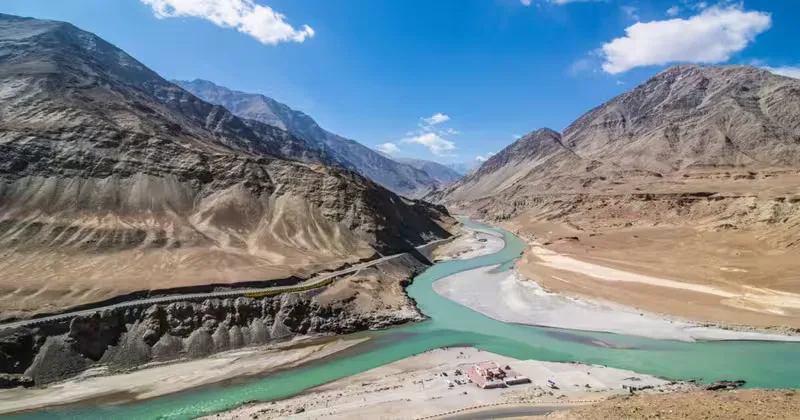
The government of Union Territory (UT) of Ladakh wants over Rs 56 crore from the Centre to build 36 check dams across multiple districts to ensure that more local communities get drinking water. These check dams are meant to raise the level of stream flowing nearby so that the water can be diverted to a nearby existing canal or a new link to take it to fields for benefit of the farmers. Some of these dams are being planned for Indus river and its tributaries with one check dam already completed near Upshi village, approximately 44 km from Leh town.
Upushi is barely 11 km upstream of Indus river from nearby cantonment of Karoo, the base for 3rd Division, India’s major bulwark against China. It is also a big centre for pashmina wool which local herders produce by rearing goats. The high altitude goats found in the Himalayan region of Changthang are the animals which produce a soft and fine fibre called pashmina.
The word pashmina comes from the Persian word ‘pashm’ which means ‘soft gold’. This fibre is known for its warmth, is lightweight and soft, besides its characteristic dye absorbing property. Pashmina has been accredited by the Guinness Book of World Records for being the costliest cloth in the world (after a ban imposed on Shahtoosh – the fibre produced by the Tibetan Antelope). Shatoosh shawls are now considered family heirlooms among rich and very rich families.
The paragraphs above seek to explain the possible reason for selecting Upshi as the site for the first check dam built to raise Indus river water level. Besides, the Indus flow is very gentle at this location, gradient being so. In fact, as you go further upstream along the river Indus and travel backwards, most of the road has been built on the right bank of the river with barely any bridge that needs to be crossed.
More about Upushi check dam on Indus river
Nearly 180 metric tonnes of rocks, ranging from about 500 kg to 10 tonnes each, were interlocked across the Indus riverbed to create this dam a couple of months ago when the flows were low. An important thing that needs to be kept in mind is that no cement or concrete was used to create this structure which utilised locally available stones.
The dam stretches nearly 200 feet, with a 30 feet wide base, a 15 feet wide top deck and a height of around five feet above the riverbed. In a way, this is an unconventional structure made not of concrete and steel, but made only of massive rocks locked together in the riverbed. The dam has helped the local communities by ensuring easy availability of potable water at their doorsteps.
Sindhu Jal Samridhi Abhiyan empowers local communities
In view of the Indus Waters Treaty (IWT) being in abeyance since April 23 last year, the project assumes added significance. The Upshi check dam is a striking example of simple engineering adapted to Ladakh’s difficult terrain. It used locally available material, with local labourers being involved in building this structure.
This is being billed as the first-ever Himalayan Rock Check Dam in India and is located at an altitude of 11,400 feet. It is a part of the Sindhu Jal Samriddhi Abhiyan (SJSA) launched by the Ladakh administration to address seasonal water shortages and improve irrigation in the high-altitude region. The project has been finalised under the guidance of Lieutenant Governor V K Saxena who had inaugurated it.
In the coming months, it is likely that more such dams will be put in place.
Approximately 40 million litres of water held back
The objective of building this dam was not to block the Indus but to slow its flow and raise the local water level. This has now created a deeper pondage area from which farmers can draw water. Harnessing this water for irrigating their fields and growing any crops was a difficult task earlier as the stream was very shallow and could be easily crossed on foot at many points.
According to the Ladakh administration, the Upshi structure has created a pondage area extending around 1,500 feet upstream and can store approximately 40 million litres of water. Water depth reaches about four to five feet along the edges and up to 10 feet in the middle of the river.
This has helped address a very local but critical problem of water scarcity, ironically at a place with a stream flowing nearby. During parts of the agricultural season, the Indus becomes too shallow in some stretches for conventional pumps to lift water to fields situated at higher elevations. The check dam is designed to provide a more reliable water pool during the sowing season.
Harnessing the river for benefit of farmers
The project does not need to be seen as a result of the Indus Waters Treaty being in abeyance. The Ladakh administration presents it as a water-conservation, irrigation and agricultural-sustainability initiative. But its timing inevitably gives the project a larger strategic backdrop.
Against that backdrop, efforts to capture and utilise more of the water flowing through India’s upper Indus basin are attracting heightened attention. However, the Upshi project is fundamentally about Ladakh’s own water crisis rather than diverting the Indus away from Pakistan. In fact, the total flow of the Indus per annum is in the range of 89 to 90 Million Acre Feet (MAF), too large to be impacted by such local interventions.
India announced in April 2025 that it was putting the Indus Waters Treaty in abeyance following the Pahalgam terror attack and has subsequently reiterated that position. On August 31, 2026, an Indian government statement again said India’s decision to keep the treaty in abeyance remained in force.
From one dam to 36 in the coming days
The experiment of Upushi dam has been a major success and already moved beyond a single structure. By the end of August, the Ladakh administration said five Himalayan Rock Check Dams had been completed. It has also submitted a proposal to the Union Ministry of Jal Shakti for 36 additional check-dam projects, seven Himalayan Rock Check Dams in Leh and 29 RCC check dams/weirs in Kargil.
The proposed projects are estimated to cost more than ₹56 crore and, according to the administration’s detailed project report, could bring over 18,600 acres of land under assured irrigation. The administration says pilot structures have been able to store an average of 25–30 million litres and withstand the seasonal rise in river flow.
It reported that Indus flow rises from around 25 cusecs in May and at a peak of nearly 200 cusecs in August, eight times more than when its stream flow is at the lower level.
Bigger battle is capturing snowmelt for farms
Incidentally, Ladakh has glaciers, snow and abundant seasonal meltwater—but much of it flows away before it can be used for agriculture. The administration estimates that less than one per cent of annual snow and glacial melt-water is currently being utilised. The new strategy is therefore less about building giant dams and more about creating a network of relatively small, locally adapted structures to hold water.
This water is precious as it can be used by farmers when they need it most, during summers when farmers can grow crops, rear livestock and this can add to their incomes significantly. The approach has also received high level attention. During his tour of Ladakh in June this year, Vice-President C. P. Radhakrishnan, accompanied by LG Saxena, had visited the first rock check dam at Upshi.
Diverting snow-melt water in many areas of Ladakh is possible with small interventions from the local government. Small scattered villages, with little land holdings can bring more adjacent land lying fallow if more water becomes available. This is what the government is trying to do.