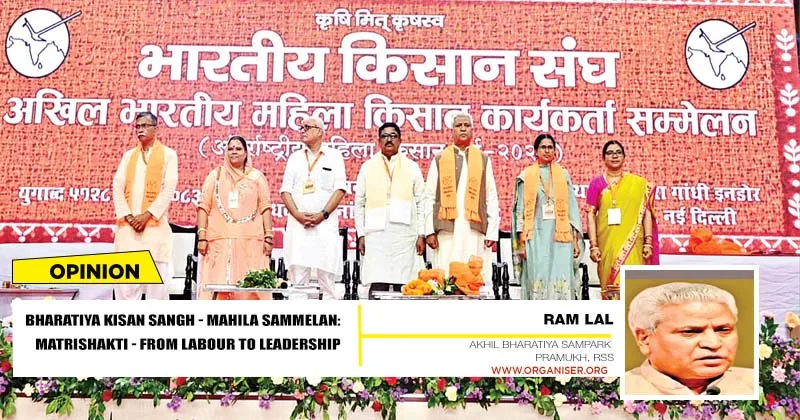
“Yatra Naryastu Poojyante Ramante Tatra Devata” — Where women are honoured and respected, the divine resides there. This sacred thought of Sanatan sanskriti is not limited to rituals alone; it comes to life every day in the fields of Bharat as the “Women Farmer Power” that produces grain. The fabric of Bharatiya agricultural system has rested on the tireless hard work, sacrifice, and dedication of Matrishakti since time immemorial. From sowing seeds in the field to harvesting, threshing, conserving indigenous seeds, and animal husbandry, women handle nearly 60 to 70 per cent of all physical labour associated with farming. Despite this, in social structures and official Government documents, they have often been viewed merely as agricultural labourers or family helpers. To change this scenario and perception, and to grant women farmers their true identity, respect, and self-esteem, a grand and historic All India Women Farmer Workers’ Convention was organised on September 30 at the Indira Gandhi Indoor Stadium in New Delhi under the auspices of the women’s wing of the Bharatiya Kisan Sangh. Set against the backdrop of the “International Year of the Woman Farmer 2026” declared by the United Nations, this convention was not merely an organisational meeting, but an emerging manifestation of women’s contribution in Bharatiya agriculture and a new clarion call for policy restructuring.
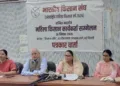
The most unprecedented and inspiring feature of the convention was that thousands of women farmers — coming from Attock to Cuttack, Kashmir to Kanyakumari, and Arunachal and Manipur in the North East — reached Delhi at their own expense without any external aid, presenting their views with utter fearlessness and clarity. Amidst shouts of “Jai Balaram” and “Naari Shakti Jaagegi, Saari Samasya Bhaagegi”, the resolve “Hum Bharat Ki Naariyan Vaibhav Laayengi” echoed throughout KD Jadhav Hall. This massive gathering of active women farmer workers from across the country stood as a living proof of the Bharatiya Kisan Sangh’s strong grassroots presence, women’s self-reliance, and their emerging leadership.
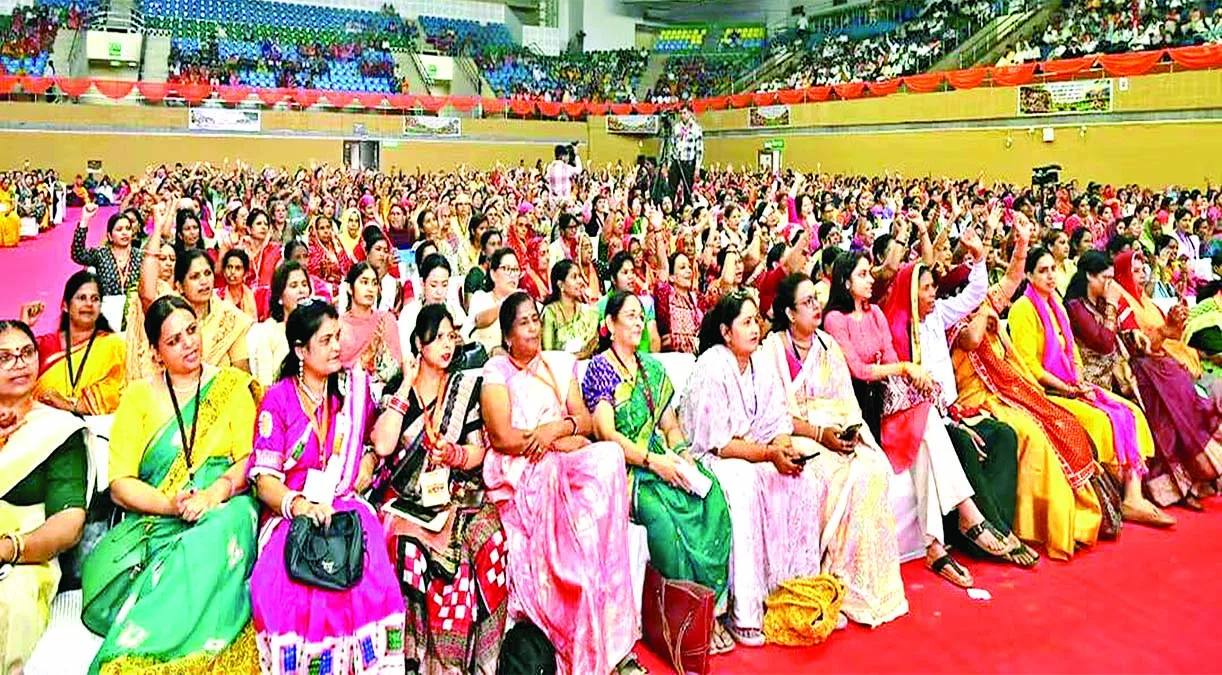
Brimming with enthusiasm and energy at the venue, women farmers fearlessly voiced their issues in their regional traditional attire and local languages. The venue showcased a mini-model of Bharat characterised by unity in diversity.
From Fields to Policy
During the convention, there was deep deliberation on how the vision of a Viksit and Swasth (Developed and Healthy) Bharat by 2047 cannot be achieved through industrialisation alone; its foundation must be our traditional concept of “Gau-Krishi-Vanijyam”. Concerns were expressed regarding GM (Genetically Modified) seeds and gene editing technology. Women farmers collectively pledged that women’s power would take primary responsibility for safeguarding the overall health of the nation, society, and family. To achieve this goal, the convention proclaimed five key pillars: poison-free farming and cow-based organic agriculture, nectarous food (Amrit Aahar), disease-free living, addiction-free humanity, and profitable pricing for
agricultural produce.
This convention was not merely a platform for the exchange of ideas; it strongly underlined the need for sweeping and fundamental changes in the country’s agricultural, farmer, and rural development policies. Current policies often revolve around corporate and chemical farming, whereas the ground reality is that the success of rural development lies in the hands of women’s power. The Central and State Governments must place women farmers at the centre of their policies. Easy credit systems, the establishment of local processing units, and Government policies for marketing organic products must be adapted to suit the ground-level needs of women.
Among the most emotional and inspiring moments of the programme were those when women farmers from remote areas — who had achieved outstanding innovations in farming despite severe adversity — were honoured on the national stage. The contributions of women farmers who saved native seeds from extinction, developed organic model farms, and enabled other rural women to become self-reliant through self-employment were commended and honoured.
This event at the Indira Gandhi Indoor Stadium sends a clear message: when Bharat speaks of sustainable agriculture and a prosperous rural economy, it must place women farmers in the front row of decision-making. They must be granted legal and social recognition not merely as labourers working on the land, but as farmers and agri-entrepreneurs capable of taking independent decisions with self-reliance and discernment. This motherly power which came to Delhi on its own strength has begun a historic revolution that bestows a new sense of pride and dignity to the word Annadata and leads the nation towards a disease-free, prosperous future. I believe that while the Bharatiya Kisan Sangh is stepping forward with Matrishakti, all organisations in the country should learn from such an event and give motherly power its rightful place and honour.