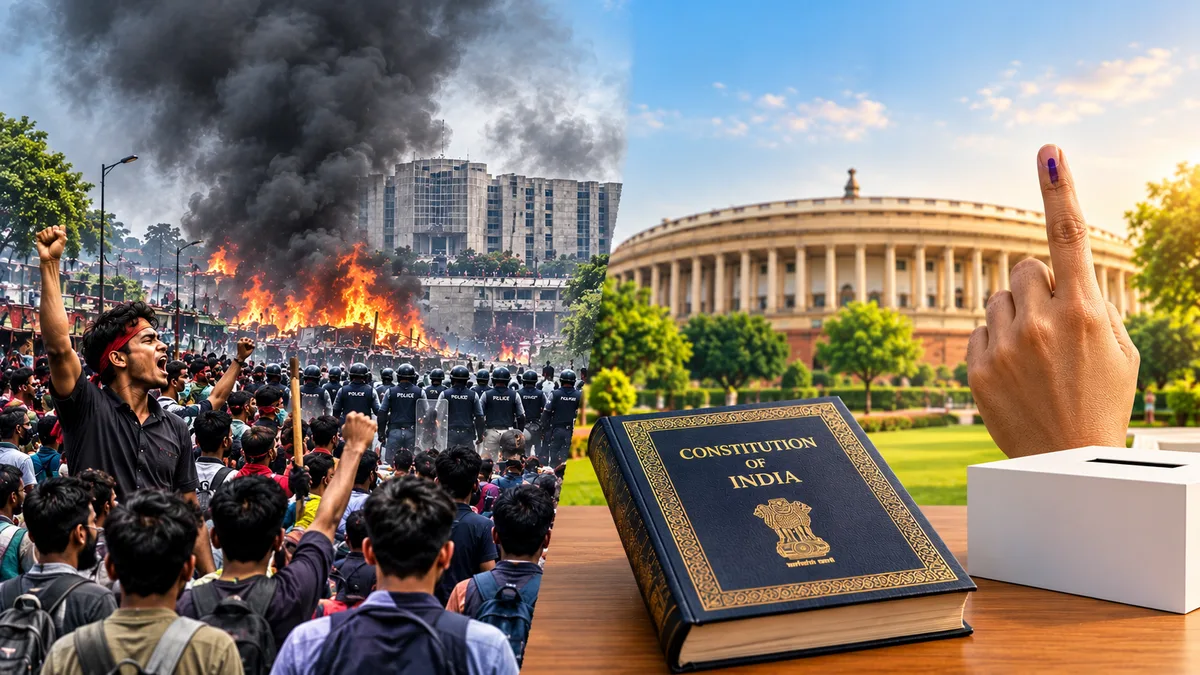
Protests are integral to electoral democracy and are indeed a legitimate tool to express public dissent against the governance apparatus and ensure their accountability. However, political opposition nurturing radical elements to seek narrow deeds & glorifying the sinister agendas under the veil of protest is dangerous to democracy. Such actions don’t picturise a responsible opposition. It will neither yield the intended results.
Regime change plot is not possible in Bharat, a country backed by strong constitutional values, living democratic ethos and most importantly, a well-informed & vigilant electorate. In that backdrop, radical protests will not necessarily yield ballot box victory. Moreover, even the ballot box victory will not necessarily translate into political stability & policy success.
Bangladesh indeed reflects this harsh reality of how radical protests, regime change operations and the ballot box victory will not harness stability, growth and prosperity. Despite a massive protest and dismantle of the Sheikh Hasina led Awami League government, Dhaka is still reeling under a security crisis, steep inflation, economic fragility, socio-political polarisation, communal violence and minority rights hanging in doldrums. Thus, before backing and glorifying radical protests, be aware of the sinister strategies, hidden political motives and interrogate whether it aids the long-term imperatives for the democracy & prosperity of the country.
Regime change radical protest in Bangladesh and the aftermath
The world has witnessed the Bangladesh regime change model. A massive student uprising initiated the regime change operation and ousted the Sheikh Hasina led Awami League government. The youth of the country, in general, may have aspired for a more prosperous, politically stable and economically strong Bangladesh. However, the aftermath of the regime dismantle, reveals recurring episodes of violence, economic & security crisis and communal violence.
The interim government who took over the power helm in Dhaka, led by its Chief Advisor Muhammad Yunus, didn’t walk in the path of political stability and economic prosperity. The period of the interim regime was characterised by steep economic crisis, high inflation, communal violence, polarisation and the country acted as a fertile soil for radical elements. For example, the minority Hindu community, was repeatedly prone to targeted violence & mob lynching. Hindu houses, which have been integral to Bengali culture for thousands of years, were torched down. Hindus were set ablaze in public.
Apparently, such horrific episodes are recurring despite a new elected government being placed in Dhaka since February 2026, with no concrete accountability and action. The radical extremist elements began to resurface during the interim regime. The economy & GDP began to cripple. Industries and textile exports, the soul of Bangladesh’s economy, lost their momentum. Inflation breached sustainable limits. Moreover, the Awami League was banned from the country and was barred from participating in the elections. Was this the true intention of the regime change operation? Is this a symbol of democracy, political participation and economic prosperity?
The next phase of the political trajectory of Bangladesh is the aftermath of the February 2026 national elections. As the Awami League was banned, the Bangladesh Nationalist Party(BNP) came to power, with a landslide electoral victory. However, did this ballot box victory drive policy success, democracy and economic prosperity? Bangladesh is still reeling under economic crisis, steep inflation rates, massive human rights violations and the safety of the minority community hanging indoldrums.
Political parties are banned, activists are in prison and democratic pluralism has been an illusion in Bangladesh. Violent actions, hate crimes, mob violence has not been halted. On the economic front, in the previous year, Bangladesh received only USD 1.8bn foreign investment, which is less than many fragile African economies. Political uncertainty, massive corruption record and institutional weakness has led to failed foreign investment.
Moreover, on the security front, the actions of Bangladesh are raising severe concerns. Its increasing tilt towards Pakistan has the potential to trigger a larger regional security crisis. The confrontational posture with India, has derailed the long-standing and decades of diplomatic goodwill. The ruptured Delhi-Dhaka partnership, has harmed one of the best defined diplomatic legacies in the region, which was a testament to good bilateral ties. This indeed has larger implications in terms of regional security, stability and growth.
This political history of Bangladesh, since the ouster of Sheikh Hasina regime, thus raises many questions. Was this derailment of the country’s growth momentum the real goal of regime change? Also, Bangladesh’s trajectory illustrates a harsh reality. Glorifying radical protests is indeed dangerous to democracy. Moreover, regime change operations or ballot box victory, doesn’t necessarily translate into political stability, economic growth and prosperity. Protests are integral to democratic politics. However, they can be hijacked by hidden radical elements to seek narrow political deeds.
Glorifying radical protests dangerous to democracy; Doesn’t reflect responsible opposition
As mentioned, protests and public dissent are critical to a vibrant democracy. They check the governance apparatus and keep them accountable. However, encouraging and glorifying radical elements under the veil of protest is dangerous to democracy. It implies a deliberate threat and harm to political stability and democratic functioning to seek narrow political gains. On the other hand, hijacking people’s aspirations to seek political interests and primacy doesn’t reflect a responsible opposition.
Radical elements and aspirations do exist in every society. But, nurturing them, rendering them a mainstream platform, media attention and glorifying them by manipulating facts doesn’t align with responsible democracy and the established constitutional values. Aiming to harness political strategies by harnessing and glorifying radical elements, is a threat to democracy. Such immature actions yield neither ballot box victory, nor political legitimacy.
Mainstreaming and glorifying radical voices doesn’t fetch electoral triumph and in turn the prosperity of the nations. Such unsolicited actions, only defame the global stature of India and derail the country’s growth momentum, rather than doing good for the country’s prosperity. In the backdrop of latest developments in India, is that the real vision of a responsible & mature opposition?
The opposition parties are mainstreaming and glorifying radical elements under the veil of protest rather than indulging in credible political opposition. Lessons from Bangladesh testify that such radical actions will not yield true prosperity of a nation.
Bharat is not Bangladesh: Well-informed electorate doesn’t nourish radicalism or regime change
Independent India has been built by strong constitutional values. For 8 decades, the country has been nurtured by a living constitution and a vibrant democracy. Most importantly, the well-informed and vigilant electorate of India, will not entertain the radical elements or any narrow political ambitions. For decades, a series of draconian actions have repeatedly failed including the 1975 emergency. Ultimately, a legitimately elected government has always prevailed.
Unlike Bangladesh, radical regime change operation is not possible in Bharat, for a simple reason, Bharat is not Bangladesh. It is a country with a big demography, vibrant democracy and a wise franchise power. Any hidden agenda or sinister strategy by the radical elements and political opposition, hence, will not yield the intended results. Moreover, the lessons from Bangladesh and other countries clearly testify that the radical aspirations and actions don’t accelerate growth and prosperity. It only ruins the growth momentum of the country. The populace has to thus stay vigilant about political exploitation of demonstration, romanticisng extra-constitutional elements, hijacking of protests by vested interests and mainstreaming or glorifying the radical voices.