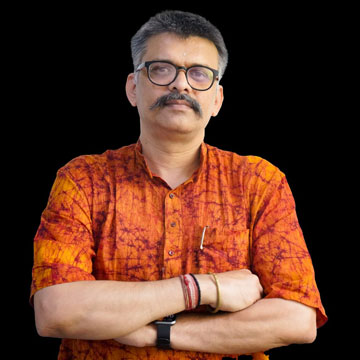


In a world where global equations are shifting rapidly, India finds itself at a crucial juncture, neither a passive bystander nor a mere emerging power, but a nation expected to shape the contours of the 21st-century global order. At this juncture, Shri Ram Madhav, President, India Foundation and key political leader, public intellectual and author associated with the RSS school of thought has brought out a book titled ‘The New World: 21st Century Global Order and Bharat’. In this wide-ranging and candid conversation, Organiser Editor Prafulla Ketkar engages Ram Madhav on the motivations behind his book and beyond, about his views on decline of the West, rise of China and the role for Brand Bharat in the emerging world order. Excerpts:
You began as a Swayamsevak, worked with ‘Jagriti’ and Bharatiya Prajna, and have now authored several important books from the Partition to the Constitution, Hindutva, and your latest work. How do you reflect on this journey?
I generally avoid speaking about myself because whatever I am today is entirely due to the Rashtriya Swayamsevak Sangh (RSS). The Sangh shaped my thinking, gave me training, and provided key opportunities throughout my journey. I was fortunate to be given responsibilities early. —editing Jagriti at 25, starting an English monthly, and later becoming the Sangh spokesperson at 36. In 2014, I was sent to the BJP to look after North East and Jammu & Kashmir affairs. Writing has been my passion since childhood—debates, articles, even songs for the Sangh. Over the decades, I have authored books in Telugu and English. But more than personal achievements, what matters is that the Sangh gave direction, and I have tried to use that to serve the cause in every way I could.
As the President of India Foundation, which just completed 16 years, how do you see its role as a ‘do tank’ in shaping policy, engaging global leadership, and institutionalising that process?
India Foundation is now seen as a leading intellectual centre in Bharat and has gained global recognition too. While some claim it was created after the BJP Government came to power, it began in 2009, when the BJP was in Opposition. The idea emerged after Guruji Golwalkar’s birth centenary celebrations, which revealed growing curiosity and support for nationalist thought among the intelligentsia. We wanted to institutionalise that dialogue and counter the notion that so-called ‘Right-Wing’ movements are anti-intellectual.
In fact, Bharat has given two original ideas to the world—Gandhiji’s ‘Ahimsa’ and ‘Satyagrah’, and Pt. Deendayal Upadhyayji’s ‘Integral Humanist Approach’. The latter, though rooted in the nationalist camp, influences major welfare and governance policies today. Through platforms like the India Ideas Conclave, India Foundation has brought together thinkers, writers, media professionals, and policy minds aligned with or open to engaging with these ideas. The idea was that the right-wing ecosystem should have a strong forum which can articulate its ideas in a manner that someone outside can easily understand and appreciate.
Over the last 15 years, it has helped build networks, supported policy discourse, and created space for the right-of-centre ecosystem to articulate itself coherently. Personally, the journey has been very fulfilling.
Your book comes at a time when the global order is in flux. What was your thought process behind writing ‘The New World’ now?
My book The New World is a timely contribution to global thought, as the current world order—shaped by the West after 1945—is clearly in decline. While many talk about a transition, few have defined what the new world order will look like. I have attempted to do that by identifying 10 key characteristics, such as the waning influence of the West, the rise of China, and the emergence of a multipolar world.
“When China rises, it brings a value system that worries the world. When India rises, we must offer an alternative—based on our civilisational ethos, rooted in dharma, democracy, and decentralisation. That is the true Brand Bharat”
In the post-1945 system, Bharat was a passive participant, focused on nation-building and calling itself ‘Non-Aligned’ or ‘Third World.’ But today, Bharat has strength, vision, and global stature. If we don’t help shape the new order, others, particularly China, will. So in Part Two of the book, I outline 10 steps Bharat must take to play a proactive role in shaping the 21st-century global order. Bharat has to understand that it has a role in shaping this world order, and for that, Bharat has to prepare itself.
China is seen as a revisionist power challenging the US-led global order. Do you see a China-centric global system truly emerging?
Yes, China envisions a world with itself at the centre—that’s its 2049 goal, marking 100 years of Communist rule, as also explored in the book The Hundred-Year Marathon. In the 20th century, economic strength drove global power, but in the 21st century, it’s technology and trade. China has a clear lead in both, being the second-largest economy and a strong tech competitor to the US.
This makes China a formidable challenge in the new world order. But unlike the US, which shares democratic values and a diaspora connection with Bharat, China offers neither. Bharat and China also share the same geostrategic space and ambitions, which naturally creates competition.
Bharat must handle this challenge wisely by building strong alliances. I am not a China hawk—I believe we must understand China as a civilisational power, just like Bharat, and find ways to compete without escalating to conflict. The current Government is rightly avoiding direct confrontation, despite global pressures, especially from the US. China is not a democracy, so liberalism has no place in its worldview. Unlike Bharat’s inclusive nationalism, China’s model opposes political freedom, while promoting economic freedom. It backs regimes that limit freedoms but align with Chinese interests.
To deal with China wisely, we must deeply understand its mindset, rooted in strategy, like Sun Tzu’s The Art of War. We need not pick daily fights, but we must be clear-eyed and strategic in our approach.
While many speak of a new bipolar world, you highlight not just multipolarity but heteropolarity, with global NGOs, big tech, and MNCs becoming new power centres. How do you see this unfolding?
At a recent conference in Hungary, Prime Minister Viktor Orbán called George Soros Hungary’s biggest enemy—not because he has an Army, but because he wields immense influence through finance and NGOs. Similarly, in the Russia-Ukraine war, when Russia disabled Ukraine’s satellite links, Ukraine’s Foreign Minister didn’t reach out to a country, but tweeted Elon Musk for Starlink. Within hours, Musk provided terminals, helping Ukraine stay connected and resist Russian advances.
This shows we are no longer in a strictly state-centric world. Powerful individuals, tech giants, and NGOs now play decisive roles. Smaller nations feel this deeply. This is what I call a heteropolar world—where multiple non-state entities shape global power dynamics, and states must account for them.
You have written about Artificial Intelligence (AI), “hybrid humans,” and humanoids in your book. How do you see AI shaping the strategic landscape over the next 20–25 years?
AI is set to radically transform humanity, possibly even redefine what it means to be human. Just as Neanderthals went extinct 45,000 years ago, we too could be replaced by more advanced beings. We are entering an age of machine-man hybrids, where AI is no longer artificial—it is real and, in many cases, already smarter and faster than us. Today, robots handle tasks in hospitals, and machines can think independently. The next frontier is consciousness—can machines feel, react, or even exhibit emotion? We are closer to that than we think.
“Enough thinking has happened in India. We have 5,000 years of thought. What we now need is action. That’s why we call India Foundation a ‘Do Tank’—not just a think tank. It’s time to convert ideas into implementation”
In fact, even religious bodies like the Vatican are taking AI seriously. In 2021, it launched the ‘Rome Call for AI Ethics,’ urging that AI serves humanity but never surpass it. Yet, we are already part-machine—pacemakers are one example. In the future, chips may power not just our hearts, but our minds.
Whether we fade out and give way to meta-humans or retain control depends on the choices we make now. But there is no doubt—we are moving swiftly in that direction.
As nationalism rises globally, how do you see its conflict with woke ideology, especially in terms of culture and values?
I identified two major sociological trends shaping the new world: the return of nationalism and the rise of wokeism. Nationalism—especially national identity and sovereignty—is making a strong comeback, not just in Asia but across Europe and the West.
The second, more troubling trend is wokeism, which challenges all traditional institutions—state, religion, family, even biological gender. It promotes a fluid social order where even a child’s gender is not fixed at birth. For instance, some European schools let children choose their gender at 14, and one of President Biden’s first executive orders allowed men to use women’s toilets.
This ideology, in the name of liberation, destabilises long-held social norms. Bharat has been more resilient due to its strong cultural and conservative roots. The Government’s stance against legalising same-sex marriage—while not opposing same-sex relationships—reflected that cultural grounding. But as over 60 countries move in that direction, Bharat too must stay aware of global shifts without blindly following them.
Operation Sindoor tested Bharat’s principles of strategic autonomy and dehyphenation, core to PM Modi’s foreign policy. How can we sustain this approach in an increasingly chaotic global order?
In today’s tech-driven wars, no one truly wins. Even victors suffer, and perception management often distorts outcomes. That is why Bharat must tread carefully. We have maintained strategic autonomy – as seen in Russia-Ukraine and Israel or Iran conflicts — despite pressure and criticism. In such conflicts, , never catch the tiger’s tail — you cannot hold it forever, and you cannot let go either. Bharat’s balanced approach is commendable, but now we must step up and assert a larger role. The so-called ‘Global South’ is not a geographic term but a geopolitical one, referring to nations outside the Western bloc.
We need stronger engagement in the Indian Ocean Region. Like China, which calls itself a developing country and regional power even with an $18 trillion economy, we too must focus on building regional influence—gradually, strategically, and consistently.
Apart from strategy, you have spoken on education, innovation, technology, and demography. How do you view demographic challenge in the context of the Viksit Bharat vision?
Demography is destiny, but managing a large young population requires resources and planning. We must train our youth for global opportunities— Govt of India already have agreements with countries like Japan and Korea for a human resources exchange programme. We also need to move beyond traditional manufacturing, which is a saturated region. High-end sectors like defence, aerospace, AI, and biotechnology offer scope. Additionally, sectors like tourism and hospitality need better infrastructure and trained personnel. Skill enhancement—not just skilling—is key. Industry must invest in R&D and re-skilling to meet future demands. Demographics, employment, and innovation are all deeply connected.
You have said India should give up romanticism, yet you speak of Dharmocracy, Ekatma Manav Darshan, Chiti, and Bharat’s national character. So, what is Brand Bharat—just a rebranding exercise, or do we have something truly unique to offer the emerging world order?
We must shift from grand claims to concrete outcomes. To truly become a developed nation, we need realistic goals like a $10 trillion economy, strong per capita growth, and major investments in R&D, innovation, and deep tech.
Brand Bharat should not be a replica of the West. When India rises, it must rise with its values—democracy rooted in people-centric traditions, decentralisation, and civilisational wisdom. Concepts like stakeholder capitalism, now celebrated globally, were originally part of Indian thought, like Gandhi’s trusteeship.
“Even concepts like stakeholder capitalism—now celebrated globally—originated in India. Gandhi’s trusteeship is being repackaged and promoted by the West. Why aren’t we the ones putting it on the global table?”
So instead of imitating Western models, we should institutionalise and internationalise our unique civilisational ideas. If China’s rise is concerning because of its ideological exports, India’s rise should offer a humane, value-based alternative. That, to me, is the essence of Brand Bharat.
Where do you see your role and that of India Foundation in shaping and building Brand Bharat, beyond party or organisational lines?
I became a Pracharak at 16 and since then, I have never really thought in terms of personal ambition. I have always gone with the flow; sometimes opportunities came, sometimes I created them. I am sure I will continue to contribute in whatever role I am assigned.
As for India Foundation—and for all of us who belong to a certain ideological school, there is a huge opportunity today. If we rise above romanticism and seize this moment, there is a lot we can do. At India Foundation, we see ourselves more as a “Do Tank” than just a Think Tank. Enough thinking has happened; now it’s time for action.
Our focus is on India and the extended neighbourhood. There is a deep civilisational connect in the region—we are welcomed warmly, but we have not capitalised on it fully. We need to strengthen people-to-people ties and institutional linkages. That is the direction in which we are working, and will continue to support the Government in achieving its broader goals.