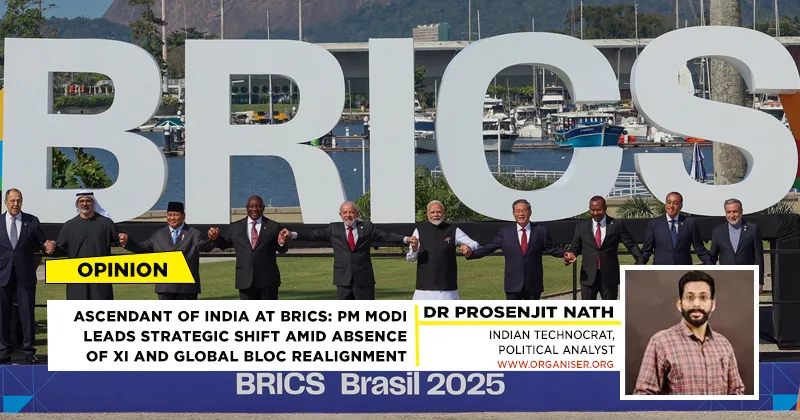
As Prime Minister Narendra Modi embarks on an ambitious 8-day diplomatic tour spanning Ghana, Namibia, Argentina, Brazil, and Trinidad and Tobago, all eyes are on the 17th BRICS Summit in Brazil’s Rio de Janeiro from July 5 to 8. This year’s summit carries historic weight. BRICS is no longer a compact group of five; it has expanded to ten full members, with 13 additional countries joining as formal partners. Amid this transformation, three developments define the moment: the evolution of BRICS itself, the conspicuous absence of Chinese President Xi Jinping, and India’s emergence as the central figure poised to shape the group’s future.
The gathering in Brazil marks a turning point, a moment of flux and opportunity. And PM Modi appears ready to seize it.
The Curious Case of Xi’s Absence
One of the most talked-about developments ahead of the summit is the absence of Chinese President Xi Jinping. It is the first BRICS summit Xi will miss in his 12 years of leadership, and the reasons offered by Beijing are less than convincing. Citing “scheduling concerns” related to preparations for the Shanghai Cooperation Organisation (SCO) Summit, which is months away, simply doesn’t add up. Not when Hu Jintao attended the BRICS Summit in 2010 in Brasília, despite a major earthquake back home.
This move is being interpreted as more political than logistical. According to reports, Brazil’s invitation to PM Modi for a state dinner following the summit appears to have irked Beijing. Xi, reportedly, does not want to be perceived as a “supporting actor” in an event where India’s diplomatic stature is prominently celebrated. The optics matter to China, perhaps too much.
Brazil, for its part, has not taken the snub lightly. President Luiz Inácio Lula da Silva had travelled to Beijing earlier this year in goodwill, expecting reciprocal engagement. The Chinese cold shoulder is seen in Brasília as a breach of protocol and courtesy. Nevertheless, Lula has stayed the course. India remains central to Brazil’s BRICS vision, and ties between the two nations may soon deepen through a reported defence pact involving Indian-made Akash missile systems.
PM Modi at the Helm: BRICS’ Most Senior Leader
With Xi absent and Putin constrained, the latter skipping the summit due to the ICC warrant and Brazil’s refusal to guarantee immunity, PM Modi now becomes the most senior leader among the founding BRICS nations present at the summit. This is not just symbolic; it represents a substantive shift in BRICS’ leadership dynamics.
India is now positioned to play a pivotal role not merely as a participant, but as a potential shaper of BRICS’ future. For a group that now includes economic and energy heavyweights like Saudi Arabia, the UAE, and Iran, India’s emphasis on development, digital infrastructure, and strategic autonomy makes it an ideal interlocutor.
India has long maintained that BRICS should be non-West but not anti-West. This distinction matters. While China and Russia have at times used BRICS as a counterweight to the G7 and NATO blocs, India has consistently pushed for a more inclusive and development-focused orientation. As External Affairs Minister S. Jaishankar famously put it, “Why the club? Because there was another club, the G7, and you won’t let us in. So we made our own.”
India’s Agenda: From Trade to Terrorism
PM Modi’s presence is not merely performative. India is carrying a full agenda to the Rio summit—one that reflects its vision for a truly multipolar world.
First, there is the push for trade in national currencies. Amidst the rising weaponisation of the U.S. dollar, sanctions, and financial disruptions, many BRICS members seek to reduce their dependence on the dollar. India supports this move, though it has resisted calls for total de-dollarisation, preferring a calibrated shift that avoids financial instability.
Second, export controls within BRICS are being targeted. By eliminating internal trade barriers, BRICS can become a more cohesive economic entity. This also aligns with India’s goal of enhancing South-South trade and deepening interdependence among emerging economies.
Third, Digital Public Infrastructure (DPI), a domain where India leads the world, is set to become a major area of collaboration. PM Modi will showcase the success of India Stack, Aadhaar, UPI, and DigiLocker as replicable models for the Global South.
Fourth, India is pushing to elevate counterterrorism as a key agenda item for BRICS. After China and Pakistan blocked condemnation of the recent Pahalgam terror attack at the SCO summit, India is determined to ensure BRICS does not repeat the mistake. MEA officials have stated that the final declaration on terrorism will be “to India’s satisfaction,” signalling a tougher stance and a more sincere consensus.
Fifth, AI and cybersecurity cooperation are on the table. India wants to ensure that emerging technologies are harnessed responsibly, with a focus on inclusion, ethics, and digital sovereignty.
Finally, PM Modi is expected to reiterate India’s advocacy for the interests of the Global South, encompassing climate finance, vaccine equity, and multilateral reform. India envisions BRICS as a platform for a collective voice and collaborative action, rather than a geopolitical bloc that mimics Cold War rivalries.
A Pragmatic and Multipolar Moment
The expansion of BRICS has created both promise and peril. With 13 new partners and ten full members, coordination is bound to be a challenge. But therein lies India’s opportunity. It is the only country in the BRICS that is simultaneously a founding member of the grouping and a regular invitee to the G7. It bridges the divide between the West and the non-West, maintaining credibility on both sides.
While China grows more insular and assertive, increasingly using forums like the SCO and BRI to amplify its state-centric worldview, Russia remains diplomatically handicapped. In contrast, India represents a different model. One rooted in multi-alignment, not bloc-building.
This approach resonates with new entrants and partner countries in the BRICS, such as Nigeria, Indonesia, and Egypt, which are not looking to align with a new Cold War axis. They want voice, dignity, access, and practical cooperation, not a binary choice between Washington and Beijing. India offers a template that matches this aspiration.
Moreover, India’s foreign policy has shown consistency. From abstaining on UN Ukraine-related votes to engaging with the Quad while attending the SCO, from hosting the G20 summit to participating in the Voice of the Global South initiative, New Delhi has refused to be boxed in. This principled flexibility is what gives India the credibility to lead or at least to steer multilateral platforms like BRICS.
A Shift in Global Gravity
The Rio BRICS Summit marks more than just an annual gathering. It reflects a global order in flux. As the old certainties of unipolarity and bloc politics fade, a more complex, multipolar world is emerging, and India is firmly at its centre.
Xi Jinping’s absence may appear like a tactical snub, but it only underscores a deeper reality: China’s insecurity over India’s rising stature. Russia’s constraints highlight the fragility of using geopolitics as a form of coercion. In contrast, India’s diplomacy, driven by engagement, partnerships, and reform, signals what a 21st-century power looks like.
PM Modi’s presence at the BRICS Summit is not just about India taking the lead; it’s about redefining leadership itself away from domination and toward collaboration. If the BRICS evolves into a true voice of the Global South, it will owe much to India’s patient and persistent diplomacy.
This is not just a PM Modi moment. It’s a moment for Bharat to shape the future. And this time, the world is watching and listening.