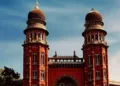
In a significant ruling, the Madras High Court permitted the Hindu Munnani to conduct a protest under strict conditions, emphasising that the right to freedom of speech and expression must always be subject to public order and peace, along with other constitutional restrictions.
A division bench comprising Justice G Jayachandran and Justice R Poornima heard a series of petitions filed by M Murugan, P Sundravadivel, and the Hindu Dharma Parishad. The petitioners sought police permission to hold a planned protest at Thiruparankundram and requested the revocation of the Section 144 order imposed on February 3 and 4 to prevent the demonstration.
Court’s Verdict and Conditions Imposed
The court, while allowing the protests, restricted the Hindu Munnani to conduct their demonstration on February 4, 2025, at the Palanganatham junction between 5:00 pm and 6:00 pm. The judges ordered that adequate arrangements be made for the event and instructed both the organizers and police to ensure that no law and order issues arise. Additionally, the organizers were permitted to use only one megaphone, and the entire protest had to be video recorded.
Justice Jayachandran, who authored the verdict, noted that the General Secretary of Hindu Munnani, Madurai City, had earlier approached the Inspector of Police, Thiruparankundram, seeking permission for a demonstration on February 4, 2025, from 3:00 pm to 9:45 pm near the 16 Kal Mandapam. The protest was planned in response to the alleged encroachment on temple land and the police’s inaction against encroachers. However, the police denied permission, leading to the legal battle.
The court observed that the respondent police had released a press note warning the general public not to visit the Thiruparankundram temple on February 4. Furthermore, fleet owners and transport operators were cautioned against facilitating public transportation to the temple for the protest. Following a recommendation from the Commissioner of Police, the District Collector imposed a two-day prohibitory order covering February 3 and 4. Aggrieved by this, the petitioners approached the court, leading to a collective hearing of the writ petitions.
Court’s Observations on the Police’s Actions
The bench, after carefully considering arguments from both sides, emphasized that while the right to expression is a fundamental right, it must be exercised within the limits of public peace and constitutional restrictions. The court also expressed its dissatisfaction with the manner in which the authorities handled the situation, suggesting that the issue could have been managed more effectively.
However, the situation was defused through deliberations involving the learned Public Prosecutor and Additional Advocate Generals. A consensus was reached, allowing the demonstration to be shifted from the Thirupparankundram temple 16 Kal Mandapam to Palanganatham junction. This arrangement was made to avoid inconvenience to temple devotees.
The police agreed to provide proper arrangements and security for the protest at the designated venue from 5:00 pm to 6:00 pm. The demonstrators were explicitly instructed to maintain peace, refrain from provocative slogans, and ensure that the protest did not disrupt public tranquility. The court also mandated that the event be fully video-graphed, with police given the freedom to record it without any interference. The petitioners were held responsible for ensuring the peaceful conduct of the protest. The court scheduled further hearings on the matter for February 19, 2025.
Petitioner’s Concerns on Temple Encroachment
Hindu Munnani’s General Secretary in Madurai, S Kalanithi Maran, had approached the High Court seeking to overturn the police’s rejection order and requesting permission to hold the protest at the 16 Kal Mandapam of the temple from 3:00 pm to 9:45 pm on February 4. In his petition, Maran emphasized that the Thirupparankundram temple is a significant pilgrimage site for Bhagwan Muruga and is one of the six sacred locations associated with Lord Subramanya.
He further alleged that certain groups were attempting to encroach upon the hill and incite religious tensions by planning to sacrifice goats and cocks at the dargah in the area. Maran contended that the protest was necessary to draw government attention to the temple’s protection and prevent encroachment.
Court’s Comments on Prohibitory Orders
During the hearing, the court made critical observations regarding the prohibitory order issued by the authorities. The judges remarked that the order lacked proper reasoning and clarity. The court also raised concerns over the selective nature of permissions granted for different religious processions.
“The prohibitory order is so truncated, without any reason. You’re now saying that you will allow religious processions. What if now they (the protestors) decide to change their program and style of protest and decide to carry some milk pots on their heads, will you allow them? There’s no clarity. These types of processions should be allowed,” the court orally observed.
Allegations of Bias Against the Tamil Nadu Government
Critics have accused the Tamil Nadu government of selectively denying permissions for Hindu processions and protests while allowing similar events organized by the ruling party and minority groups.
Observers argue that this is not the first instance where the state government and its police force have denied permission for Hindu organizations’ events, citing law and order concerns. They point to previous instances where the Rashtriya Swayamsevak Sangh (RSS) was denied permission to conduct its annual route marches, as well as restrictions on the installation and immersion of Vinayagar (Ganesha) idols during Vinayagar Chathurthi.
Critics highlight that while Hindu organizations face repeated restrictions, the government has permitted events organized by the ruling DMK and its allies without similar concerns. For example, on February 3, 2025, a DMK minister was allowed to hold a silent march in Madurai to mark the death anniversary of DMK founder C N Annadurai, despite the prohibitory orders being in place.
Similarly, critics pointed out that the same government granted permission in Coimbatore, a communally sensitive area, for a funeral procession of a terrorist who had died of illness. Thousands reportedly participated in the event, hailing him as a martyr, raising concerns over the state government’s approach to law enforcement and public order.
Legal experts and political analysts argue that these decisions highlight the DMK government’s alleged minority appeasement policies and discriminatory actions against Hindu organisations. The courts have previously directed the state government to ensure that all groups are treated equally when granting permissions for processions and protests, instead of denying approvals at the last moment.