'Every grave or dargah is not automatically Waqf property'
June 9, 2026
  • Read Ecopy
  • Circulation
  • Advertise
  • Careers
  • About Us
  • Contact Us
Android AppiPhone AppArattai
Organiser
  • ‌
  • Bharat
    • Assam
    • Bihar
    • Chhattisgarh
    • Jharkhand
    • Maharashtra
    • View All States
  • World
    • Asia
    • Europe
    • North America
    • South America
    • Africa
    • Australia
  • Editorial
  • International
  • Opinion
  • RSS @ 100
  • More
    • Op Sindoor
    • Analysis
    • Sports
    • Defence
    • Politics
    • Business
    • Economy
    • Culture
    • Special Report
    • Sci & Tech
    • Entertainment
    • G20
    • Azadi Ka Amrit Mahotsav
    • Vocal4Local
    • Web Stories
    • Education
    • Employment
    • Books
    • Interviews
    • Travel
    • Law
    • Health
    • Obituary
  • Subscribe
    • Subscribe Print Edition
    • Subscribe Ecopy
    • Read Ecopy
  • ‌
  • Bharat
    • Assam
    • Bihar
    • Chhattisgarh
    • Jharkhand
    • Maharashtra
    • View All States
  • World
    • Asia
    • Europe
    • North America
    • South America
    • Africa
    • Australia
  • Editorial
  • International
  • Opinion
  • RSS @ 100
  • More
    • Op Sindoor
    • Analysis
    • Sports
    • Defence
    • Politics
    • Business
    • Economy
    • Culture
    • Special Report
    • Sci & Tech
    • Entertainment
    • G20
    • Azadi Ka Amrit Mahotsav
    • Vocal4Local
    • Web Stories
    • Education
    • Employment
    • Books
    • Interviews
    • Travel
    • Law
    • Health
    • Obituary
  • Subscribe
    • Subscribe Print Edition
    • Subscribe Ecopy
    • Read Ecopy
Organiser
  • Home
  • Bharat
  • World
  • Operation Sindoor
  • Editorial
  • Analysis
  • Opinion
  • Culture
  • Defence
  • International Edition
  • RSS @ 100
  • Magazine
  • Read Ecopy
Home Bharat

‘Every grave or dargah is not automatically Waqf property’: Madras High Court’s landmark verdict

The Madras High Court set aside the Tamil Nadu Waqf Board's appointment of a Mutawalli for a Triplicane Dargah, holding that the existence of a shrine alone does not establish Waqf status and that mandatory legal procedures had not been followed.

Surender KumarSurender Kumar
Jun 9, 2026, 04:40 pm IST
in Bharat, Law, Tamil Nadu
Follow on Google News
FacebookTwitterWhatsAppTelegramEmail

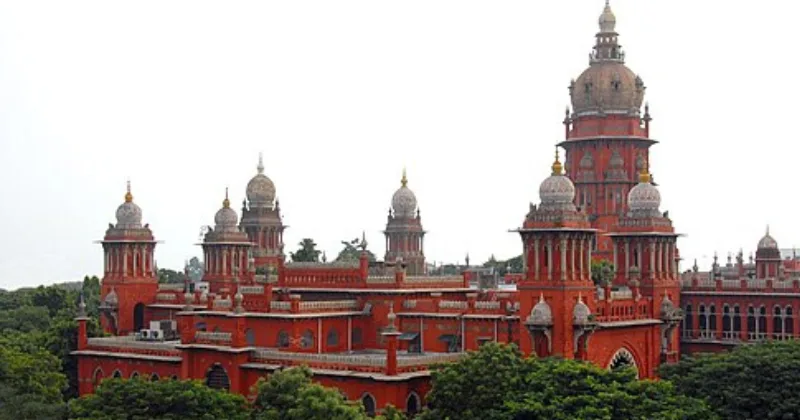
The Madras High Court has ruled that the mere existence of a Dargah, tomb, or shrine does not automatically make it a Waqf property and has set aside the Tamil Nadu Waqf Board’s appointment of a Mutawalli for a Dargah in Chennai’s Triplicane area.

Justice K. Govindarajan Thilakavadi delivered the judgment on June 5, 2026, in an appeal filed by the Sarkar Syed Habibullah Sha Khadari Arif Rabbani Hazarath Dargah. The Court overturned the Waqf Board’s 2023 resolution appointing a Mutawalli and the consequential order issued by the Board.

What was the dispute?

The case concerned the Sarkar Syed Habibullah Sha Khadari Arif Rabbani Hazarath Dargah situated on Kamaraj Road, Triplicane, Chennai.

The appellant claimed that his family had been maintaining and serving the Dargah for more than 40 years and argued that the land on which the Dargah stands belongs to the Public Works Department (PWD), not to any Waqf. He challenged the Tamil Nadu Waqf Board’s decision to appoint another person as Mutawalli (manager of a Waqf institution).

The Waqf Board and the fifth respondent (A. Shainsha, the person appointed by the Waqf Board as Mutawalli) argued that the Dargah was a Waqf institution and that the appointment had been made after an enquiry.

Also Read: Waqf Board Exposed: 72 per cent of ‘claimed’ properties lack legal records as UMEED Portal deadline bursts 9 lakh myth

What did the Court find?

The Court noted that the Public Works Department claimed the Dargah stands on Government poromboke land, originally belonging to the Municipality under G.O. No. 880 dated 1 July 1974, and later allotted rent-free to the Bharat Scouts and Guides.

The Court found that no statutory survey had been conducted and no Gazette notification had been issued declaring the property as Waqf, as required under the Waqf Act.

The judge found that the respondents failed to produce evidence showing that the property was included in the official “list of auqaf” or that it had undergone the mandatory legal process required under the Waqf Act.

The Court further observed that no statutory survey had been conducted and no Gazette notification had been issued declaring the property as Waqf. According to the judgment, such procedures are mandatory under Sections 4 and 5 of the Waqf Act before a property can be recognised as Waqf.

It held that the existence of a Dargah alone does not make a property Waqf and that the Waqf Board could not appoint a Mutawalli without first establishing that the property was legally a Waqf.

The judge held that a property cannot be treated as Waqf merely because a Dargah exists on it. The Court observed that there must be evidence of a lawful and permanent dedication of property for religious, charitable, or pious purposes recognised under Muslim law, and such evidence was not found in the present case.

As a result, the Court concluded that the Tamil Nadu Waqf Board could not assume jurisdiction over the Dargah or appoint a Mutawalli without first establishing that the property was legally a Waqf through the procedure prescribed under the Waqf Act.

The controversial argument

A. Shainsha, the 5th respondent, argued through his counsel that the Dargah had existed “from time immemorial” and had been administered by his forefathers for generations. He contended that under Muslim law, a mosque or Dargah used by the public for worship could become a “Waqf by user” even without a formal deed of dedication. According to him, “the mere act of permitting the Muslims of the Village to build a Mosque itself amounts to a complete dedication or a declaration that the mosque is a public property.” On that basis, he argued that the Dargah was a public Waqf and therefore fell under the jurisdiction of the Tamil Nadu Waqf Board.

Also Read: Looting in the name of Allah: Waqf Board’s betrayal of Indian Muslims

Court’s response

The High Court, however, held that the respondents had failed to establish the legal requirements necessary to treat the property as a Waqf. The Court found that no statutory survey had been conducted and no Gazette notification had been issued, and observed that the mere existence of a Dargah or shrine does not automatically make a property a Waqf.

Judge’s key observations

Justice K. Govindarajan Thilakavadi held: “Mere religious use or existence of a tomb or shrine is not automatically sufficient. There must be permanent dedication of property by a Muslim for purposes recognised by Muslim Law as pious, religious, or charitable, which is not found in the present case.”

The Court also stated: “Every grave or Dargah is not automatically Waqf property. Existence of a Muslim endowment is required.”

In another significant observation, the Court said: “If a Dargah has never been surveyed, registered or notified as Waqf, the Waqf Board ordinarily cannot assume automatic control merely because it is a Muslim Religious Institution.”

What law did the Court rely on?

The Court referred to:  Section 83(9) of the Waqf Act, 1995 (as amended by the Waqf Amendment Act, 2025), under which the appeal was filed.

Sections 4 and 5 of the Waqf Act, dealing with survey and notification of Waqf properties.

Sections 6 and 7, which relate to disputes concerning properties included in the list of auqaf.

Section 36(4), relating to registration of Waqf institutions.

The Court emphasised that conducting a statutory survey and publishing the property in the official list of Waqfs are essential legal requirements before a property can be treated as Waqf.

Final ruling

The High Court held that the Waqf Board could not assume jurisdiction over the Dargah without first establishing that it was legally a Waqf property.

The judge observed: “Therefore, mere existence of a Dargah does not automatically confer jurisdiction upon the Board unless the institution is established or treated as a Waqf in accordance with law.”

Holding that the Board had not established the necessary jurisdictional facts, the Court set aside the Tamil Nadu Waqf Board’s resolution dated August 23, 2023, and the consequential order dated September 14, 2023 appointing the Mutawalli. The appeal was allowed, and the Tribunal’s order was overturned.


Topics: tamil nadu Waqf BoardWaqf ActWaqf Property disputeTriplicane DargahJustice K Govindarajan ThilakavadiMadras High Court
ShareTweetSendShareSend
✮ Subscribe Organiser YouTube Channel. ✮
✮ Join Organiser's WhatsApp channel for Nationalist views beyond the news. ✮
Previous News

US Court strikes down Trump’s $100,000 H-1B fee as executive overreach; Lawmakers & Republicans welcome the verdict

Next News

Tamil Nadu: TVK government arrests YouTuber Maridhas; BJP alleges crackdown on dissent

Related News

Tamil Nadu: TVK government registers FIR against former DMK minister KN Nehru in cash-for-jobs case

Madras High Court quashes case against RSS swayamsevaks linked to centenary celebrations in Ambur on Vijayadashami 2025

Temple Funds in TNPFC: Tamil Nadu govt offers sovereign guarantee for Rs 2,700 crore deposits after HC Scrutiny

Tamil Nadu: Madras HC backs Tamil Nadu govt’s move to shut 717 TASMAC shops

Tamil Nadu: Madras HC issues notice to ECI, Joseph, Stalin, EPS over plea alleging use of children in TVK campaign

Petition Seeks Special Relaxation for Churches; TVK Govt Faces Tough Test

Tamil Nadu Church Approval Row: Plea for DTCP exemption for building small churches sparks outrage

Load More

Latest News

Chinese President Xi Jinping, Russian President Vladimir Putin and Prime Minister Narendra Modi

China’s New Tone Towards India: Tactical shift or strategic necessity? What Beijing’s push for RIC ties really signals

Keralam’s 2026 Fiscal Health White Paper has unveiled a mounting debt burden of Rs 5.07 lakh crore, exposing deep structural challenges in the state’s economy

Keralam’s Financial Reality Check: White Paper exposes Rs 5.07 lakh crore debt crisis

Tamil Nadu: TVK government arrests YouTuber Maridhas; BJP alleges crackdown on dissent

‘Every grave or dargah is not automatically Waqf property’: Madras High Court’s landmark verdict

US Court strikes down Trump’s $100,000 H-1B fee as executive overreach; Lawmakers & Republicans welcome the verdict

Union Defence Minister Rajnath Singh

Uttar Pradesh: Defence land goes green; Rajnath Singh clears 250 MW solar project in Sitapur

Afghanistan Foreign Minister Amir Khan Muttaqi and External Affairs Minister Dr. S. Jaishankar(File Photo)

India extends gratis long-term business visas to Afghan traders; Slams Pakistan for “trade & transit terrorism”

How Modi's Zero-tolerance doctrine reshaped India's anti-terror policy (This is an AI generated image)

Twelve Years of Modi Government and the rise of India’s zero-tolerance doctrine against terrorism

Press Conference organised by Janjati Suraksha Manch at the Press Club, Ranchi, National Convener Dr Raj Kishore Hansda

Success of Janjati Sanskritik Samagam symbolises unity and cultural pride: Dr Raj Kishore Hansda

India delivered a historic performance at the inaugural World Yogasana Championships, finishing at the top of the medal tally with an astounding 114 medals, including 102 golds

World Yogasana Championships: India scripts historic triumph with 114 medals and 102 gold medal wins

Load More
  • Privacy
  • Terms
  • Cookie Policy
  • Refund and Cancellation
  • Delivery and Shipping

© Bharat Prakashan (Delhi) Limited.
Tech-enabled by Ananthapuri Technologies

  • Home
  • Search Organiser
  • Bharat
    • Assam
    • Bihar
    • Chhattisgarh
    • Jharkhand
    • Maharashtra
    • View All States
  • World
    • Asia
    • Africa
    • North America
    • South America
    • Europe
    • Australia
  • Editorial
  • Operation Sindoor
  • Opinion
  • Analysis
  • Defence
  • Culture
  • Sports
  • Business
  • RSS @ 100
  • Entertainment
  • More ..
    • Sci & Tech
    • Vocal4Local
    • Special Report
    • Education
    • Employment
    • Books
    • Interviews
    • Travel
    • Health
    • Politics
    • Law
    • Economy
    • Obituary
  • Subscribe Magazine
  • Read Ecopy
  • Advertise
  • Circulation
  • Careers
  • About Us
  • Contact Us
  • Policies & Terms
    • Privacy Policy
    • Cookie Policy
    • Refund and Cancellation
    • Terms of Use

© Bharat Prakashan (Delhi) Limited.
Tech-enabled by Ananthapuri Technologies