At the end of Dwaparyug, after the disappearance of Bhagwan Krishna, Yugabdha started in India, in the fourth century of the third millennium, Mahakavi Bhas was born, who established many facts by presenting the idea of Bharat Rashtra in the drama art.
The main sentence of Mahakavi Bhas’s plays Dutvakayam, Bal Charitam, Swapnavasavadattam is- Imam Sagarparyantam Himavad Vindhyakundalam Mahimekaatpatradangaam Rajsingh: Prashastu. That is, the land which extends till the sea, whose Himalayas and Vindhyachal are the ear rings, the one Chhatrapati who rules, should be our Rajsingh. As per the estimation, during Mahakavi Bhas’s time, Maharaja Rajsingh would have ruled on the land of Bharat Rashtra. The facts of the nation which Mahakavi Bhas presented in his plays are-
- Bharat Rashtra is spread till the sea.
- The Himalayas and Vindhyachal mountains of this country enhance the beauty like earring
- The administration here is of a Chhatrapati.
In the then India, this feeling of patriotism was not only in the rulers but also in the poet society whose creations show it directly. Due to the influence of these creations, there was an ideological flow of patriotism in the whole of India which kept the entire Indian land in harmony.
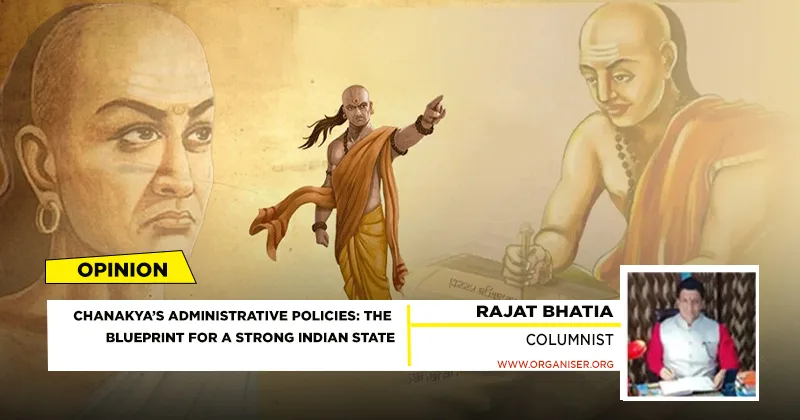
Kautilya Chanakya was born three centuries after the great poet Bhas, at that time the Greeks had attacked twice on the northeastern border of India. During that time the social system supported the nation, due to which the enemy got stuck at the border of India. But this method proved that in future small states should be combined to form a big polity in the form of a nation so that foreign powers can be faced. According to some facts, Chanakya was born in Tamil Nadu, a state in the southern part of India. If we accept that Chanakya is from the south, then we will also have to accept that Chanakya of south India was worried about the foreign invasions in north-east India, which was resolved by going to Pataliputra later on. This fact refutes Periyar’s false narrative of north vs south, which divides India.
It was not possible for India, which was divided into small states, to maintain its existence as a single country up to the seas under the shadow of foreign invasions. His intention to solve this difficult task was the idea of a united India. For which, with the help of his ability to duty, prosperity, suitability of physical strength, and firm resolve to do his work, Chanakya made Magadh his centre and established the Maurya Empire by making Chandragupta his weapon. The tradition of establishing empires through yagyas like Rajsuya, Ashvamedha etc. existed in those days, the exact definition of which is given by Chanakya in the ninth chapter of ‘Kautilya Arthashastra’ that – India is considered to be a country spread from mountainous regions to the sea, the goal is to establish dominance under one roof, which is called Chakravarti region. The criteria established by Chanakya at the global level became the first definition related to Chakravarti, which is an India-centric definition.
In Chanakya’s opinion, nation and state were different, but complementary to each other. According to Chanakya, nation was Janapada related units. The group of people living on the earth, who are endowed with the qualities of sustaining, truth, penance, ability etc. was considered to be the nation. Chanakya in his book ‘Shashtamdhikaranam Mandalayoni:’ explains seven reactions of revenue – life related (king, amatya, district and friends), system related (fort, treasury, punishment).
Swamyamatyajanapadadurga koshadandmitrani parkratya.
Like the present times, there was a rule of octroi on entry into the cities, which was decided by Chanakya under a well thought out policy.
Rashtra peedakaram bhandam uchchindayad phalan cha yat mahopakar muchchulkam kuriyad bijam cha durlabham.
That is, there was a ban on goods that were harmful or injurious to the nation and the progress and prosperity of the nation was to be achieved without investing capital on goods that were very beneficial for the nation.
Chanakya organized the tax system for the nation and focused it on agriculture and transport-
Sita Bhogo Balih Karo Vaanik Nadipalastaro Naavh Pattanam Vivitam Vartani Rajjuschorajusch Rashtram.
That is, agricultural tax, enjoyment of agricultural produce, sacrifice (for religious purposes), fruit-related tax, commercial income tax, river palanquin for protection of pilgrimage sites, tax for crossing the river, tax for doing border trade, Pattan- tax taken from the cities on the banks, Vivitam, Vartani- tax taken for protection of roads, Rajju(rope), Chor Rajju (Rope used for tying thieves) ( Translated from the book: Bharat Rashtra ka Anant Pravah, Writer: Ranga Hari, Page no. 69)
Chanakya was a philosopher, hardworking, active scholar. He, understanding national security, made a capable, dutiful person wise under the policy and deepened the scene of the Chakravarti region and made the nation safe. As a result, he defeated the pleasure-seeking, directionless king Nanda of Magadh and made the mighty Chandragupta the king, who stood like a Himalaya in front of foreign invaders. Seeing his dedication, the internal conflicts of the nation were also pacified and a prosperous state was formed.
Acharya Chanakya’s aim was to unify the entire nation like Magadha and make a strong state. During the rule of Chandragupta, coin became a dimension of economic level which strengthened the country by establishing the concept of new administration, due to which a uniform currency came into circulation in the entire state. The roads connecting the states were paved and widened, which resulted in faster traffic. Ease of travel led to ideological harmony, which ended many types of differences in social strata and the idea of patriotism was spread throughout the nation. Administratively, Acharya Chanakya established the criteria for the appointment of secretaries, ministers, ambassadors, etc. so that the Varna system prevails over the caste system. The Penal Code was created, which does not discriminate on any basis (caste, sex, religion) while punishing the guilty. Acharya Chanakya emphasized on workability and not on birth-based ability.
In short, the social contribution of Acharya Chanakya, who brought Indian nationhood to fruition in the third millennium of Yugabda, is like a lamp that gave the light of knowledge to the entire nation. For the society, Chanakya is similar to the divine grace that Arjuna received in the form of Krishna in Mahabharata, whose teachings can pave the way for the nation’s prosperity by studying them.