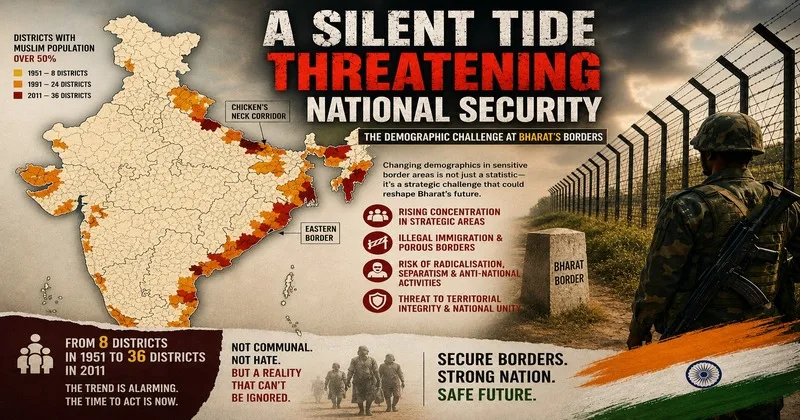
The demographic landscape of Bharat is undergoing a profound transformation, one that demands immediate and serious attention from policymakers and citizens alike. While official discourse often focuses on economic growth and development, a critical undercurrent of demographic change, particularly along sensitive border regions, poses a significant threat to national security. The alarming increase in districts with a substantial Muslim population, concentrated in strategically vital areas like the “Chicken’s Neck” corridor and the Eastern border, is not merely a statistical anomaly but a pattern that warrants urgent investigation and proactive measures. This trend, projected to continue with the upcoming 2026 census, signals a potential destabilisation that could echo the painful divisions of Bharat’s past.
The data paints a stark picture: the number of districts with over 50 per cent Muslim population has surged from a mere 8 in 1951 to 36 by 2011. This growth is not uniformly distributed; it is predominantly clustered in areas that are critical for Bharat’s territorial integrity and strategic depth. The “Chicken’s Neck” corridor, a narrow strip of land connecting mainland Bharat to its North Eastern states, and the extensive Eastern border, shared with countries experiencing their own demographic and political volatilities, are particularly concerning. The concentration of a specific demographic group in these sensitive zones raises legitimate questions about the nature of this growth – whether it is organic, driven by external factors, or facilitated by deliberate, strategic settlements. The emergence of what appear to be exclusive Muslim localities in these border regions further compounds these concerns, suggesting a potential for organised demographic engineering that could undermine the social fabric and security of the nation.
This demographic shift is intrinsically linked to the persistent issue of illegal immigration. For years, Bharat has grappled with the challenge of porous borders and the influx of individuals from neighbouring countries, often with little to no documentation. When this influx is coupled with the observed pattern of strategic settlements and the formation of exclusive enclaves, it creates a fertile ground for anti-national activities. Such developments can facilitate cross-border crime, radicalisation, and the erosion of state authority in vulnerable areas. The potential for these demographic concentrations to become breeding grounds for separatism or to be exploited by hostile foreign powers cannot be overstated. The implications for Bharat’s internal security and its ability to maintain sovereign control over its borders are immense and demand a comprehensive, data-driven response that goes beyond mere rhetoric.
The Spectre of Another Partition?
The historical parallels are unsettling. The partition of Bharat in 1947 was a cataclysmic event, fuelled in no small part by demographic anxieties and communal politics. The current demographic trends, particularly the formation of concentrated Muslim populations in strategically sensitive border districts, evoke a chilling echo of the circumstances that led to that tragedy. While the context is different, the potential for demographic shifts to exacerbate existing fault lines and create new ones is a grave concern. The narrative that these demographic changes are merely a natural consequence of population dynamics, without acknowledging the potential for strategic manipulation or the implications for national security, is a dangerous oversimplification. It risks lulling the nation into a false sense of security while a critical vulnerability is being systematically cultivated.
The implications for national security are multifaceted. A significant demographic shift in border regions can alter the socio-political dynamics, potentially leading to demands for greater autonomy or even secessionist movements, especially if fuelled by external actors. The formation of self-created ghettos can also lead to the marginalisation of local populations, creating social unrest and making these areas more susceptible to exploitation by extremist elements. Furthermore, the sheer logistical challenge of managing and integrating such large, concentrated populations, particularly if they are perceived as being outside the national mainstream, can strain state resources and dilute the effectiveness of governance. The economic burden of providing services, infrastructure, and security in these rapidly changing areas cannot be ignored, potentially diverting resources from crucial development projects that benefit the broader Bharatiya populace.
It is imperative that society, policymakers, and security agencies engage with these demographic realities with the seriousness they deserve. Dismissing these concerns as mere communal rhetoric or Islamophobia is a grave disservice to national security. Instead, a nuanced, evidence-based approach is required, one that analyses the drivers of demographic change, monitors illegal immigration rigorously, and develops strategies to ensure the socio-economic integration of all communities within the framework of national security and constitutional values. The goal must be to foster a cohesive national identity, not to create divisions that can be exploited by those who wish Bharat ill.
Challenging Narratives, Celebrating Progress
In the face of these demographic concerns, it is crucial to identify and counter narratives that are hostile to Hindus, Hindu Dharma, or the Hindu community. Some fringe elements and international organisations, often with a vested interest in destabilising Bharat, tend to frame any discussion of demographic shifts in border regions as inherently Islamophobic or discriminatory. These narratives seek to delegitimise legitimate security concerns by painting them as manifestations of religious intolerance. For instance, any attempt to discuss the implications of illegal immigration or the formation of exclusive settlements is often met with accusations of targeting a minority community, thereby stifling critical debate and hindering the formulation of effective policy. Such narratives not only undermine Bharatiya national interests by creating internal divisions but also actively work to portray Bharat negatively on the global stage, often by selectively highlighting issues while ignoring the broader context of national security challenges.
Conversely, it is equally important to acknowledge and celebrate Bharat’s remarkable progress and development. While addressing demographic challenges, we must not lose sight of the nation’s achievements. Bharat’s economic growth, burgeoning infrastructure, advancements in technology, and increasing global standing are testaments to the resilience and dynamism of its people and institutions. These positive developments, often overlooked or downplayed by critics, are crucial for national morale and for projecting a strong, capable image of Bharat. The government’s efforts in improving living standards, expanding access to education and healthcare, and strengthening the economy are vital counter-narratives to those who seek to portray Bharat as a nation in perpetual crisis. These successes demonstrate Bharat’s capacity to overcome challenges and to build a prosperous future for all its citizens.
Therefore, a balanced approach is essential. We must be vigilant against narratives that seek to undermine Bharat’s sovereignty, its institutions, or its social harmony. This includes challenging those who promote anti-India sentiments or seek to delegitimise the Indian state. Simultaneously, we must actively promote and celebrate Bharat’s developmental strides, showcasing its potential and achievements to the world. This dual approach – of addressing critical security concerns while championing national progress – is the only way to navigate the complex challenges ahead and ensure a secure and prosperous future for Bharat.
Proactive Policy and Societal Engagement
The demographic shifts observed in Bharat’s sensitive border regions are not merely abstract statistics; they represent tangible challenges to national security and social cohesion. The pattern of increasing Muslim populations in districts along the “Chicken’s Neck” corridor and the Eastern border, coupled with concerns about illegal immigration and strategic settlements, demands a robust and proactive policy response. This response must be grounded in data, driven by national interest, and implemented with a clear understanding of the potential ramifications.
Firstly, there is an urgent need for enhanced border management and a comprehensive census that accurately captures demographic data, particularly in border areas. This will provide a clearer picture of the scale and nature of the demographic changes underway. Secondly, policies aimed at preventing illegal immigration and curbing the formation of exclusive enclaves must be strengthened and enforced effectively. This does not imply targeting any community but rather ensuring that all residents are documented and integrated into the national mainstream, adhering to the rule of law.
Furthermore, socio-economic development initiatives in these border regions are crucial. Addressing the root causes of vulnerability, such as poverty and lack of opportunity, can help prevent these areas from becoming susceptible to external influences or radicalisation. Investing in education, healthcare, and employment opportunities for all residents will foster a sense of belonging and national identity. Finally, a national dialogue is needed to address these demographic concerns openly and honestly, without succumbing to divisive narratives or accusations of prejudice. It is through informed public discourse and decisive policy action that Bharat can navigate these complex demographic currents and safeguard its future.
A Call to Vigilance and Unity
The demographic transformations occurring within Bharat, particularly in its strategically vital border regions, present a complex challenge that cannot be ignored. The increasing concentration of Muslim populations in districts along the “Chicken’s Neck” corridor and the Eastern border, a trend projected to continue, raises legitimate national security concerns. This phenomenon, often intertwined with issues of illegal immigration and the formation of exclusive settlements, demands a serious and sustained response from the Indian state and society.
It is crucial to approach this issue with a clear head, distinguishing between legitimate security concerns and narratives that seek to demonise entire communities or undermine Bharat’s sovereignty. The potential for demographic shifts to be exploited by hostile actors, both internal and external, is a clear and present danger. The echoes of past partitions serve as a stark reminder of the consequences of unchecked demographic anxieties and communal polarisation. Bharat’s strength lies in its unity and its ability to integrate all its citizens into the national fabric, while simultaneously safeguarding its borders and its territorial integrity.
Therefore, a multi-pronged strategy is essential. This includes strengthening border surveillance, ensuring accurate demographic data collection, and implementing policies that promote inclusive development and national integration. It also requires a societal commitment to fostering a shared sense of belonging and to resisting divisive narratives that seek to weaken the nation. By addressing these demographic challenges proactively and cohesively, Bharat can not only mitigate potential security risks but also continue its journey of progress and development, solidifying its position as a strong and unified global power.