In an insightful presentation on the growing importance of organic farming, PV Rao, Chairman of Ekalavya Grameena Vikas Foundation (EGVF), highlighted the need to shift toward organic practices to ensure agricultural sustainability in Bharat.
“We reached quantity but at the cost of soil degradation; now, we must focus on quality and sustainability,” stated PV Rao at a recent media interaction event at Keshav Memorial Law College, Hyderabad on 13 October. Emphasizing the need to respect the soil and each other, Rao called for robust central and state initiatives, policy support, and a shift in scientists’ focus from yield to sustainability.
Speaking about the Krishi Vigyan Kendra, Medak (KVK-Medak), Rao underscored the challenges posed by conventional, chemical-based farming and outlined how organic methods are emerging as viable alternatives for farmers seeking sustainable solutions.
“In India, we are witnessing a vital resurgence in organic farming,” PV Rao explained in his presentation, “as a response to the damaging impacts of decades of chemical-intensive agriculture. Following the Green Revolution of the 1960s, India achieved remarkable productivity gains through high-yield crops, synthetic fertilizers, and pesticides. Yet, these gains came at a high cost: soil degradation, biodiversity loss, and increasing health risks. Prioritizing yield over sustainability created a cycle of chemical dependence, pest resistance, and nutrient-depleted soils.
By the late 20th century, the toll on our soil and environment was undeniable, underscoring the need for a sustainable path forward. Organic farming, addressing soil health and reducing chemical dependence, is proving essential not only for environmental and public health but also for long-term climate resilience.”
The Need for Organic Farming
Decades of intensive, chemical-heavy practices have taken a toll on soil health, leading to nutrient depletion, loss of biodiversity, and increased susceptibility to pests. Rao explained that this pattern has not only affected the soil but has also led to greater water pollution and harmful chemical residues in the food supply.
He stressed that organic farming—defined by the International Federation of Organic Agriculture Movements (IFOAM) as a practice that sustains soils, ecosystems, and people—is needed to counter these adverse effects. Organic farming methods involve using natural fertilizers and crop rotation techniques, which help restore soil health, enhance biodiversity, and promote resilience against climate change.
Organic Farming as a Sustainable Alternative
Rao shared how organic farming can provide a sustainable solution by reducing dependence on synthetic inputs, promoting healthier ecosystems, and delivering more nutritious food. He emphasized that, beyond environmental benefits, organic farming offers economic advantages, with growing consumer demand creating new market opportunities for farmers. Rao highlighted that with the right guidance and support, organic agriculture could become a sustainable, profitable choice for farmers.
Tackling Challenges and Inviting Farmers to Adopt Organic Practices
Despite its advantages, organic farming faces challenges, including the initial cost of transitioning, complex certification processes, and limited infrastructure. Rao’s presentation addressed these issues, advocating for simplified certification processes and calling for enhanced support from government and non-government organizations. He urged farmers to view organic farming not as an expense, but as an investment in long-term soil fertility, ecosystem balance, and food quality.
In encouraging farmers to adopt organic practices, Rao emphasized reconnecting with traditional farming knowledge and practices, which inherently relied on organic methods. “We need to rebuild our connection with the roots of our farming heritage,” he said, underscoring the wisdom in traditional methods that harmonized with nature.
Institutional Support and Initiatives
EGVF, as the host organization for KVK-Medak, plays a pivotal role in disseminating organic farming knowledge and technologies. KVKs, established by the Indian Council of Agricultural Research (ICAR) under the Government of India, function as district-level agricultural science centers. These centers offer farmers hands-on training, technology demonstrations, and support tailored to local conditions.
Through KVK-Medak, Rao’s team actively promotes on-farm testing of sustainable techniques and offers technical guidance to farmers, making the transition to organic farming smoother and more accessible.
“In pioneering organic agriculture, some states have set remarkable examples,” PV Rao highlighted in his presentation. “Sikkim has transitioned 76,000 hectares entirely to organic, making it India’s first fully organic state, while Gujarat has established a Natural Farming Science University to promote natural farming practices. However, our state agriculture universities still face challenges—funding shortages, infrastructure limitations, and a predominant focus on high-yield crops—all of which slow the progress of organic research and development. If we aim for a truly sustainable agricultural future, addressing these issues is essential.”
To promote organic farming, the Indian government has introduced multiple initiatives aimed at enhancing sustainable practices and reducing reliance on synthetic inputs. The National Program for Organic Production (NPOP), launched in 2001 under the Agricultural and Processed Food Products Export Development Authority (APEDA), fosters organic practices and provides accreditation for certification bodies. The Soil Health Card Scheme, introduced in 2015, assesses soil quality and promotes balanced fertilizer use, indirectly supporting organic farming by encouraging soil health. Additionally, the Paramparagat Krishi Vikas Yojana (PKVY) supports organic clusters with Participatory Guarantee System (PGS) certification.
For the northeastern states, the Mission Organic Value Chain Development for the North Eastern Region (MOVCD-NER) develops certified organic production chains, connecting local growers with consumers across India. Another initiative, the Bhartiya Prakritik Krishi Padhati (BPKP), a sub-scheme under PKVY launched in 2020–21, promotes traditional indigenous practices and natural farming through government-funded support.
In conclusion, PV Rao’s presentation outlined a clear, actionable path forward for Indian agriculture, championing organic farming as a method that aligns with both ecological principles and market demands. His call for wider adoption, institutional support, and a return to traditional knowledge lays the groundwork for an agricultural model that benefits farmers, consumers, and the environment.
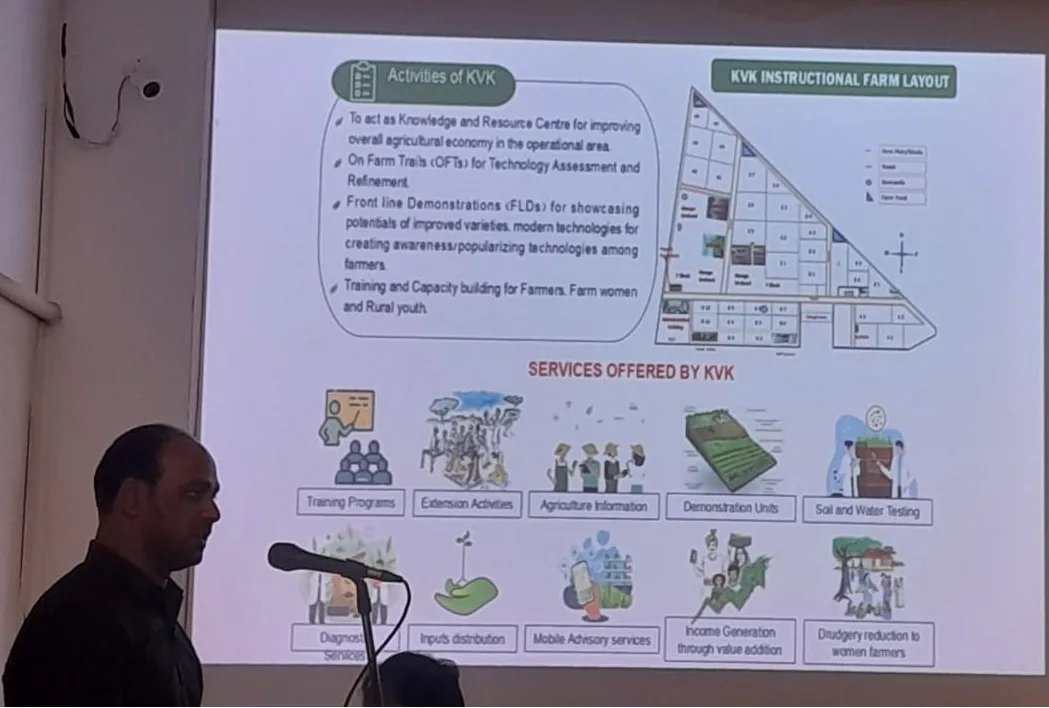
Speaking at the event, M. Srinivas, a horticulture scientist, highlighted the extensive activities and achievements of Krishi Vigyan Kendra (KVK) in Medak. Situated on 30 acres, this center is one of 731 KVKs nationwide and stands out for its pioneering organic farming practices, cultivating over 35–40 chemical-free crops, including fruits. It produces vermicompost, crafts organic soaps, and utilizes solar drying technology. Equipped with a world-class lab for virus-free testing, KVK Medak supplies produce to the Hyderabad market and serves as a nodal training center for cluster-based business models.
In an insightful address, Bhagayya ji, RSS Akhil Bharatiy Karyakarini sadasya, emphasized the urgent need for soil protection and a revival of Indian cow-based farming practices. He confidently stated that farmers could earn between ₹20,000 to ₹30,000 per month through sustainable and organic methods.

He emphasized successful initiatives by showcasing farmers in Nandurbar district, Maharashtra, who have successfully transitioned to organic cotton farming. He also highlighted inspiring success stories from various regions across the country, including Madhya Pradesh, Assam, Sikkim, and Gujarat, demonstrating the potential of organic practices in enhancing agricultural productivity and sustainability.
Furthermore, Bhagayya ji raised concerns about India’s heavy reliance on imported palm oil, costing the nation approximately ₹70,000 crores. He expressed concern over the homogenization of dietary habits, urging a return to diverse local oils suited to our varied terrains and food preferences.
He raised a strong concern about global market forces imposing their will on Indian farming practices, creating a dependency on foreign agricultural products and seeds. This external influence threatens the autonomy of Indian agriculture and undermines local methods and traditions that are essential for sustainable farming.
In line with PV Rao’s insights on reconnecting with traditional agricultural roots, he stressed the importance of educating farmers and society about sustainable practices. By leveraging local resources and ancestral knowledge, we can promote food sovereignty and bolster environmental sustainability, ultimately cultivating a resilient agricultural ecosystem. Bhagayya ji’s message serves as a clarion call for a return to our roots, ensuring that agriculture thrives in harmony with nature.
The media interaction was attended by journalists from various media outlets. The KVK team was led by PV Rao, Chairman of Eklavya Grameena Vikas Foundation, along with Dr. Sambhaji Dattatreya Nalkar, Senior Scientist and Head of Krishi Vigyan Kendra, Medak; Rama Chandra Murthy, Scientist at EGVF; P Ravi, Scientist in Plant Protection; M Srikanth, Scientist in Agriculture Extension; and V Srinivas, CEO of EGVF. Other participants also contributed to the event.