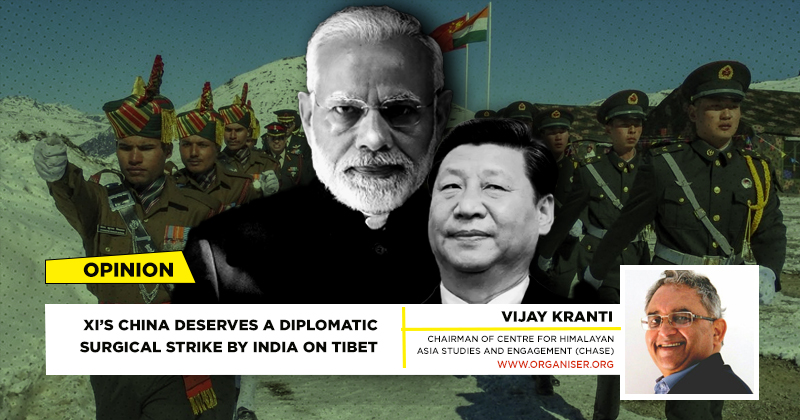
Beijing’s aggressive reaction against Prime Minister Narendra Modi’s visit to India’s north-eastern state of Arunachal Pradesh for the inauguration of a strategically important road tunnel at Sela Pass on March 9 was no less intense and bullying than China’s earlier reactions on similar occasions in the past. Hence, it was not very surprising, though shocking, for the common Indians. But what is surprising is the defensive response of the Modi government that had otherwise earned a different image and expectations after India’s aggressive and decisive response to Pakistan in Balakot and across the LOC in Jammu & Kashmir.
New Delhi’s verbose and oft-repeated reaction to China’s aggressive and humiliating assertion has disappointed those who are watching India’s foreign policy achieve new heights under the Modi government. They see it as just a replay of what is generally termed a docile, timid and self-evasive ‘Nehruvian’ response, which BJP and its leaders have always scoffed at. Trying to dismiss China’s claims over Arunachal Pradesh, the MEA statement from New Delhi on March 12 looks like a copy-past exercise. This time, it reads that China’s claims “will not change the reality that the State of Arunachal Pradesh was, is, and will always be an integral and inalienable part of India”. In his media briefing, the Indian spokesman once again tried to assure the nation by saying, “The Chinese side has been made aware of this consistent position on several occasions.”
This MEA’s statement is in no way different from what it had said when Beijing challenged all similar visits by other Indian leaders like Home Minister Amit Shah in April 2023, PM Dr. Manmohan Singh in October 2009, USA’s New Delhi-based Ambassador’s visit in November 2023; Dalai Lama’s visit in April 2017 or China’s other humiliating acts like assigning Chinese names to more than 11 Indian cities and towns of Arunachal in 2017 and 2023. In July last year, China again issued stapled visas to Indian athletes from Arunachal and Jammu & Kashmir for participation in the Asian Games, saying that it does not recognize J&K as a part of India and that the Arunachal visitors don’t need a Chinese visa as they are ‘Chinese’ citizens.
An ordinary Indian today has come to realize that Xi Jinping’s ever-increasing assertion on claiming Arunachal as a ‘part of China’ and his open challenge to the authority and right of the Indian PM even against entering a State of his own country amounts to a far more aggressive act than Pakistan’s open support to separatism and terrorist acts at Pathankot, Uri and Pulwama.
Looking back into the history of India-China relations, one will be amused to notice that neither the tendency of Chinese aggression and advances on Indian soil has changed over the past seven decades, nor there is a change in India’s defensive and half-hearted, rather apologetic tone against the Chinese manoeuvres. For example, soon after occupying Tibet in 1950-51, China quietly grabbed about 38,000 sq km of Indian land of Aksai Chin in upper Ladakh. When the Indian Foreign Secretary brought this to the notice of PM Pandit Jawahar Lal Nehru, he was furious. He instructed the FS to send a strong letter of protest to Peking (i.e. today’s ‘Beijing’). However, only a few hours later, Nehru called him back and asked him to hold it, saying he would talk to Chinese PM Zou Enlai.
But it never happened. It was only in September 1957, when China inaugurated the 1200 km long stretch of G-219 highway through Aksai Chin and invited the Indian Ambassador in Peking to attend the ceremony, that the Nehru Government got furious. Even then, the official reaction from New Delhi was limited to the question: how did Chinese labour enter this Indian region without an Indian visa?
In the next five years, China developed Tibet into a military foothold and used the Tibetan land as its launch pad to attack an unprepared and unsuspecting India in October 1962. However, despite suffering a humiliating defeat in this attack from China, India has perpetually failed to realize that it is only illegally occupying Tibet, which is the real fountainhead of all aggression and territorial troubles for India from Beijing rulers. Indian security agencies have confirmed once and again that China has been using the occupied Tibetan land for training, sheltering and supplying arms, money and drugs to a host of anti-India terrorist and separatist groups like the Naxalites, Nagas. Mizos etc.
The latest Chinese danger, looming large from across the Indo-Tibetan borders, is President Xi Jinping’s campaign to occupy the religious institution of reincarnation of Tibetan Buddhism. His real aim is to install the next, i.e., the 15th Dalai Lama, as a Chinese puppet after the demise of the current ageing 14th Dalai Lama. This exiled religious ruler of Tibet has been living in India since 1959, when China violently crushed the Tibetan people’s uprising against its colonial rule, and the 25-year-old Dalai Lama had to escape to India to save his life. Understanding the fallout of this move of Xi Jinping, the US Congress, despite a serious clash of opinion and policies among the warring Democrats and Republicans, has passed a near-unanimous bi-partisan constitutional amendment which makes it obligatory for all future Presidents and governments of the USA to take effective action against Chinese government to stop it from usurping the institution of Dalai Lama.
Unfortunately, total silence and indifference on the part of New Delhi make one believe that the Indian Government is oblivious to the severe consequences of Xi’s designs for India’s national integrity and sovereignty. The fact remains that the supreme religious root-temples and root-Gurus of almost all Buddhist traditions of Indian Himalayas, Nepal and Bhutan today lie inside Chinese occupied Tibet. A situation in which a puppet Dalai Lama and other incarnate root Gurus would act on Beijing’s diktats holds seeds of imminent havoc falling upon the entire 4000-long Himalayan belt for all these three countries. This single development can convert today’s Ladakh, Himachal, Uttarakhand, Sikkim and Arunachal from India’s ‘first line of defence’ to porous floodgates of sabotage and rebellion against India’s sovereignty and territorial integrity.
This surely calls for a qualitative change in the Indian Government’s approach towards the Dalai Lama and the overall issue of Tibet. Sadly, right from the day the Chinese PLA marched into Tibet in 1950 to walk over to India’s borders and subsequent signing away of Tibet by New Delhi as ‘China’s Autonomous Region’ through its much-hyped ‘Panchsheel’ Agreement of 1954, all Indian governments have been handling Dalai Lama and the issue of occupied Tibet as a liability rather than an asset in their dealings with Beijing. With consistent use of Tibet as an anti-India launch pad and Xi’s claims on Arunachal as ‘Southern Tibet’, New Delhi must have by now realized that the natural source of trouble from China for India is the former’s colonial control and presence in Tibet. Unless India starts contesting and challenging China’s illegal occupation of Tibet, New Delhi cannot hope for any end to the Chinese aggression.
It may not be easy for India to take any military action against today’s mighty and rogue China. But the policymakers in New Delhi can surely use some fine surgical tools of diplomacy and international politics by taking some decisive baby steps like standing by the Dalai Lama on the issue of his reincarnation, honouring him with India’s highest civilian award, ‘Bharat Ratna’ (as in the cases of other foreigners like Mother Teresa, Nelson Mandela and Khan Abdul Gaffar Khan); and bestowing a more respectful status to Dalai Lama’s Dharamshala ‘Central Tibetan Administration’ as compared to its present ‘NGO’ like status in India. Taken one after another in a staggered manner, such steps are bound to force Xi and his communist establishment to shift from their aggressive gear to a defensive one. But that can happen only if the Modi government decides to show the courage of undertaking a diplomatic surgical strike in the same way as it did on the war front with Pakistan in Balakot and Uri.