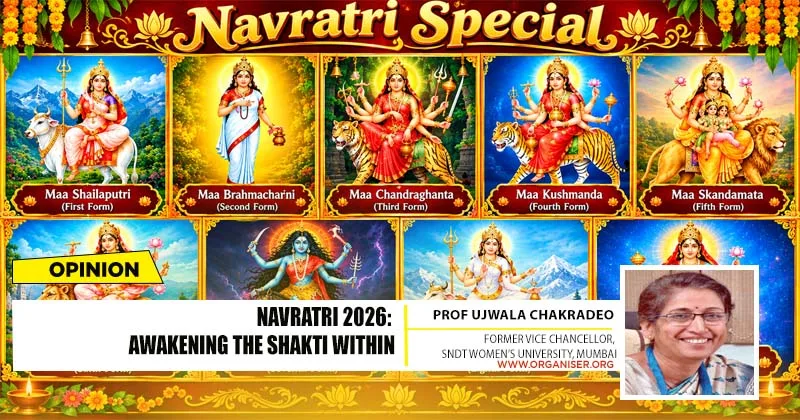
Navratri is far more than a festival of ceremonies, decorations, music, and celebrations. It is a cultural and spiritual reminder of the everlasting power of Shakti, the divine feminine spirit that nurtures, protects, and transforms the world. For thousands of years, Bharatiya civilisation has valued womanhood not merely as a manifestation of creative energy.
The word Shakti itself signifies power, strength, energy, and capability. In the Bharatiya worldview, femininity is not secondary to masculinity; rather, it is the very force that enables creation, preservation and transformation. The universe is always in a harmonious relationship between Purusha (consciousness) and Prakriti (creative energy). Without Shakti, even the highest consciousness remains inactive. Therefore, Navratri is a celebration of this feminine energy that resides in nature, society, and within every individual.
Woman As Shakti
Since ancient times, women have been revered in Bharatiya sanskriti as personifications of strength, wisdom, compassion, creativity, and flexibility. She is celebrated as a mother, teacher, nurturer, creator, protector, and guide. Her tenderness is not a sign of weakness; rather, it is one of her greatest strengths. She possesses the unique ability to love deeply, care selflessly, and protect fiercely when circumstances demand.
The feminine spirit is honoured through numerous manifestations of the Devi, including Saraswati, Lakshmi, Durga, Kali, Parvati, Annapurna, and countless forms worshipped across Bharat. Temples dedicated to these divine forms are spread throughout the land, from Sharada Peeth in the north to Kanyakumari in the south, and from Kamakhya in the east to Hinglaj in the west. This vast network of sacred sites reflects the deep respect given to the feminine spirit by Bharatiya people. These mandirs are not merely places of worship; they stand as reminders that feminine power has always been significant in the spiritual imagination of Bharat.
Seven Divine Qualities
One of the most relevant descriptions of feminine power is found in the Bhagavad Gita. In Chapter 10, Verse 34, Bhagwan Sri Krishna states the seven noble qualities of femininity, “Kirtih Shrirvaak cha Naarinaam Smrutirmedhaa Dhrutih Kshama” meaning, among women, I am fame, prosperity, speech, memory, intelligence, steadfastness, and forgiveness.
Navratri remains one of the most meaningful festivals of Bharat because it celebrates values that are eternal. It reminds society to honour women, respect nature, develop inner strength, & uphold righteousness
Kirti (Fame or Glory) – the ability to inspire, Shri (Prosperity and Grace) – abundance and auspiciousness, Vak (Speech) – communication and wisdom expressed through words, Smriti (Memory) – the protection of knowledge, sanskriti, and tradition, Medha (Intelligence) – power of discernment, Dhriti (Steadfastness) – courage and perseverance, and Kshama (Forgiveness) – compassion and the strength to rise above bitterness.
The woman who embodies these virtues becomes a source of harmony and inspiration for her family, society, the nation and herself.
The Ardhanarishvara Principle
Ardhanarishvara symbolises the inseparable nature of Purusha and Prakriti. This philosophy conveys a timeless truth: neither masculine nor feminine energy is complete in isolation. Both possess unique roles and strengths, and together they create balance, harmony, and continuity in the cosmos. Ardhanarishvara is therefore not merely a devotional image but a philosophical statement about equality, interdependence, and mutual respect.
Prakriti As Shakti
Bharatiya sanskriti has long perceived nature itself as feminine. Mountains, rivers, forests, caves, and the earth are revered as manifestations of the Divine Mother. The nurturing and life-giving qualities observed in nature are reproduced in the feminine spirit. The concept of Prakriti has a central place in Bharatiya philosophy. Prakriti represents activity, diversity, creativity, and interconnectedness. The relationship between Purusha and Prakriti forms the foundation of Bharatiya environmental thought, highlighting the unity between human beings and the nature. Women, through their roles as nurturers and sustainers of life, naturally symbolise this connection.
Many Forms
Shakti is manifested in diverse forms. As Saraswati, she is wisdom, learning, creativity, literature, music, and the arts. She grants the ability to understand the Shastras, appreciate beauty and create something new. Knowledge becomes a form of power, and learning becomes a pathway to liberation. As Lakshmi, she represents prosperity, harmony, dignity, and well-being. As Durga, she symbolises courage, righteousness, and protection. She challenges injustice and reinstates balance. As Mahakali, she is fierce determination and the destruction of evil. When adharma prevails, the protective and transformative power of Kali emerges.
Thus, a woman’s strength is multidimensional. She may be gentle yet fearless, compassionate yet firm, forgiving yet capable of punishing when necessary. The same person who nurtures and supports others can become a protector when circumstances demand.
Inner Strength
In current times, issues of women’s safety and empowerment focus on external actions. While social support and legal protections remain vital, Bharatiya wisdom also highlights the importance of awakening inner strength. A woman who recognises her inherent dignity, capabilities, and divine nature develops confidence and self-respect. She becomes aware that she is not helpless. The spirit of Durga, Kali, Saraswati and Lakshmi resides within her. This does not mean that society is relieved of its responsibility to ensure safety and justice. Rather, it highlights an equally important truth: empowerment begins with self-awareness. When women become conscious of their inner strength, knowledge, courage, and resilience, they are better equipped to face challenges, take appropriate decisions, and stand firmly against injustice.
The message of Navratri is therefore not merely to worship the Goddess in temples but to recognise the Goddess within.
Shakti Today
Navratri remains one of the most meaningful festivals of Bharat because it celebrates values that are eternal. It reminds society to honour women, respect nature, develop inner strength, and uphold righteousness. It is a journey from ignorance to wisdom, weakness to strength, and fear to courage. The dormant Shakti within can be awakened through worship and devotion.
The true message of Navratri therefore is to recognise, honour, and awaken this Shakti within women, within society, and within ourselves. When that inner power is realised, it becomes a source of confidence, dignity, protection, and transformation
The Bhagavad Gita highlights seven divine qualities of womanhood. The philosophy of Ardhanarishvara affirms the complementary and inseparable nature of masculine and feminine energies. A woman is strong, beautiful, compassionate, intelligent, and courageous. She is Saraswati when she learns and creates, Lakshmi when she nurtures prosperity, Durga when she protects, and Kali when she confronts injustice.
The true message of Navratri therefore is to recognise, honour, and awaken this Shakti within women, within society, and within ourselves. When that inner power is realised, it becomes a source of confidence, dignity, protection, and transformation. In celebrating the Goddess, we celebrate the limitless potential of womanhood and the eternal power of Shakti.