CCP tracks faith across China, maps Christians & Muslims
August 15, 2026
  • Read Ecopy
  • Circulation
  • Advertise
  • Careers
  • About Us
  • Contact Us
Android AppiPhone AppArattai
Organiser
  • ‌
  • Bharat
    • Assam
    • Bihar
    • Chhattisgarh
    • Jharkhand
    • Maharashtra
    • View All States
  • World
    • Asia
    • Europe
    • North America
    • South America
    • Africa
    • Australia
  • Editorial
  • International
  • Opinion
  • RSS @ 100
  • More
    • Op Sindoor
    • Analysis
    • Sports
    • Defence
    • Politics
    • Business
    • Economy
    • Culture
    • Special Report
    • Sci & Tech
    • Entertainment
    • G20
    • Azadi Ka Amrit Mahotsav
    • Vocal4Local
    • Web Stories
    • Education
    • Employment
    • Books
    • Interviews
    • Travel
    • Law
    • Health
    • Obituary
  • Subscribe
    • Subscribe Print Edition
    • Subscribe Ecopy
    • Read Ecopy
  • ‌
  • Bharat
    • Assam
    • Bihar
    • Chhattisgarh
    • Jharkhand
    • Maharashtra
    • View All States
  • World
    • Asia
    • Europe
    • North America
    • South America
    • Africa
    • Australia
  • Editorial
  • International
  • Opinion
  • RSS @ 100
  • More
    • Op Sindoor
    • Analysis
    • Sports
    • Defence
    • Politics
    • Business
    • Economy
    • Culture
    • Special Report
    • Sci & Tech
    • Entertainment
    • G20
    • Azadi Ka Amrit Mahotsav
    • Vocal4Local
    • Web Stories
    • Education
    • Employment
    • Books
    • Interviews
    • Travel
    • Law
    • Health
    • Obituary
  • Subscribe
    • Subscribe Print Edition
    • Subscribe Ecopy
    • Read Ecopy
Organiser
  • Home
  • Bharat
  • World
  • Operation Sindoor
  • Editorial
  • Analysis
  • Opinion
  • Culture
  • Defence
  • International Edition
  • RSS @ 100
  • Magazine
  • Read Ecopy
Home International Edition News

CCP tracks faith across China’s state system, mapping Christians, Muslims and others to guard party control

The CCP is expanding scrutiny of religious affiliation beyond places of worship into China’s hospitals and schools, mapping Christians, Muslims and other believers within the state system. The Chengdu drive offers a glimpse of how Beijing seeks to monitor faith as a potential political and administrative concern

Dr Vishnu AravindDr Vishnu Aravind
Aug 15, 2026, 06:00 pm IST
inNews, World, China, Asia, International Edition
Follow on Google News
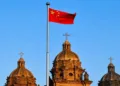
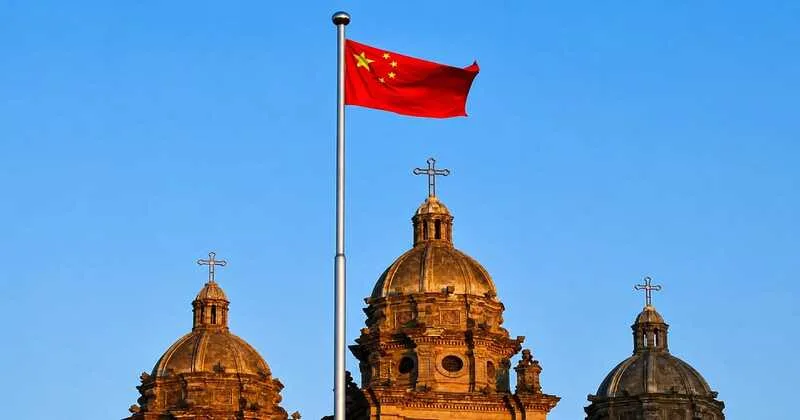
St. Joseph's Church, also known as Wangfujing Catholic Church, in Beijing, China.

St. Joseph's Church, also known as Wangfujing Catholic Church, in Beijing, China.

Facebook
Twitter
WhatsAppTelegramEmail

New Delhi: A religious-affiliation survey reportedly being conducted at a public hospital in Chengdu has brought fresh attention to the expanding scrutiny of personal faith in China, with employees, including permanent staff, contracted personnel and temporary workers, being required to disclose whether they practise a religion.

At the same time, education authorities in the southwestern Chinese city are reportedly collecting information about the religious backgrounds of students and their parents. Together, the measures indicate how monitoring of religious identity is extending beyond churches, mosques and other religious institutions into workplaces, schools and family records.

Hospital employees ordered to declare religious beliefs

An internal notice recently circulated on social media from a public hospital in Chengdu said the institution was conducting a comprehensive survey of employees’ religious beliefs as part of requirements for the “regular investigation of ideological, ethnic, and religious work”. The notice instructed the hospital to cover “every individual without leaving anyone out”, making the exercise applicable to the entire workforce rather than only those suspected of religious activity.

Read More: Youth are Bharat’s demographic dividend, must be properly guided today to build responsible next generation: Dr Bhagwat

Employees were required to provide the requested information and were warned against concealing or omitting relevant details. Designated personnel were tasked with collecting the information, which the notice said would be kept confidential. Workers who did not follow a religion were also required to register and select “no religious belief”, meaning that declaring an absence of religious affiliation was itself part of the mandatory exercise.

The notice further stated that members of the Chinese Communist Party (CCP) are not permitted to practise any religion. Employees who have religious affiliations were instructed to report the matter to their Party branch. Religious proselytising and religious activities were prohibited in the workplace, while the notice also warned that the information collected was “strictly prohibited” from being disseminated online.

The document does not state that employees would automatically face disciplinary action simply because they identify with a religion. Nevertheless, the requirement that every worker disclose his or her religious status, including those who have no faith, places religious belief within an institutional monitoring framework rather than treating it exclusively as a private matter.

Schools extend religious checks to students’ families

The reported scrutiny also extends into Chengdu’s education system. According to accounts cited in the reports, schools are investigating the religious affiliations of students and compiling statistics for submission to higher authorities. The information reportedly includes whether students or their family members practise Christianity, Islam or other religions.

The inclusion of parents is particularly significant because it expands the scope of scrutiny from an individual student to the religious background of the immediate family. One account said the education system conducts background checks on students’ families every year before new students enter school, with religious affiliation among the information collected.

This suggests that religious-background checks in Chengdu’s education system may not represent a one-time campaign but could form part of a recurring administrative process linked to the beginning of each academic year. The education system is also reported to maintain contact with the regime’s religious authorities.

The available accounts cannot independently establish how widely the hospital’s survey or the schools’ family investigations are being conducted elsewhere in China. Nor do they establish precisely how the information is ultimately used. But the reported practices provide a glimpse into how religious identity can become an administrative category within public-sector workplaces and educational institutions.

Religion as an issue of political and ideological control

The terminology used in the Chengdu hospital notice is significant. References to an “ideological” as well as “ethnic and religious” investigation reflect the CCP’s broader approach of placing religious affairs within political and ideological management. Under President Xi Jinping, the Party has strengthened its emphasis on leadership over religious affairs and promoted the policy commonly described as the “Sinicization of religion”, under which religious organisations are expected to conform to China’s political and cultural framework. Academic research has likewise documented the expansion of state supervision over religious communities under Xi.

In September 2025, Xi Jinping presided over the 22nd collective study session of the Political Bureau of the CCP Central Committee, devoted to systematically advancing the Sinicization of religions in China. He called for stronger institutional regulation, comprehensive governance and grassroots work, and said Party committees at all levels must strengthen leadership over religious affairs. Xi also called for religious doctrines, management systems, rituals and behavioural norms to reflect Chinese characteristics and adapt to the requirements of the socialist society.

The wider policy framework makes the Chengdu reports particularly noteworthy. Official Chinese statements describe religious affairs as an important component of state governance and emphasise law-based administration, tighter institutional mechanisms and Party leadership.

Accounts cited in the reports also suggest that restrictions on religious affiliation are not confined to Chengdu. Reports claimed that Shandong and Zhejiang prohibit civil servants from being Christians and alleged that those discovered to be believers can be forced to leave their jobs. The source also referred to a civil servant in Wenzhou, Zhejiang Province, who was reportedly dismissed for being a Christian several years ago, and alleged that participation in house-church gatherings can lead to prolonged harassment by state-security personnel.

The Chengdu hospital notice itself does not establish that such penalties are being applied there. What it does demonstrate is that the state is seeking systematic information about religious identity across a public institution, while similar investigations reportedly reach students and their parents. The combination of compulsory disclosure, ideological monitoring, restrictions on religious activity and Party rules against members practising religion illustrates the extent to which faith can be incorporated into China’s administrative and political surveillance structures.

Topics: Xi JinpingCCP
Dr Vishnu Aravind
Dr Vishnu Aravind
Dr Vishnu Aravind is a researcher, political commentator and writer based in New Delhi, with a PhD from Jawaharlal Nehru University (JNU). His areas of interest include international politics, Indian foreign policy, electoral politics, election analysis, political developments, and cultural affairs. [Read more]
Share
Tweet
SendShareSend
✮ Subscribe Organiser YouTube Channel. ✮
✮ Join Organiser's WhatsApp channel for Nationalist views beyond the news. ✮
Previous News

Tamil Nadu: Chidambaram Nataraja Temple continues tradition of hoisting Tricolour atop Rajagopuram on Independence Day

Next News

Two Asian Democracies, One Date: Why 15 August Belongs to India and Korea

Related News

Zhu Rongji’s passing revives memories of reform-era China and the 1989 Tiananmen protests, testing Beijing’s grip on public sentiment

China on Tiananmen Alert: Zhu’s death raises fear that public mourning could spark anti-Xi protests ahead of plenum

Former Politburo member Ma Xingrui

China expels Ma Xingrui in fresh politburo purge as Xi Jinping tightens grip amid mounting internal challenges

Floods, wage protests and expanding digital surveillance underscore Beijing's efforts to contain social unrest and suppress public dissent

China tightens online surveillance and censorship as floods, economic distress and labour unrest fuel dissent

As India expands its global partnerships, China grapples with growing political, military and economic challenges

Coup Fears in China? Why President Xi staying home while PM Modi expands India’s global diplomatic footprint?

CCP tightens grip on China's state-controlled Catholic church

Bible and Xi: China’s new mandate makes president’s speeches mandatory study in Catholic Churches

President Xi Jinping's loyalty drive and military purges deepen uncertainty within China's PLA leadership

China’s Deepening PLA Crisis: Xi expands purges with loyalty tests to crush dissent among top generals

Load More

Latest News

India’s journey from Swadhinta to Swatantrata begins with decolonising minds and embracing Bharatiya values (This image is generated by AI)

Decolonising the Mind: How citizens can embrace Bharatiya languages, traditions & values to realise absolute freedom

Two Asian Democracies, One Date: Why 15 August Belongs to India and Korea

Two Asian Democracies, One Date: Why 15 August Belongs to India and Korea

St. Joseph's Church, also known as Wangfujing Catholic Church, in Beijing, China.

CCP tracks faith across China’s state system, mapping Christians, Muslims and others to guard party control

Tamil Nadu: Chidambaram Nataraja Temple continues tradition of hoisting Tricolour atop Rajagopuram on Independence Day

Odisha | Partition Horrors Remembrance Day: Recalling 1947 vital to prevent repetition of history, Says Prafulla Ketkar

Bharat’s decolonization continues, requiring deeper reforms beyond colonial institutions and inherited systems (This image is generated by AI)

Beyond Symbolism: Why Bharat’s decolonisation journey needs deeper institutional, intellectual and cultural reforms

Bharat’s journey from ancient prosperity to colonial exploitation was marked by political upheaval, social disruption and economic decline (This image is generated by AI)

Bharat’s Historical Journey: Ancient prosperity, colonial exploitation and social disruption

Keralam: SFI stages mock funeral of Sanskrit University VC Ciza Thomas, highlights pattern of intimidation of faculty

What the World Could Learn from India's Democracy

What the World Could Learn from India’s Democracy

Bharat’s decolonization is reshaping laws, education and culture while reclaiming its civilisational identity (This image is generated by AI)

Decolonising Bharat: How legal, educational and cultural reforms are reclaiming India’s indigenous identity

Load More
  • Privacy
  • Terms
  • Cookie Policy
  • Refund and Cancellation
  • Delivery and Shipping

© Bharat Prakashan (Delhi) Limited.
Tech-enabled by Ananthapuri Technologies

  • Home
  • Search Organiser
  • Bharat
    • Assam
    • Bihar
    • Chhattisgarh
    • Jharkhand
    • Maharashtra
    • View All States
  • World
    • Asia
    • Africa
    • North America
    • South America
    • Europe
    • Australia
  • Editorial
  • Operation Sindoor
  • Opinion
  • Analysis
  • Defence
  • Culture
  • Sports
  • Business
  • RSS @ 100
  • Entertainment
  • More ..
    • Sci & Tech
    • Vocal4Local
    • Special Report
    • Education
    • Employment
    • Books
    • Interviews
    • Travel
    • Health
    • Politics
    • Law
    • Economy
    • Obituary
  • Subscribe Magazine
  • Read Ecopy
  • Advertise
  • Circulation
  • Careers
  • About Us
  • Contact Us
  • Policies & Terms
    • Privacy Policy
    • Cookie Policy
    • Refund and Cancellation
    • Terms of Use

© Bharat Prakashan (Delhi) Limited.
Tech-enabled by Ananthapuri Technologies