Every generation produces its own historical anxious about fragility of democracy. It’s said that Institutions are hollowing out, publics are retreating inward, and nationalism is treated, almost by reflex, as democracy’s opposite number, the force that swallows pluralism whole. India adds complexity to the narrative, and it has been complicating it for nearly eight decades. It is a country of more than 1.4 billion people, hundreds of languages, every major world religion, and a complex societal system that predates the nation-state itself, and it has governed all of that difference not by suppressing it but by building a constitutional order designed to hold it. Cultural amalgamation spanning many centuries, dating to the civilizational era, has left many social scientists bewildered. That is not a small achievement. It is arguably the single most underexamined data point in the global conversation about whether democracy can survive scale and diversity at once.
The two questions has been asked through — why the world might learn democracy from India, and why cultural nationalism matters to that story — are not separate questions. They are the same question asked from two directions. India’s democratic durability cannot be explained without its particular form of nationalism, a civilisational and constitutional nationalism built around shared cultural values rather than an identity driven ethnicity, language, or creed. And that form of nationalism cannot be understood without the democracy that gives it its content. Not just after 1947, they grew up together, through a decade marked by haste, improvisation, and sometimes disagreement. Here, the ethos of Ram Rajya found its way into society, and their relationship has only deepened since.
A Democracy Built Against the Odds
In 1950, when India adopted universal adult suffrage, the most of Western scholars was in believe that this system would not endure. The argument has phrased the time that in western parameters of stable democracy required a threshold of literacy, income, and cultural homogeneity that conspicuously won’t fit as nation state India. It was, by most western prism standards used at the time, the least likely large democracy on earth: a colonized, partitioned, overwhelmingly rural country with a literacy rate under twenty percent, hundreds of princely states to absorb, and a partition-driven refugee crisis that had already killed hundreds of thousands and displaced tens of millions. Political scientists coined theories of modernization that all but predicted India’s democracy would collapse into military rule or fracture into secessionist civil war within a generation. The contours of India as a nation won’t be able to define, the whole construct of this nation was based on its cultural civilisational ethos of society which makes it a nation. Even after the partition thrown on us by western political theories of nation defined, it has not only grown bigger, deeper but also now example for other democracies in the world.
It did neither. Since 1951, India has held eighteen general elections and hundreds of state elections, all under civilian constitutional authority, with a single eighteen-month interruption during the 1975–77 Emergency, a black spot on Indian democracy, an episode notable less for having happened than for how it ended: at the ballot box, when voters removed the government that had suspended their rights, the moment democracy was restored to them. That single data point deserves more attention than it gets. Democracies do not only prove themselves by never faltering; they prove themselves by how they recover.
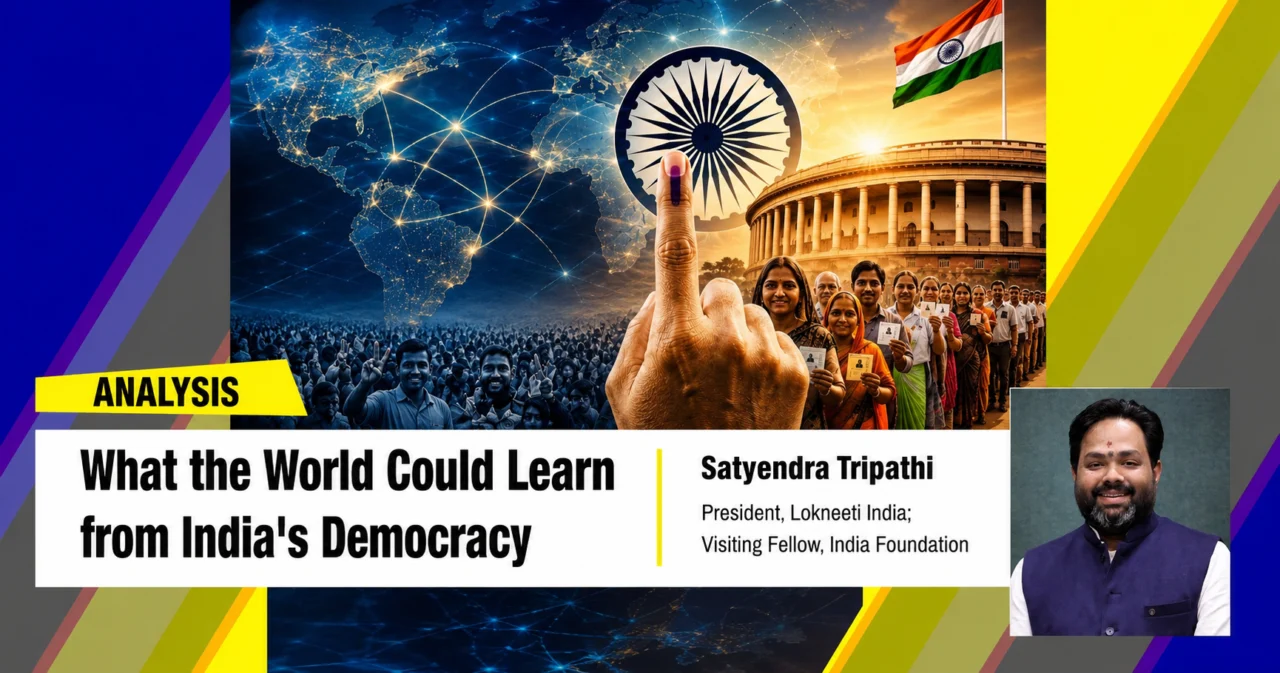
Scale alone would make India’s democracy noteworthy. In order to ensure that no citizen’s vote would be influenced by their location, the recent 2024 general election involved nearly a billion eligible voters, more than a million polling stations, and a logistical operation that included dispatching election of officials by boat and on foot to reach villages of a single family in the Himalayas and the Rann of Kutch. No other democracy in history has organized an exercise of this size. However, the intriguing aspect is not scale. The intriguing thing is that this scale has been sustained without the support of a common language, a common religion, or a common ethnic identity — the three components that most theories of nationhood, starting from Herder onward, originally treated as prerequisites for a functioning nation-state.
Nationalism Without a Single Story
This is where nationalism enters into the picture, and where India’s version of it diverges most sharply from the western construct of nationalisms now resurgent elsewhere. The nationalism that has driven India’s cohesion is not ethnic, linguistic, or religious, it’s in Dharmic Civilisational philosophical construct. It is, in its founding conception, constitutional, an allegiance to a shared societal rather than to a shared bloodline or creed. Gandhi during freedom struggle have said many times that India’s constitutional restructuring should be based on the principals of Ram Rajya; a moral values based justice, equality and truth which has been core of the society since ages. Philosophy of togetherness in India has been, and never asked to speak one language, worship one god, or trace descent from one people in order to belong to the nation. Revered Adi Shankaracharya in 8th century talked about the philosophy of Oneness, travelled in the veins of this nation. They are not only bind to a common constitutional arrangement: the Republic, its courts, its elections, its fundamental rights but too this ‘Oneness’. That is a strikingly thin definition of nationhood by global historical standards, and it is precisely its thinness that has let it stretch over so much difference.
Contrast this with the nationalism ascendant in much of the world today, in which the nation is imagined as coextensive with a single ethnic majority, a single language, or a single religious identity, and where difference is treated as something to be assimilated, tolerated at the margins, or expelled. That model of nationalism has driven partitions, civil wars, and the slow erosion of minority rights across multiple continents in the past two decades. India’s founding generation —Nehru, Rau, Patel, Ambedkar, and the framers who sat in the Constituent Assembly through 1946 to 1949 — deliberately rejected that model, not out of sentimentality but out of necessity tracing back its civilisational ethos. A country freshly partitioned along religious lines, having just witnessed what an ethnically or religiously defined nationhood does to a shared subcontinent, chose instead to build a republic whose nationalism was procedural: built from rights, elections, and institutions rather than from religious identity.
“We are building a nation which is going to be a democratic country… We do not want a Hindu or a
Muslim India, but a strong free India in which all communities live in perfect harmony.”
JAWAHARLAL NEHRU, CONSTITUENT ASSEMBLY, 1949
This is not to romanticize the record. India’s civilisational nationalism has been contested from its first day and remains contested now; the apprehension between the parties on appeasement has been into the core of constitutional idea of the nation which is the idea of Indian societal ethos one runs through Indian politics in every decade. But the durability of the idea of coexistence, its persistence as the framework courts, oppositions, and civil society continue to invoke and defend, even amid real strain, is itself the lesson. A nationalism organized around shared civilisational value rather than shared identity has proven exible enough to survive sixteen prime ministers, a dozen major regional secessionist movements, and religious, caste, and linguistic fault lines that would have fractured a nation defined more narrowly.
A Civilisational Thread Beneath the Constitution
Civic nationalism ethos explains in India’s institutions, but it cannot alone explain why so vast and diverse population accepted those institutions as its own from the very beginning. Beneath the constitutional argument flows a much older, civilisational one. India is not merely a geographical state that formed in 1947; it is a living cultural space that long predates it – a shared reservoir of epic literature, pilgrimage routes, philosophical schools, and ritual calendars that has linked Kashmir to Kanyakumari, and Gujarat to Assam, for millennia, well before any modern border was drawn. A Tamil devotee reciting verses composed in Sanskrit, a Bengali festival calendar built around the same lunar cycle observed in Rajasthan, a river worshipped from its Himalayan source to its delta a thousand miles away, these are not the product of the modern nation-state. They are what the modern nation-state inherited.
This civilisational continuity is what gives Indian nationalism a second register beneath its civic one: a cultural nationalism rooted in the idea of Bharat as a living inheritance rather than an administrative convenience. It is why national symbols reach backward past 1947, to Ashoka’s lion capital, to classical texts, to temple towns and river ports that have drawn pilgrims across every dynasty and empire that ever ruled parts of the subcontinent. The nation, in this sense, did not have to be invented from nothing in the twentieth century; it had to be recognized, and given a constitutional home.
The tension worth naming, honestly, is that this civilisational thread can be told two ways. Told expansively, as a shared inheritance available to every Indian regardless of faith or region, it reinforces the same the Constitution codifies, a cultural unity broad enough to include a oldest church of Kerala, a communities of Rajasthan, and a symbol of faith Sikhs in Punjab gurdwara as equally native to the civilisation, not exceptions to it. Told narrowly, as the property of one community alone, it curdles into the majoritarianism the framers explicitly wrote the Constitution to guard against. The healthier version of Indian nationalism, the one that best explains its durability, is the expansive one: cultural heritage as a shared foundation, civic law as the shared roof.
Union-State as the Engine of Unity
The mechanism that has let India’s nationalism absorb so much different identities, culture, believes, faith is not just constitutional structure but it is tenderness too. India is a federal union of twenty-eight states and eight union territories, most drawn along linguistic lines after independence, a decision that, at the time, many worried would fracture the country by giving each language its own political base. It did the opposite. By granting linguistic communities real political homes within the union, their own state governments, their own official languages, their own legislatures, India converted into cultural unity what could have been separatist grievances into ordinary federal politics. A Tamil speaker and a Bengali speaker do not need to share a language to share a passport; they need a state government that answers to them and a national government that shares power with it.
This federal architecture extends into religion and personal law as well, however imperfectly. The definition of secularism in India is not the strict church-state separation of the French model; it is inheritance into its cultural ethos to what scholars call “principled distance,” in which the state engages with all religious communities rather than none, accommodating everyone rather than guiding religious believes in public life. It’s acceptability is more negotiated secularism than the European template, and it has helped to convince the misreading, over personal law, over religious conversion, over the treatment of minorities. It has now only allowed India to avoid the trap of state enforced religious homogeneity in a country where doing so would have meant enforcing the majority faith on nearly two hundred million people who do not practice it, it has become home for prosecuted minorities globally.
A Caution Complacency, and a Case for Attention
India offers a finished model to be exampled to the world. Its judicial system has shown always a guiding light to democracy whenever it curtails by authoritarian powers over decade. Pending cases lies in Indian courts giving depression to appellants as famously said ‘Justice delayed is Justice denied’. Another pillar of democracy, the Press, has become voice of unheard voices since freedom struggle India. Even the press freedom had compromised during Emergency, it has stood against all odds. Religious communal violence has history since partition, and the appeasement politics over the years has not only defeated the ethos of the constitution and it tried to design against remains a live current in Indian politics, not a defeated one. Any honest account of Indian democracy has to hold the achievement and the strain in the same frame; the two are not in cohesion, but they learn from the same story. What makes India worth studying is not that it has solved the problem of governing difference. It is that it has kept trying, in public, under electoral pressure, for seventy-eight consecutive years, without ever concluding that the problem was better solved by force.
That is the part the rest of the world is increasingly short on. Across established democracies, the temptation to simplify, to imagine a nation would function better with less internal difference, fewer languages, one faith, one story, has been rising, not falling. India’s example argues, empirically rather than philosophically, that the opposite bet has also worked: that a nation can hold together, and hold elections, and hold rights, precisely by refusing to make itself simpler than the people who live in it.
India did not become a democracy by first becoming homogeneous. It became a democracy by building institutions large enough to hold a country that never would be.
What Transfers, and What Does Not
The specific instruments are not universally exportable, India’s linguistic states, its particular federal bargains, its Election Commission, its reservation system for the representation of marginalized castes, were all built to answer India’s own history and cannot simply be copied onto another country’s geographical map. But three underlying principles travel further than the instruments themselves.
The first is that national identity and cultural uniformity are inseparable. A country does not need one language or one religion to have one citizenship, provided its institutions are designed from the outset to represent difference rather than paper over it. The second is that federal structures, not merely central tolerance, are what let diversity coexist with unity, devolving real power to sub-national communities converts identity politics into ordinary governance model. The third is that democratic resilience is tested most, and proven most, in recovery: a democracy is not measured by whether it is ever threatened, but by whether it corrects course when it is, as India did in 1977 and has had to do, in smaller ways, many times since.
The Argument, Restated
The world does not need to learn democracy from India neither India wanted to do so because India has perfected it. India needs to pay more attention because India is running, at a scale no other country has attempted nor they can, the experiment most other democracies are only now being forced to confront: whether a nation can remain one thing while its people remain many things. The answer India offers to the world, provisional and contested as it is, is that nationalism does not have to mean sameness. It can mean a shared cultural values and commitment to the argument itself, to the elections, the courts, and the Constitution that let a Punjabi farmer, a Malayali fisherman, a Marwari trader, and a Naga student all call the same country home without any of them having to stop being who they are. Even become home for those who prosecuted globally likes Jews, Parsis, Ismailis.
That is a harder nationalism to build on ground on national interest than the kind organized around a single ag-bearing identity. It offers no slogging and no shortcut to unity. It is continuum efforts of culturally engagement and unite them on one ‘nation first’. But it has now outlasted every prediction made against it, and in a world increasingly persuaded that difference is a problem to be solved rather than a condition to be governed, India’s stubborn, imperfect, still-unfinished example is worth more study than it currently receives.