Beijing: China is watching the public mood surrounding the death of former Premier Zhu Rongji with unusual political sensitivity. The 97-year-old reform-era leader died in Beijing on August 12, just as the Communist Party of China (CCP) enters a politically important period leading to the Fifth Plenum in October and the annual Beidaihe retreat of senior leaders.
Analysts quoted in recent reports say the immediate concern is not Zhu’s death itself, but whether public mourning could become a channel for wider dissatisfaction with the present political and economic order. That concern has a distinctly Chinese historical echo. In 1989, mourning for former CCP leader Hu Yaobang developed into a much larger protest movement, eventually culminating in the Tiananmen Square crackdown.
Zhu is a very different political figure and there is no reported evidence that his death is automatically producing a comparable movement. Yet his reputation as an outspoken economic reformer, combined with growing debate about China’s economic direction and Xi Jinping’s concentration of power, makes his death politically sensitive.
The possibility is therefore less about a repeat of history in exact form and more about the fear of an unpredictable public mobilisation. In a political system that tightly controls spontaneous gatherings, even a funeral, memorial ceremony or online discussion can acquire significance if citizens use it to express frustrations that cannot easily be voiced through conventional political channels.
A reform-era figure dies as Beijing enters a sensitive political season
Zhu Rongji died in Beijing on August 12, 2026, at the age of 97, according to Chinese state media. He served as China’s vice premier from 1991 to 1998 and as premier from 1998 to 2003 under President Jiang Zemin. He became one of the most influential economic policymakers of the reform era, known for his blunt manner, anti-corruption stance and willingness to impose painful economic changes.
As premier, Zhu reportedly pushed major restructuring of state-owned enterprises, reforms of China’s financial and fiscal systems and measures to control inflation. His policies contributed to large-scale layoffs in state enterprises but were also credited with improving efficiency and creating conditions for faster economic growth. His most internationally significant achievement was helping negotiate China’s entry into the World Trade Organisation in 2001, a landmark that accelerated the country’s integration into the global economy.
Former Chinese premier Zhu Rongji died of illness at the age of 98 in Beijing at 11:06 am Wednesday. https://t.co/RkCSyI5YGz pic.twitter.com/uHN6LKUDCi
— China Daily (@ChinaDaily) August 12, 2026
Zhu’s economic legacy is particularly interesting at a time when China is struggling with some of the structural problems associated with the model that followed the reform boom. Property-sector weakness, local-government debt, subdued domestic demand and pressure to rebalance the economy have renewed debate over the sustainability of China’s growth strategy.
Zhu nevertheless occupies a distinctive place in the political memory of modern China. He was regarded as a pragmatic reformer rather than a champion of political liberalisation. His legacy was economic transformation within the Communist Party system, not an attempt to dismantle that system. The Guardian notes that, despite being compared by some with reformist figures abroad, Zhu remained committed to CCP rule.
It is precisely this reform-era image that gives his death potential political resonance. Reports cited by various media say some analysts believe public mourning for Zhu could become a symbolic outlet for dissatisfaction with current political and economic conditions.
The Hu Yaobang precedent that still haunts Beijing
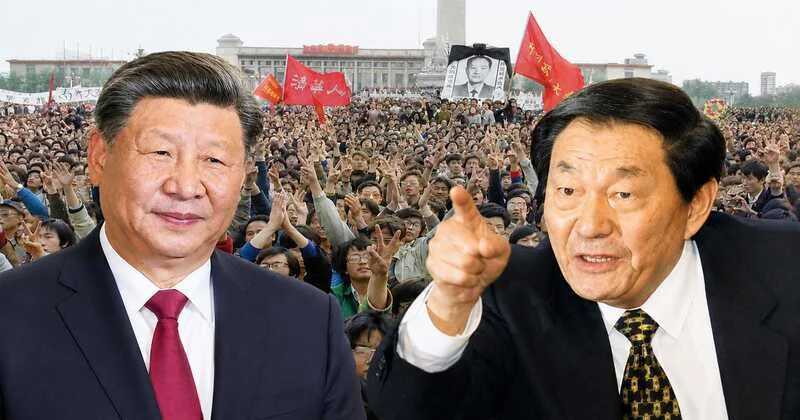
The CCP has particular reason to remember what happened after Hu Yaobang died on April 15, 1989. Hu, a former party general secretary associated with political and economic reform, had been removed from his post in 1987 after coming under criticism from party conservatives. His death prompted students in Beijing to gather to mourn him. What began as commemoration soon expanded into demands concerning corruption, political reform, press freedom and democracy.
By April 17, students had begun gathering at Tiananmen Square. Thousands assembled, and the demonstrations grew rapidly. By April 21, about 100,000 students marched towards Tiananmen Square despite instructions that the area would be closed for Hu’s memorial service. The movement subsequently expanded beyond Beijing and drew workers and other sections of society into protests.
The authorities declared martial law on May 20. The crisis culminated on June 3 and 4, when Chinese troops and tanks moved against demonstrators in Beijing. Hundreds, and possibly thousands, were killed, although the precise death toll remains disputed. The crackdown remains one of the most tightly censored episodes in modern Chinese history.
The lesson for the CCP was unmistakable that a public commemoration surrounding a senior political figure can become a vehicle for much wider grievances. That history helps explain why the party remains extremely wary of spontaneous public gatherings, particularly when political dissatisfaction, economic concerns and nostalgia for an earlier era intersect.
The sensitivity has continued into the Xi era. In 2026, Chinese authorities again tightened controls around the anniversary of the Tiananmen crackdown, including restrictions on relatives of victims seeking to visit graves. The continued suppression of public remembrance demonstrates how seriously Beijing treats events that could encourage collective political expression.
Zhu’s case is not identical. Unlike Hu, he was not removed from the top leadership after a political struggle that became a central grievance among students. Nor is there currently evidence of a comparable student mobilisation. But the historical precedent means that Beijing cannot simply treat the public response to a prominent former leader as politically neutral.
Why Zhu’s legacy can become an uncomfortable comparison for Xi
Zhu’s political importance today also derives from the contrast between his reform-era economic approach and the increasingly centralised political system under Xi Jinping. Zhu served during a period when China was aggressively opening its economy, restructuring state enterprises and deepening integration with global markets. His tenure culminated in WTO membership and helped lay the foundations for a period of extraordinary economic expansion.
Xi’s China has moved in a different political direction, with power concentrated more firmly around the party leadership and Xi himself. The contrast has encouraged speculation about whether Zhu’s death could revive nostalgia for an era that many Chinese citizens associate with economic dynamism and a somewhat different political atmosphere.
#OTD 4 June 1989: Massacre in Tiananmen Square.
Several hundred civilians have been shot dead by the Chinese army during a bloody military operation to crush a democratic protest in Peking's #Tiananmen Square.📽️"Going to march, Tiananmen Square." "Why?" "It's my duty." pic.twitter.com/AqEB2xPZJF
— Pawel Sanders #OTD (@changnoi2018) June 4, 2024
One incident frequently cited in discussions of Zhu’s relationship with Xi occurred at the opening of the CCP’s 19th National Congress on October 18, 2017. After Xi delivered his lengthy opening speech, former senior officials stood and applauded. Zhu, seated among retired leaders, initially appeared not to join the applause. The footage circulated online and generated speculation about whether he was signalling dissatisfaction with Xi.
Similarly, claims that Zhu personally opposed Xi’s policies or submitted recommendations critical of the current leadership have circulated in recent years. What is established is that Zhu remained associated with the reformist economic tradition and that his legacy offers a natural point of comparison with China’s present economic and political direction.
That contrast could make mourning politically uncomfortable even if Zhu himself never becomes the centre of an organised opposition movement. A funeral or memorial event can provide a rare public setting in which people remember an earlier leadership generation, discuss economic conditions and express dissatisfaction indirectly.
Beijing’s dilemma: honour Zhu without creating a political gathering
The CCP now faces a familiar dilemma. Zhu was too important to ignore and too politically resonant to leave entirely outside the official narrative. The state is therefore expected to control the form and scale of public mourning while presenting him within the officially approved history of the Communist Party.
China’s official obituary has described Zhu as an outstanding Communist Party member and statesman, emphasising his service to the party and country. Such language places his legacy firmly within the party’s authorised historical narrative rather than allowing public discussion to redefine him as a symbol of opposition.
At the same time, the authorities have reason to monitor online discussions, memorial activity and public gatherings. The concern is not necessarily that millions of people will suddenly take to the streets. It is that an initially limited gathering could acquire a political character if participants begin linking Zhu’s legacy to economic hardship, corruption, political restrictions or dissatisfaction with the current leadership.
This is where the approach differs from a conventional obituary story. Zhu Rongji’s death is significant not merely because a former Chinese premier has died, but because his passing arrives at a politically sensitive moment. The Fifth Plenum is expected in October, while senior leaders are participating in the annual Beidaihe political season. The current Beidaihe retreat is itself being closely watched for signals about the direction of the leadership and policy debates.
Zhu’s death therefore places Beijing in an uncomfortable position that it must honour a premier whose reform-era legacy remains important to China’s economic story while ensuring that public remembrance does not become a platform for questioning the direction of Xi Jinping’s China. Whether that concern remains only a precaution or develops into a genuine political challenge will depend on what happens in the streets, online and within the party as the October Fifth Plenum approaches.