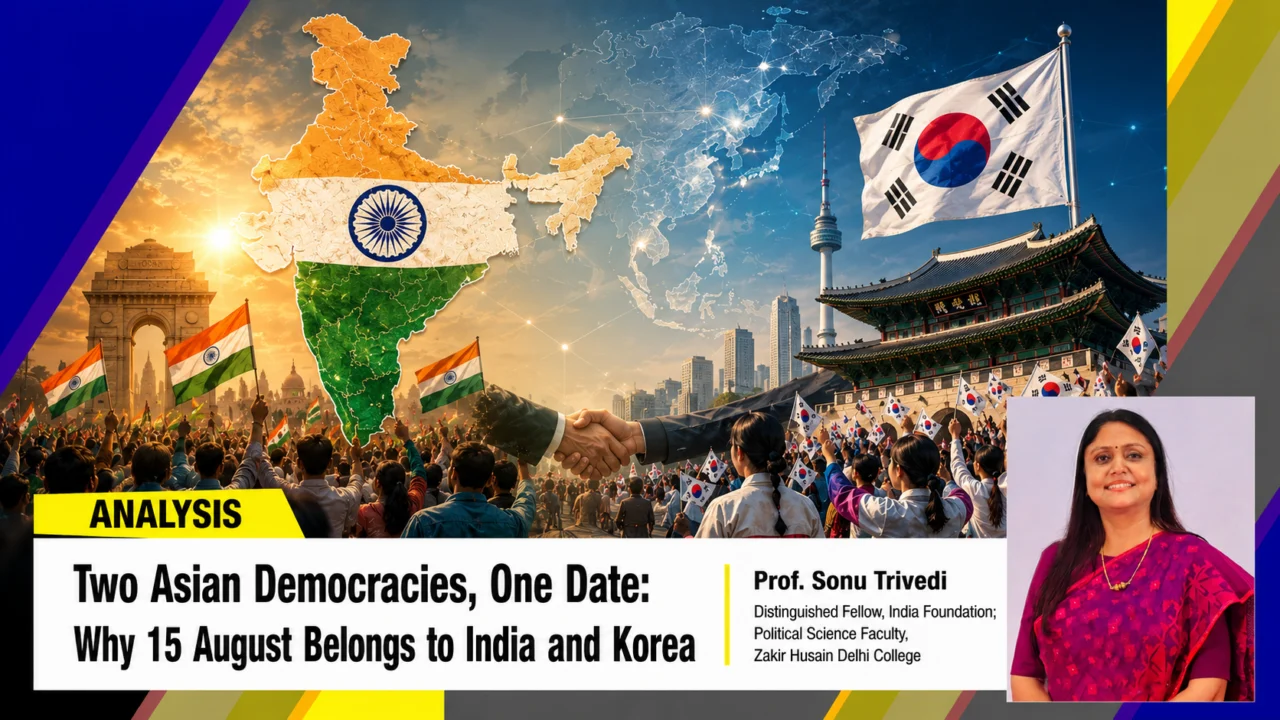
On 15th August, India and Korea pause to remember their respective freedoms from the colonial rule. The day marks in India as independence from British colonial rule in 1947. In the Republic of Korea, 15th August is Gwangbokjeol, the day of liberation from Japanese colonial rule in 1945. Though separated by geography, culture and language, they represent the same historical moment, the awakening of Asia after centuries of imperial domination.
For an Indian who has lived in Republic of Korea on diplomatic assignment, the coincidence of these two national days is more than a matter of the calendar. It is an invitation to reflect on a relationship that is at once ancient and contemporary, cultural and strategic, emotional and pragmatic. India and Republic of Korea are not merely two countries building a partnership in the Indo-Pacific. They are two civilisations that have experienced colonisation, war, partition, poverty and reconstruction, and have responded to those trials by choosing social and economic development with dignity and democratic aspiration.
The connection between India and Republic of Korea, therefore is not a recent development. It has been shaped by centuries of cross-cultural influence, bringing the hearts and minds of the people of the two countries together.
Two nations, one Asian awakening
When Korea was liberated from Japanese rule on 15th August 1945, the country faced an uncertain future. Liberation did not immediately bring unity. The peninsula was divided along the 38th parallel, and ideological rivalry soon transformed Korea into one of the most dangerous theatres of the Cold War. The independence in India also arrived in 1947 with the trauma of partition and communal violence. Thus, both countries saw the light of freedom under immense trials and tribulations.
This shared experience, however, is crucial. Neither country perceived their independence as an automatic, simple transfer of power followed by mass jubilation. It was a difficult project of reconstructing a state and renewing confidence of the masses amidst poverty, insecurity, and international pressure. Although both nations have adopted divergent political and economic paths, they recognise that sovereignty cannot be secured without consistent effort and resilience.
During the early years of their independence, India as a young democracy struggled to consolidate itself, and took a firm diplomatic stake in the future of the Korean peninsula. During the Korean War from 1950-53, India judiciously maintained its balance and restraint. It supported the United Nations action against aggression with humanitarian commitment. Indian support came up in the form of the “60th Parachute Field Ambulance”, which attended to over 220,000 wounded soldiers and civilians. India also played a pivotal role as a negotiator in the prisoners of war repatriation, which involved supervising the release of prisoners by both the side. It is, however, noteworthy that India’s participation in Korean affairs, was that of an active participant rather than a passive spectator. This humanitarian outreach demonstrated the far-reaching influence of Indian diplomatic endeavours.
The Cultural Resonance
However, the bonds between India and Korea stretch back even further than these modern historical events. Korean heritage attributes the founding of the Gaya kingdom to the Queen Heo Hwang-ok, who according to the legend, travelled from a distant land called Ayodhya in India, to marry the Korean King Kim Suro. Many Koreans have closely identified their ancestry to the Indian city of Ayodhya and continue to hold that legacy in the ‘Kim’ and ‘Heo’ clans of Gimhae. These legends are significant examples of shared imagination, enabling Koreans to view Indians not as foreign entities but as part of shared geography and facilitated by maritime trade, inter-cultural marriages, social norms and belief systems.
It must, however, be remembered how the Gimhae City Government organises the ‘Queen Heo Wedding Road Festival’ that celebrates the magical tale of the journey of Queen from Ayodhya in India to Gimhae at the young age of sixteen and marrying the Korean King Kim Suro. The Karak dynasty established by Kim Suro and Queen Heo from Gimhae is the torch bearer of this venerable heritage and generations of Incheon ‘Lees’ and Gimhae ‘Heos’ have descended from this ancient transnational romance.
It is also worth mentioning here, the resonance between the leaders of the national movement of the two countries. Mahatma Gandhi’s message to the President of Donga Ilbo newspaper, who had requested for a message inspiring Korean nationalists in their liberation struggle, was published in Donga Ilbo in 1927. Gandhi writes, “The message I can send is to hope that Korea will come to her own through ways absolutely truthful and non-violent”.
Gurudev Rabindranath Tagore’s famous poem ‘Lamp of the East’ written in 1929, “In the golden age of Asia, Korea was one of its lamp bearers, And that lamp is waiting to be lit once again, For the illumination of the East” focusses on Korea’s glorious past and its promising future which remains an inspiration in hearts and minds of every Korean even today.
It is noteworthy, that this realization is not merely about holding cultural festivals, Yoga Day, food fairs, and performing ceremonial arts. Such events may also serve as important reference point for joint and collaborative study. Universities of both countries must endeavour to promote combined research initiatives on different aspects of their shared heritage ranging from Buddhist networks to maritime routes, ancient trade to Sanskrit influences upon Korean writing. Museum collections should be broadened and tailored to present the history of the two regions within the much larger Asian historical context, alongside collaborative translation programmes to bring India’s literary contributions to Korean readers, and Korean literary traditions to Indian people.
This cultural relationship must reach beyond those overly familiar narratives of Buddhism and Queen Heo Hwang-ok, and instead recognize shared contemporary experiences worthy of deeper exploration, such as rapid urbanization, fierce competition for educational excellence, shifting familial structures and roles, an aging population and its implications, massive technological transformations, and the relentless pressure on national security.
Development Partners to Strategic partners
Formal diplomatic relations between India and Republic of Korea were established in 1973. This relationship has deepened both economically and strategically in the past five decades. Korean companies are household names in India today. It has been observed that the skilled Indian professionals contribute immensely to global Korean networks. Trade, investment, and industrial collaboration have grown considerably between the two countries in the sector such as the automobile, electronics, infrastructure development, renewable energy and advanced manufacturing.
The economic relations, however, remains short of their full potential. The synergy between India’s vast market and Republic of Korea’s advanced technological expertise, does not automatically translate into productive cooperation. This requires coherent policies, logistics, and willingness to understand the respective business cultures of each nation.
India’s ambitions of becoming a global leader in manufacturing and technology would immensely benefit from the Republic of Korea’s state of the art technologies that ranges from semiconductors, shipbuilding, and electric cars, batteries and robotics to engineering and its sophisticated machineries. Republic of Korea, on the other hand, finds India as a country with sizeable market and a growing pool of skilled manpower along with a thriving startup ecosystem in a strategically important Indian Ocean region.
In the ensuing phase of relationship development, mutual effort should focus on “co-production” rather than a one-sided allocation of funds and resources. Korean businesses must not simply view India as a site of low-cost assembly or primarily a consumer market, just as Indian companies should not consider Korea merely a source of capital and technology. Joint research and intellectual property sharing, combined with local supply chains and product development targeting the wider global market will be key to the future growth of this partnership. Education will undoubtedly have a major role to play as well, ensuring more Indians pursuing careers in Korea than ever before, and ensuring more Koreans are educated about India beyond the typical perceptions of Bollywood films, Indian cuisine, or spirituality. While encouraging collaboration in fields such as engineering, management, public policy, international relations, and climate change research will be important, humanities studies have an equally crucial role.
The Indo-Pacific Connection
The security landscape of Asia is greatly different from what it was during the Korean War. Despite the passage of time and the continued division of the Korean Peninsula, events on the peninsula continue to serve as a reminder of the ever-present need for vigilance to protect peace. While their immediate security environments are divergent, India and Republic of Korea’s trajectories are invariably intertwined by the dynamics of the Indo-Pacific’s regional stability, secure maritime supply lines and the ongoing competition among great powers.
As a result, any partnership between India and Republic of Korea ought to transcend the traditional scope of bilateral relations. Both countries can cooperate in maritime security, cyber governance, disaster relief, climate adaptation, and the defense of sensitive technologies. They can both contribute to an open, inclusive, and rule-based regional order without turning every question into a military contest.
The complementarities could also be seen in the economic journey of the two countries. The transformation of a war-ravaged Republic of Korea into a technological powerhouse in the modern times has been a remarkable journey. On the other hand, the narrative of India’s growth story has also been uneven. It illustrates the power of democratic resilience and social aspiration. The Korean experience can influence India’s industrial policies, educational and urban planning. In turn, India can shed light on Republic of Korea’s understanding of pluralism, democratic governances, and its management of diversity.
As partners in the cooperative endeavour, thus, neither country can replicate the other as a model of itself. India can neither be the template for Republic of Korea, nor Republic of Korea be the alternative template for India. Instead, what both need to focus is co-operation without any estrangement.
Shared Horizon: Implications of 15th August for India and Korea
The significance of the day, 15th August, offers a rare opportunity for both, India and Republic of Korea. It is the Independence Day for India, and liberation day for Korea. Freedom goes beyond liberation from foreign occupations. it encompasses people’s freedom to shape their lives, defend their dignity and establish institutions that cater to their welfare.
For India, remembering Republic of Korea on 15th August means recognising that our national history has always been connected to the wider Asian struggle against imperialism and war. It also means recalling that India’s foreign policy choices were not abstract declarations but practical acts of courage and compassion on Korean soil.
For Republic of Korea, remembering India should mean acknowledging a partner which stood during its critical moments, through diplomacy and peace keeping. It also looks forward to India as a nation which has consistently been interested in Korean security and the needs of Korean people.
Today, the two countries are at a juncture where 15th August marks both a chance to commemorate history and a pathway for a future relationship. What matters beyond the formal diplomatic engagements, is the people-to-people connections. The stronger ties, I realised over my years there, sprang up not at formal events, but during interactions with student, informal conversations over lunches and dinners and most significant being conversations about art, heritage and cultural traditions. These exchanges revealed complementarities, and more critically, demonstrate that genuine international friendship is built on mutual respect for each other.
From ancient times to the present, both India and Korea should look backward to, the anti- colonial struggle; the Korean War, and India’s diplomatic intervention during the war, and look forward to cooperation based on technologies, arts and culture, health, security, and the well-being of the people.
The beacon, rekindled in Korea in 1945, and the torch lit in India in 1947, are integral elements of an awakened Asia. When the sun rises on 15th August each year, it lights up Korean peninsula before illuminating the Indian peninsula. Every year, it reminds us how two great Asian democracies, hold a shared destiny. The task of both the countries currently is to convert this hope from a mere memory to a mutual future, transforming historical friendship into cooperation and a shared vision in two resilient Asian democracies.