



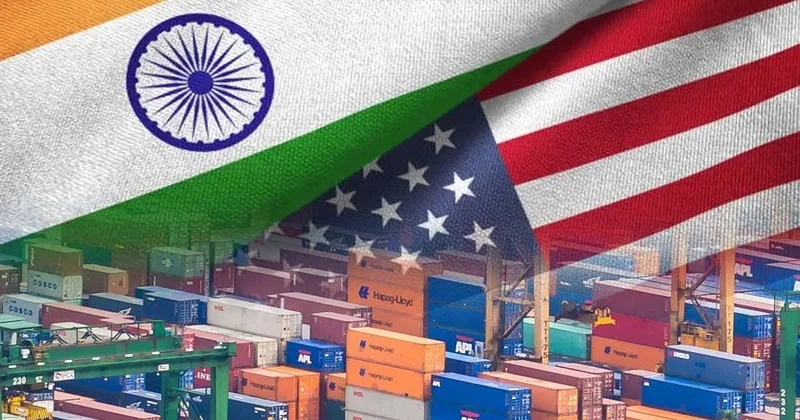
India has secured a relatively favourable position in the latest round of United States trade measures, with Washington imposing a 10 per cent tariff on most Indian exports under Section 301 of the US Trade Act of 1974, while key competitors such as China and Vietnam have been placed in the higher 12.5 per cent tariff bracket.
The development comes as a significant relief for Indian exporters, particularly as the United States remains India’s largest export destination and negotiations on the proposed India-US Bilateral Trade Agreement (BTA) continue.
The new tariff regime, announced by the Office of the United States Trade Representative (USTR) on July 23 and effective from July 24, replaces the temporary duty of the same rate that expired on July 24. Although the tariff adds to the applicable Most-Favoured-Nation (MFN) duty, India has successfully avoided the steeper 12.5 per cent rate that had been proposed in the USTR’s draft report released on June 2.
Adding further reassurance, the Union Ministry of Commerce and Industry stated on July 25 that nearly 45 per cent of India’s exports to the United States remain completely outside the scope of the new 10 per cent Section 301 duty because of exemptions already available under existing US trade measures.
India secures lower tariff than major competitors
The latest US action covers 60 economies that together account for more than 99% of American imports. Among these, India has been grouped with 16 other economies that will face the lower 10% tariff.
Countries placed alongside India include Pakistan, Sri Lanka, Bangladesh, Argentina, Cambodia, Canada, Ecuador, El Salvador, Guatemala, Honduras, Indonesia, Jordan, Malaysia, Mexico, Trinidad and Tobago, and the United Kingdom. Separate tariff arrangements have been announced for the European Union, Taiwan, Japan, South Korea and Switzerland.
In contrast, China and Vietnam, two of India’s biggest export competitors, have been placed in the higher 12.5 per cent category after the USTR accused them of failing to comply with the Uyghur Forced Labor Prevention Act.
#WATCH | Delhi | On India securing a lower 10% US tariff after being initially slated for 12.5%, MEA Spokesperson Randhir Jaiswal says, "…We have taken note of the announcement. This is a 301 enforcement action and it was initiated following the US Supreme Court ruling on the… pic.twitter.com/i5UFhZzu9D
— ANI (@ANI) July 24, 2026
The difference is strategically important. Under the USTR’s June draft, India too was expected to face a 12.5 per cent tariff, which would have placed Indian exporters at a comparative disadvantage. Instead, New Delhi succeeded in securing the lower slab after introducing new policy measures addressing concerns over forced labour.
Experts have described the outcome as a notable diplomatic and policy achievement. By reducing the proposed tariff from 12.5 per cent to 10 per cent, India has preserved its competitiveness in several labour-intensive sectors, particularly textiles, garments, engineering goods and manufactured products.
Commerce ministry highlights major exemptions
Responding to the latest US action, the Ministry of Commerce and Industry issued a detailed statement on July 25 highlighting that India’s actual tariff exposure is significantly lower than initial perceptions. The Ministry emphasised that approximately 45 per cent of India’s exports to the United States remain outside the purview of the additional 10 per cent Section 301 duty.
This exemption arises because several product categories are already governed by Section 232 of the US Trade Expansion Act of 1962. These include steel, aluminium, copper, automobiles, auto components and certain derivative products.
These goods already attract duties ranging from 25 per cent to 50 per cent above the applicable MFN rate. Since they are already covered under Section 232, they are not subject to the newly imposed additional 10 per cent Section 301 tariff.
The government also pointed out that Section 232 tariffs apply almost uniformly across nearly all countries. Consequently, India does not suffer any competitive disadvantage in these sectors compared to other exporting nations.
According to the Ministry, only the remaining 55 per cent of India’s exports will attract the new additional 10 per cent duty.
The government nevertheless underlined that India’s overall tariff incidence remains comparatively lower than that of most other economies covered under the investigation. Out of the 60 countries examined by the USTR, India faces a lower tariff burden than 38 of them.
The Commerce Ministry also reiterated that the government remains fully committed to securing an early conclusion of the India-US Bilateral Trade Agreement.
BTA talks continue amid textile negotiations
The latest tariff measures are widely viewed as temporary and partial. Officials familiar with the matter explained that the current tariff architecture is expected to be replaced once the interim India-US Bilateral Trade Agreement is finalised.
Moreover, only one of the two ongoing Section 301 investigations involving India has concluded. The second investigation concerns excess industrial capacity and includes 16 economies, among them India. Its outcome carries potentially greater commercial implications.
Officials indicated that if the excess-capacity investigation ultimately results in additional tariffs on India but not on neighbouring competitors such as Pakistan, Sri Lanka and Bangladesh, which are not covered under that investigation, it could alter the competitive balance currently established through the July 23 announcement.
Final US Section 301 Measures on Forced Labour: India Placed in Lower Tariff Tier at 10%
💠The United States Trade Representative (USTR) announced on 23rd July 2026 the final measures under Section 301 of the U.S. Trade Act, 1974
💠The measures follow USTR’s investigation into…
— PIB India (@PIB_India) July 25, 2026
Unlike Section 122 of US trade law, Section 301 contains no upper ceiling on tariff rates and has no automatic expiry. However, it requires a formal investigation before duties can be imposed. The Ministry of Commerce also addressed concerns regarding India’s textile exports.
The USTR’s final report announced the creation of a new “textile mechanism” based on tariff-rate quotas (TRQs) for Bangladesh, Cambodia, Indonesia and Malaysia. The mechanism is intended to encourage those countries to import more American cotton and textile products, thereby reducing dependence on supply chains that may contain forced-labour inputs.
India was not included in this proposed textile mechanism. However, the Commerce Ministry clarified that the mechanism is yet to be established and operationalised. It further stated that India continues engaging with the United States regarding a quota-based arrangement for Indian textile exports as part of the ongoing Bilateral Trade Agreement negotiations.
The Ministry reiterated that discussions with Washington remain active and constructive. At present, US tariffs on Indian exports fall into three broad categories. Products covered under Section 232 including steel, aluminium, copper, automobiles, auto components and certain derivative products, accounting for around 8 per cent of India’s exports, continue to attract duties ranging from 25 per cent to 50 per cent above the applicable MFN rate, although a limited number of exempted products continue paying only the MFN duty.
The remaining approximately 70 per cent of India’s exports, including engineering goods, textiles and garments, chemicals, machinery, plastics, leather products, gems and jewellery, furniture and most manufactured goods, will now attract the additional 10 per cent tariff under Section 301 over and above the applicable MFN duty.
Despite the additional levy, the overall outcome has been viewed positively in policy and trade circles. India has not only succeeded in reducing the proposed tariff from 12.5 per cent to 10 per cent through timely policy reforms but has also secured a competitive advantage over major export rivals such as China and Vietnam.
With nearly half of Indian exports remaining exempt from the new levy and negotiations on the Bilateral Trade Agreement continuing, New Delhi appears to have preserved significant space for expanding trade with its largest export market while working towards a more comprehensive and durable trade framework with Washington.