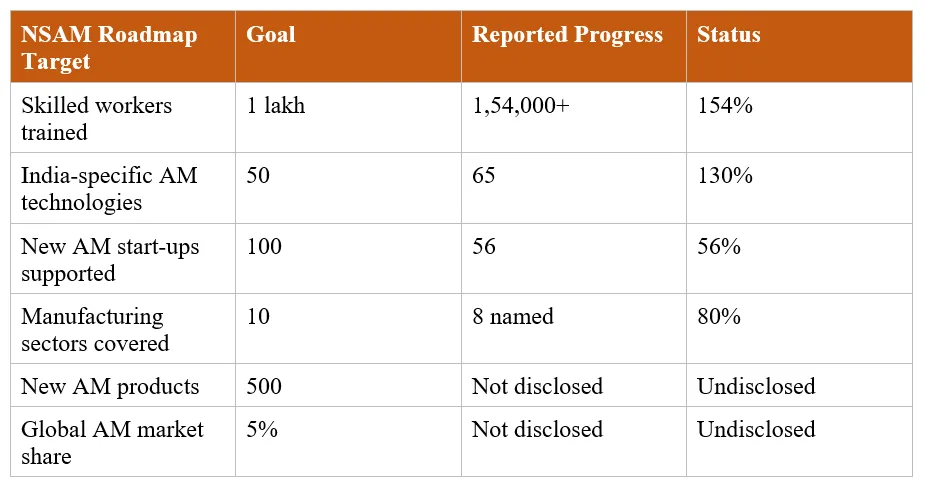
More than four years after the National Strategy for Additive Manufacturing (NSAM) was launched in February 2022, the government data tells a sharper story of success. Over 1,54,000 individuals have been trained, 56 start-ups have been backed and 65 India-specific technologies have been developed.
Data released by the Ministry of Electronics and Information Technology (MeitY), NSAM’s show a strategy running well ahead of target in some respects and still catching up in others. A close reading of these data is the clearest way to judge how India’n additive manufacturing (AM) mission is actually performing and where its next phase NSAM 2.0 will need to focus its energy.
The roadmap itself set out six measurable commitments with a 5 percent share of the global AM market, nearly US$1 billion added to India’s GDP, 50 India-specific AM technologies, 100 new AM start-ups, a lakh newly skilled workers and capability built across 10 manufacturing sectors.
Four years on have hard progress figures attached to them in the public record, one has strong indirect evidence and two remain without a disclosed update. That pattern of disclosure is itself a data point worth reading carefully.
The skilling number that beats its own target
NSAM roadmap set a target of training one lakh new skilled workers for the AM workforce. The reported figure over 1,54,000 individuals trained, it is a target exceeded by roughly 54,000 people or 54 percent above plan and that overshoot is no accident of counting.
It reflects a funnel built deliberately into the strategy. At the school level, Atal Tinkering Labs equipped with 3D printers, robotics and Internet of Things kits each backed by a ₹20-lakh grant and built into 1,200 to 1,500 square foot innovation spaces expose students from Grade VI to Grade XII to AM fundamentals years before they enter a workforce.
Layered on top are the seven specialised Development and Deployment Centres, which combine research with hands-on technology access and skilling. When training infrastructure is put in place early and widely, the resulting numbers tend to outrun paper targets a pattern worth watching as NSAM 2.0 is conceptualised.
Start-ups and technologies
Not every metric tells the same success story and an honest data read has to hold both halves together. The 65 India specific technologies developed spanning materials, machines, processes and software run well past the roadmap goal, the clearest sign that India’s AM research base is maturing faster than planned.
Start-up creation tells a different story where the enterprise layer of the ecosystem is running at roughly half the pace of its technology-development layer. It suggests NSAM has been more effective at generating deep technology than at converting that technology into commercial ventures at scale precisely the gap that NSAM 2.0 emphasis on Intellectual Property Rights generation and globally competitive commercialisation appears designed to close.
Sector Coverage: Eight named, two still unaccounted
NSAM roadmap commits to building AM capability across 10 existing and emerging manufacturing sectors. Tallying the sectors explicitly named in the government’s own account of progress gives a reasonably precise picture: aerospace and space (Agnikul Cosmos’s AM-printed rocket engine), defence (army dwellings and precast structures in Ladakh), healthcare (silk implants, bioceramic bone grafts), electronics (AM-printed batteries, antennas, capacitors and IISc’s globally first photonic circuit blocks), construction (2,500 square foot homes in under 30 days), energy (concrete-based supercapacitors for solar storage), food processing and photonics.
That totals eight distinct sectors with activity 80 percent of the ten-sector target, thus leaving two where the current release offers no specific evidence yet. NSAM institutional backbone is a network of seven Development and Deployment Centres, each assigned a distinct technological mandate and spread across seven different states.
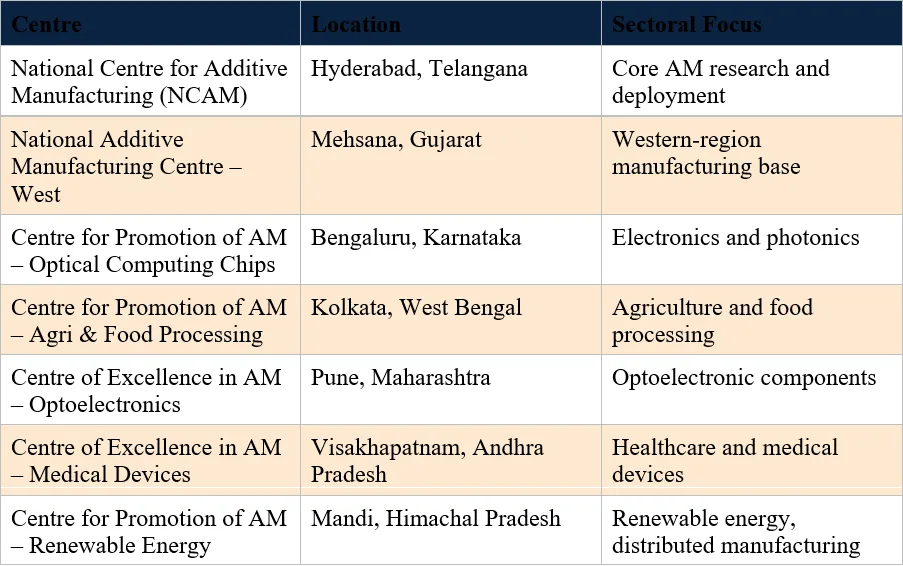
The spread is deliberately non-metropolitan in places Mandi and Mehsana sit alongside Hyderabad and Bengaluru by spreading AM infrastructure beyond India’s traditional technology hubs rather than concentrating it in one or two cities.
The market arithmetic
The government’s own backgrounder frames India’s opportunity against two external numbers: a global AM machines market projected to reach US$149 billion by 2035 and an AM-electronics supply chain expected to grow from US$18 billion to US$112 billion, a roughly 6.2-fold expansion.
Reading NSAM’s stated ambition of a 5 percent global market share against that US$149 billion figure implies a prize in the range of US$7.4 billion for India once the market matures well above the strategy’s own near-term target of adding nearly US$1 billion to GDP.
The gap between the near-term GDP target and the long-term market-share ambition is itself informative: it signals NSAM’s current numbers represent an early, foundational phase, with the larger payoff due only once start-up creation and commercialisation catch up to where technology development already stands.
Independent trackers such as the Wohlers Report size the broader global AM industry at roughly US$21.9 billion for 2024 with a narrower measure than the government’s machines-focused projection, but one confirming the same trend where AM is a fast-expanding industry, and India’s targets are calibrated to a market that will look very different in 2035.
The platforms carrying the numbers forward
Two dated events in the record show how the ecosystem is being convened, and the cadence matters as much as the content. The National Additive Manufacturing Symposium (NAMS) held its second edition on 13 March 2026 in New Delhi, bringing policymakers, scientists, start-ups and academia onto one platform, exchanging MoUs and launching new AM products while covering NSAM 2.0, defence adoption and MeitY-supported R&D centres in its panel discussions.
Seven months later, the Emerging Science, Technology and Innovation Conclave (ESTIC-2026) is set to convene at Bharat Mandapam, Pragati Maidan, from 27 to 29 October 2026, organised by the Council of Scientific & Industrial Research across 12 thematic areas, with Additive Manufacturing listed among the frontier technologies on its agenda.
Two national scale AM convenings within a single calendar year is itself a measurable signal of institutional momentum a cadence that was not part of the original NSAM roadmap but has clearly become part of how the strategy is now being executed.
What the data suggests next
Put together, NSAM numbers describe a strategy that has outperformed on research depth and workforce creation, kept pace on sectoral spread, and lagged on converting technology into start-ups and finished products.
For NSAM 2.0, now being conceptualised with an explicit focus on Intellectual Property Rights generation, digital integration and commercialisation, the data points to where the next phase of effort needs to concentrate not on generating more India-specific technologies, where the strategy is already 30 percent ahead of plan, but on the harder task of turning that technological base into the 100 start-ups with 500 products and 5 percent global market share that remain the mission unmet benchmarks.