



मंगल भवन अमंगल हारी। द्रवउ सो दसरथ अजिर बिहारी॥
“May He who is the abode of all that is auspicious and the remover of all that is not, the Lord who played in Dasharath’s courtyard, shower His grace.” — Ramcharitmanas, Bal Kand
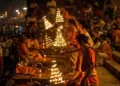
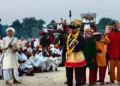
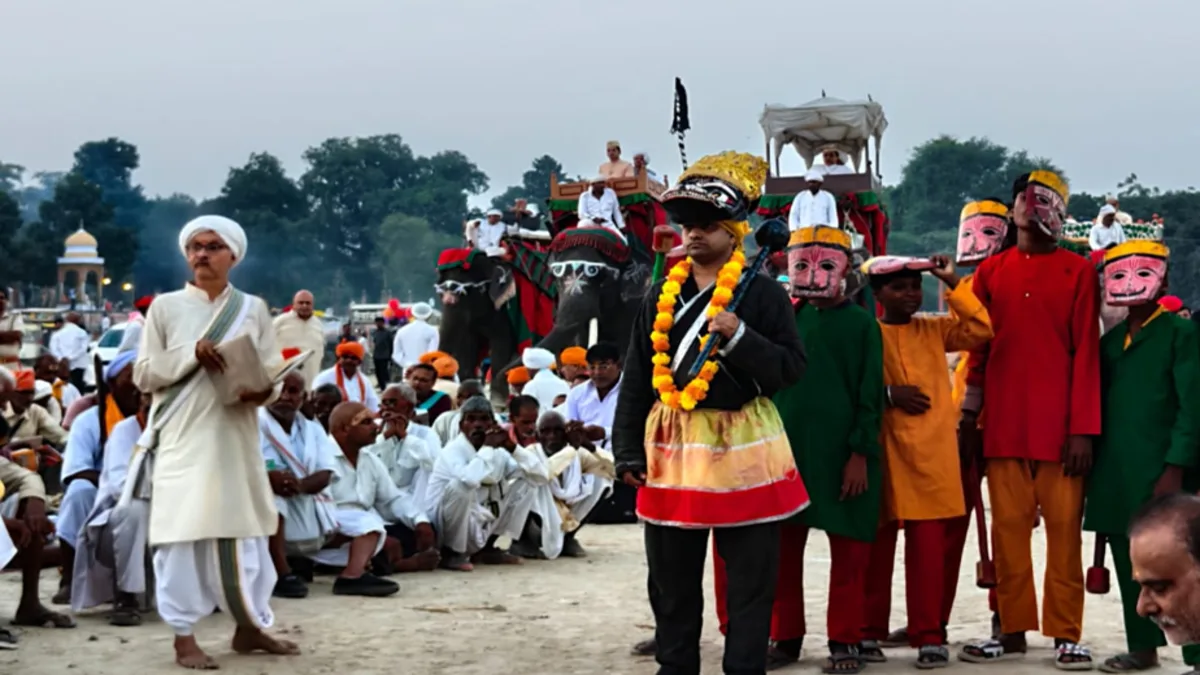
Dusk settles over the eastern bank of the Ganga and the ramparts of Ramnagar Fort catch the last of the light. There is no loudspeaker crackling, no LED screen, no ticket counter. Only the hiss of petromax lamps, the murmur of thousands and then a full-throated roar of “Har Har Mahadev” as the Kashi Naresh arrives on elephant-back to take his place.
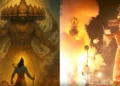
What follows is not a show in any ordinary sense. For one month every year, a small riverside town opposite Varanasi stops being a town and becomes Ayodhya, Janakpur, Chitrakoot and Lanka by turns. The audience does not sit and watch. It walks, chants, weeps and follows its gods from one end of the epic to the other.
This is the Ramlila of Varanasi or rather the Ramlilas, because Kashi never tells the story of Shri Ram just once. It tells it in many mohallas and in many moods and each tradition carries its own memory of faith, resistance and community.
The City Where the Manas Was Born
To understand why Varanasi owns this tradition so completely, one has to begin with Goswami Tulsidas. It was in Kashi, the saint-poet composed much of the Ramcharitmanas in the sixteenth century, retelling Valmiki’s Sanskrit epic in Awadhi so that the farmer, the weaver and the boatman could hold Ram in their own tongue.
The Manas did not stay on the page for long. Local tradition holds that Tulsidas and his circle began enacting its episodes in the open, turning scripture into a shared experience. From those first performances grew a form that UNESCO proclaimed a Masterpiece of the Oral and Intangible Heritage of Humanity in 2005, before inscribing it on its Representative List in 2008.
UNESCO own description is telling. Among the most representative Ramlilas of North India, it names Ayodhya, Ramnagar and Benares, alongside Vrindavan, Almora, Satna and Madhubani. Kashi, in other words, appears twice on that roll of honour, once for Ramnagar and once for the city itself.
Ramnagar: Thirty-One Nights, One Town, No Microphones
Of all the Ramlilas in India, none matches Ramnagar’s ambition. It opens on Anant Chaturdashi and closes roughly a month later on the full moon, running well past Dussehra. Its first episode is not the birth of Ram but the birth of Ravan and its last is a discourse on Ram’s teachings, delivered after the coronation.
The story of how it began is almost domestic. As recounted by the Ramlila own office-bearers, Maharaja Udit Narayan Singh once set out to watch a Ramlila organised by traders at Chhota Mirzapur, only to arrive after it had ended. Disappointed, he was advised by his queen to begin one at Ramnagar itself. The tradition is commonly dated to around 1830 and it was his successor, Maharaja Ishwari Narayan Singh, who refined the staging into the form seen today.
What sets Ramnagar apart is its geography. Permanent sites within a radius of about five kilometres carry the names of places in the epic. Palace scenes of Ayodhya unfold at the fort, Vishnu reclines on Sheshnag in a pond and Lanka occupies a wide tract where Ravan court, Ashok Vatika and Ram camp face one another. On many evenings the whole audience walks with the actors from one site to the next, sometimes more than a kilometre apart.
Writing in The New York Times, Schechner noted that during the lila Ramnagar turns into a theatrical model of the whole subcontinent, from the Himalayas to Lanka and that beside it even the famed Oberammergau Passion Play and Peter Brook Mahabharata look modest.
No microphones are used, even before crowds running into thousands, so performers project their lines in raised, trained voices. Light comes from petromax lamps and flares rather than floodlights. The effect is that of stepping into a nineteenth-century evening, which is precisely what the Ramlila intends.
Royal patronage outlived the princely state itself. When Banaras State merged with the Indian Union, the theatre critic Balwant Gargi recorded, a clause in the merger provided for an annual government grant towards the Ramlila. The royal armoury, elephants and attendants continue to serve the performance and the Kashi Naresh still presides over it.
The Swaroops: Boys Who Become Gods
At the heart of Ramnagar are the swaroops, the young boys chosen to play Ram, Sita, Lakshman, Bharat and Shatrughan. For the duration of the lila they are not treated as actors at all. They are revered as living forms of the deities and carried on devotees shoulders to their quarters at the close of each night.
The cast is generally announced in early August. With the season formally set in motion through the first Ganesh puja at the Chowk in August. A swaroop must master not just the lines but a way of being and the long preparation that follows such a selection reflects that.
Other roles travel down family lines. The parts of Ravan, Hanuman and Jatayu, among others, have been performed by members of the same families for generations. In an age of auditions and reality shows, Ramnagar quietly preserves something older are inherited with devotion, held in trust.
The Nemis and the Living Text
If the swaroops are the gods, the nemis are their most faithful congregation. These are devotees who attend every evening of the cycle, reading the Ramcharitmanas in step with the enactment. Some take an entire month away from work and travel long distances simply to be present. For such devotees, the lila is closer to a vrat than to an evening out.
Their presence explains why scholars hesitate to call Ramnagar mere theatre. The American performance scholar Richard Schechner, who first came here in 1976, described it as an “extraordinary time-space-narrative.” The audience does not merely observe Ram exile. It goes into exile with him and it returns with him to Ayodhya.
A line recorded by Gargi puts the philosophy more plainly still “Ramlila is not a play, it is a yagna.” It is an offering, made so that the people of Ramnagar may live in well-being. Seen this way, every footstep of the walking audience becomes part of the ritual.
Nati Imli: Where Raghukul Rides on Yadukul’s Shoulders
Cross the river back into the old city and the mood changes. At Nati Imli, the Chitrakoot Ramlila stages what is arguably the most emotional few minutes in Kashi’s festive calendar, the Bharat Milap, held on the day after Vijayadashami. This year it falls on 21 October, a day after Vijayadashami sets the effigies of Ravan ablaze across the city.
The Chitrakoot Ramlila is widely regarded as the oldest in Varanasi, its beginnings traced by local belief to 1543 and to Megha Bhagat, a contemporary of Tulsidas. Some accounts call him a disciple of the poet, others a fellow devotee of the same guru and tradition holds that Ram appeared to him in a dream. Local lore adds that Megha Bhagat, overwhelmed by the sight of the brothers rushing into each other’s arms, attained samadhi on the very ground.
Ram, Sita and Lakshman arrive on a wooden Pushpak Viman said to weigh around five tonnes, borne on the shoulders of men from the Yadav community, a privilege their families have guarded for generations. Devotees carry Ram towards Bharat and Bharat towards Ram, the brothers embrace and the ground erupts.
Kashi has a phrase for this moment, the meeting of the Raghukul happens on the shoulders of the Yadukul. It captures what the Bharat Milap means beyond the Ramayana. Fittingly, Hindi press accounts note that Megha Bhagat was himself an Ahir from Vishweshwarganj, so the bond between the community and the lila reaches back to its very founding.
It is no surprise that Nati Imli counts among Varanasi’s “lakkha melas”, fairs that draw lakhs of people. The Kashi Naresh attends in full regalia and bhandaras feed visitors across the neighbourhood long after the viman has passed.
Chetganj’s Nakkatayya: Faith as Defiance
If Nati Imli is tenderness, Chetganj is spectacle with a sharp edge. Its Nakkatayya re-enacts the episode in which Lakshman cuts off Surpanakha’s nose, the insult that sets Ravan on the path to abducting Sita. It is held on the night of Karwa Chauth, a little over a week after Dussehra.
Its history is the most political of all. The Nakkatayya was begun in 1887 by Baba Fateh Ram, at a time when public gatherings in colonial India were closely watched. Religious processions were harder for the British to ban, so tableaux laden with metaphor and satire became a way to mock imperial excess and rouse local pride under the cover of devotion.
That spirit of commentary has never left. After the lila at the Chetganj crossing, a night-long procession of lagas, illuminated tableaux, winds through the old city towards dawn. In 2024, its 138th edition, some 80 tableaux rolled out with Aatmanirbhar Bharat and India’s achievements in science and technology among the most talked-about themes.
The Nakkatayya, in effect, has done for well over a century what good editorials do. It holds up a mirror to its times, but in the vocabulary of the Ramayana, which every onlooker already knows by heart.
A Lila in Every Lane
Ramnagar, Nati Imli and Chetganj are only the most famous stops on a much larger map. Nakkatayya processions also roll out from neighbourhoods such as Jaitpura, Aurangabad, Shivpur, Kashipura and Ardali Bazar, each following the calendar of its own local Ramlila. In autumn, it can feel as though every mohalla is running a chapter of the same epic on its own clock.
What binds these scattered stages together is the royal house. Maharaja Vibhuti Narayan Singh, whose state merged with India in 1948, devoted himself to the festivals of Ramnagar, Chetganj, Nati Imli and Tulsi Ghat alike, Banaras went on honouring him as its king long after the formal title had lapsed. His successors have kept up the custom of attending.
Tulsi Ghat keeps the poet’s own memory closest. The Nag Nathaiya leela there, in which a young Krishna subdues the serpent Kaliya in the Ganga, is traditionally credited to Tulsidas himself, and the Kashi Naresh watches it from the royal boat. It is a reminder that Kashi’s love of lila was never confined to a single avatar.
A Tradition Under Pressure and Still Standing
None of this survives without effort, while inscribing Ramlila, UNESCO itself warned that television and mass media were thinning audiences and loosening the tradition’s role in drawing communities together. In Ramnagar, older residents recall forest paths that once lent the vanvas episodes their realism and have since given way to concrete.
There have been interruptions too. In 2020, the pandemic forced the cancellation of the Ramnagar Ramlila, leaving its devotees sad. Its return show how deep the roots run the nemis came back, the swaroops were chosen and the petromax lamps were lit once more.
The deeper safeguard is that Kashi has never treated the Ramlila as heritage behind glass. Children grow up watching it, families inherit roles, communities guard their privileges of service and every year the story is told afresh to people who already know how it ends.
Why Kashi Keeps Telling the Story
The Ramlila of Varanasi do not exist to surprise anyone. Everyone knows that Ravan will fall, that Bharat will embrace Ram, that Ayodhya will light its lamps. The point is not suspense but participation, a city choosing, night after night to live inside its own epic.
In that sense, the Ramlila is Bharat’s civilisational memory performed under the open sky. It moves from royal court to crowded mohalla, from the Maharaja on his elephant to the Yadav bearers beneath the Pushpak, from devotion to satire and back again. It belongs to no single caste, class or neighbourhood, which is exactly what Tulsidas intended when he set the epic in the language of the people.
So if you find yourself in Kashi this season, follow the crowd. Cross the Ganga to Ramnagar at dusk, stand at Nati Imli as the light fades, stay awake through Chetganj’s long night. You will not be watching a play. You will be walking, for a while, in Ram’s footsteps.