



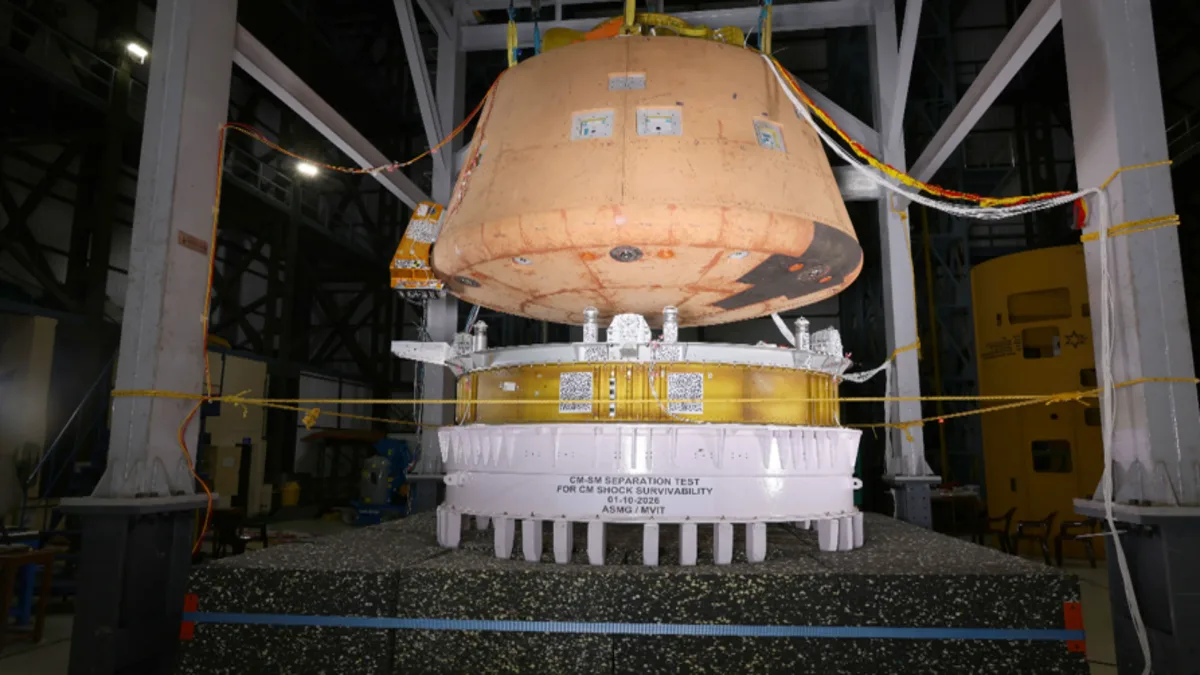
The Indian Space Research Organisation (ISRO) has cleared one of the most delicate engineering hurdles on the road to India’s first human spaceflight. On October 16, 2026 the agency announced that it had successfully completed a series of Crew Module (CM) Service Module (SM) separation tests for the Gaganyaan missions, conducted at the Vikram Sarabhai Space Centre (VSSC) in Thiruvananthapuram.
The result lends direct confidence to the separation system that will fly aboard G1, the first uncrewed Gaganyaan mission targeted for launch in 2026. It also confirms that the spacecraft’s most sensitive onboard systems can withstand the violent mechanical jolt of a separation event, a moment in a crewed flight, stands between astronauts and their journey home.
Two modules, One spacecraft
The Gaganyaan Orbital Module is built in two parts. The Crew Module is the cone-shaped capsule designed to house astronauts, while the Service Module supports it with power, propulsion and other essential functions throughout the flight. The two are joined by a dedicated separation system, with electrical and fluid servicing passing between them through umbilical connections.
These modules are integrated before launch and operate as a single unit from lift-off until the end of the on-orbit phase. That arrangement changes only when the mission turns homeward. Before re-entry into the Earth’s atmosphere begins, the Crew Module must detach from the Service Module and make the descent on its own.
This is no simple uncoupling. The separation unfolds as a chain of precisely sequenced events driven by pyrotechnic devices and jettisoning systems, with every umbilical link severed cleanly and in the correct order. A single delayed or incomplete event could leave the capsule improperly oriented or physically compromised at the very threshold of re-entry.
Recreating the moment on the ground
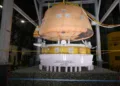
To validate the overall design adequacy of the separation system, ISRO engineers built a dedicated test setup at VSSC that simulated the complete CM–SM assembly. The rig was fitted with extensive instrumentation, allowing every load shock and response during separation to be measured and analysed.
The tests recreated the actual separation scenario, including the severing of several umbilical connections between the two modules. In effect, the sequence that will play out hundreds of kilometres above the Earth was rehearsed under controlled conditions, where any anomaly could be detected, studied and corrected well before flight.
Proving the capsule can take the shock
Beyond confirming the design of the separation hardware, the campaign demonstrated the robustness and shock-survivability of a wide range of critical Crew Module subsystems. Pyrotechnic separation generates sharp, high-frequency shocks that can damage electronics or loosen components, so proving survivability was as important as proving separation itself.
The subsystems that came through the test include the avionics and Inertial Navigation Systems, which guide the capsule’s orientation and trajectory during descent. The Thermal Protection System in the aft and conical heat shields, which must protect the capsule from intense heating during re-entry, also held up under the separation loads.
Equally significant was the performance of the Crew Module Deployable Umbilical Shield and the pyrotechnic devices of both the Crew Module Uprighting System and the Thermal and Humidity Control System. The uprighting system is meant to keep the capsule correctly oriented after splashdown, while the thermal and humidity system governs cabin conditions. Each has a direct bearing on crew safety.
Building on a methodical test campaign
The separation trials fit a deliberate, step-by-step qualification approach that has defined Gaganyaan from the outset. In October 2023, the Test Vehicle Abort Mission-1 (TV-D1) demonstrated the Crew Escape System, with the crew module later recovered at sea by INS Shakti.
That momentum is carried into 2026 and in April, the crew module cleared an air drop test, while other qualification work this year covered the uprighting system, umbilical connect-disconnect mechanisms and apex cover separation loads. Each test retires a specific risk, and the CM–SM separation trials now close another important gap.
In August 2025, ISRO Chairman V. Narayanan said that over 7,700 ground tests related to Gaganyaan had been completed, with more than 2,300 additional tests planned.
Vyommitra and the road to G1
G1 will be the first orbital flight of the Gaganyaan spacecraft, carrying the half-humanoid robot Vyommitra in place of a human crew. The robot is designed to monitor module parameters, issue alerts and carry out life-support operations, standing in for astronauts while the systems around her are proven in real flight conditions.
The mission will exercise the full flight profile, from launch aboard the human-rated LVM3 to orbital operations, re-entry parachute-assisted descent and splashdown in the Bay of Bengal. The CM–SM separation is the hinge on which that sequence turns. Without a clean separation, the descent simply cannot begin.
Aatmanirbharta beyond the atmosphere
Gaganyaan, a name that joins the Sanskrit words for sky and vehicle, carries significance well beyond engineering. A successful crewed flight would make India only the fourth nation, after the United States, Russia and China, to independently send humans into space. The systems validated at VSSC reflect a programme built on domestic design, testing and engineering capability.
Human experience is also feeding the effort. Group Captain Shubhanshu Shukla’s 2025 journey to the International Space Station under the Axiom-4 mission yielded insights that he has described as critical for Gaganyaan. Paired with exhaustive ground validation, it points to a programme that places readiness above haste.
Trust earned before flight
Spaceflight history is unforgiving towards systems that falter at moments of transition. By rehearsing one such moment on the ground, and by confirming that both the separation hardware and the capsule’s vital systems can endure it, ISRO has strengthened the foundation for G1.
The tests also carry a quieter message. When Indian astronauts eventually ride the Crew Module home, the mechanism that frees them from the Service Module will already have been tested, measured and trusted. With G1 drawing closer, India’s march towards human spaceflight has taken one more confident step forward.