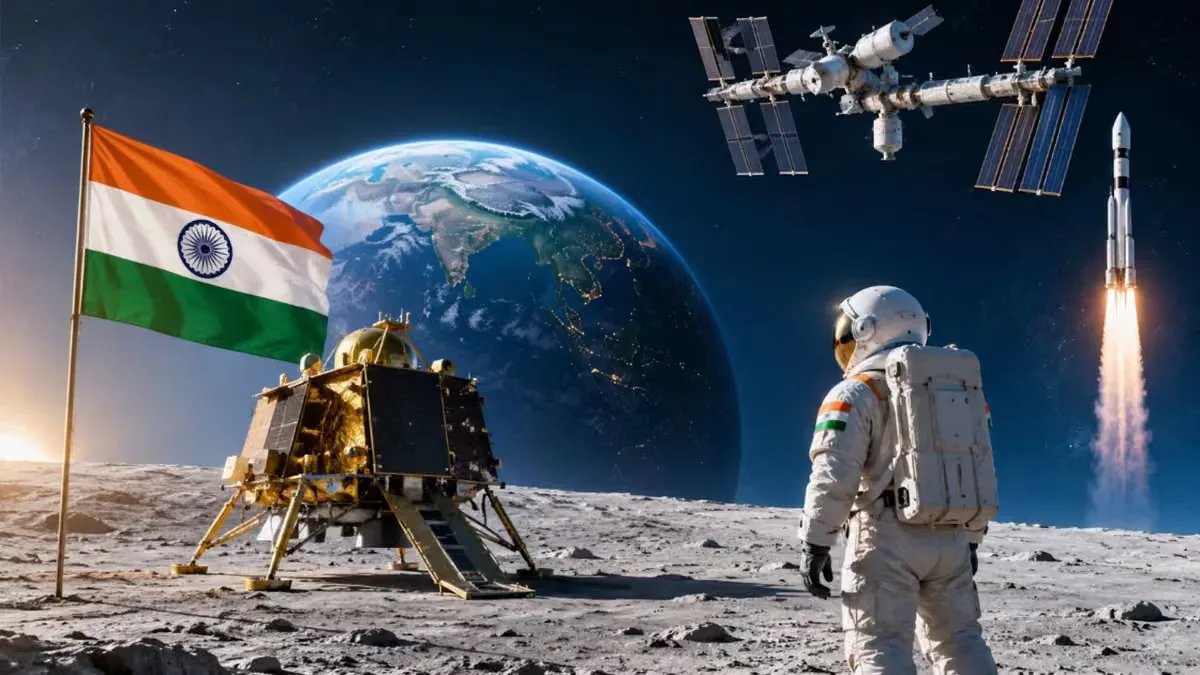
There was a time when India’s achievements beyond the atmosphere were measured purely in prestige. A successful launch made headlines, a lunar probe stirred national pride and the story usually ended there. That chapter is now closing and a far more consequential one is opening.
The new chapter was outlined at a roundtable on “Space, Sovereignty and New Economy” hosted by the Bloomberg New Economy Forum in New Delhi. Union Minister Dr Jitendra Singh put a striking figure before the country. India’s space economy, worth roughly USD 9 billion today. It is projected to reach USD 40–45 billion within the next seven to eight years nearly a fivefold leap in less than a decade.
Projections of this scale are not born from wishful thinking. They reflect a structural shift in how the nation approaches the cosmos, a state-run scientific enterprise is becoming an ecosystem where public institutions and private innovators work in tandem. The Minister described the transition precisely. The time has come to stop merely demonstrating capability and start building globally competitive companies.
That distinction matters more than it first appears. Plenty of nations can claim technical prowess, but very few have converted it into durable commercial strength. If Bharat manages that conversion, it will not just participate in the global market but help shape it.
The unlocking that changed the game
The roots of this momentum lie in a decision taken in 2019–2020, when Prime Minister Narendra Modi opened the sector to private participation. For decades, ISRO had carried the entire weight of the national programme. It did so brilliantly, yet a single agency, however capable, could never unlock the full economic potential of an industry.
The reform was bold because it challenged an entrenched habit of thinking. Earlier dispensations treated strategic sectors as zones to be guarded rather than frontiers to be expanded. The PM Modi government chose a different path and trusted Indian entrepreneurs with a domain once considered too sensitive for anyone but the state.
Institutions soon followed intent. IN-SPACe was created as a single-window body to authorise and promote non-government players, while NewSpace India Limited took charge of ISRO’s commercial work. The Indian Space Policy of 2023 clarified roles and the liberalised foreign investment norms of 2024 opened doors for overseas capital in satellite manufacturing, launch vehicles and components.
Results arrived swiftly. Skyroot Aerospace’s Vikram-S became the first privately developed Indian rocket to lift off in 2022 and Agnikul Cosmos later flew from its own private launchpad at Sriharikota. Dr Singh noted that such outcomes have emerged within just five to six years, a remarkably short window for an industry known for long gestation periods.
The flagship missions, meanwhile, kept raising the country’s standing. Chandrayaan-3 made India the first nation to land near the lunar south pole and Aditya-L1 turned the nation’s gaze toward the Sun. These milestones did more than win applause. They built the credibility on which commercial confidence now rests.
Demand is the real rocket fuel
Capability alone does not build a business. A startup may design an excellent satellite, but without a buyer it remains an expensive prototype. Dr Singh rightly identified demand generation as the foundation on which private enterprise must stand.
To meet the demand the government uses case-based approach deserves attention. By acting as an anchor customer and backing proof-of-concept projects, the state gives young firms the chance to test their technologies in real conditions. Once validated, those products can move toward wider deployment with far greater credibility.
When companies know a steady customer base awaits them, they invest in production lines, hire talent and refine products for the market. Uncertain demand drives capital away and leaves promising ideas stranded on the drawing board.
None of these amounts to a call for endless subsidies. Every major spacefaring economy has used public procurement to nurture its private industry in the early years. America’s commercial launch giants grew on the back of government contracts and India is wise to adopt a calibrated model suited to its own needs.
Red tape has no place in orbit
If demand is the fuel, regulatory efficiency is the guidance system. The Minister stressed that companies seeking installation or export licences must receive approvals within defined timeframes. In a fast-moving global market, a delayed clearance can mean a lost contract.
His remarks on GST related measures for space products were equally pointed. Reforms on paper, he argued, must translate into tangible gains on the ground. Lower costs of doing business and smoother supply chain integration decide whether Indian firms can price competitively against entrenched international rivals.
This emphasis reflects a governance philosophy that has defined the past decade. From scrapping outdated compliance burdens to championing ease of doing business, the effort has been to make the state a facilitator rather than a gatekeeper. Extending that spirit fully into the aerospace sector is the logical next step.
Dr Singh observed becomes sustainable only when three conditions meet where predictable demand, efficient processes and a clear path to growth. If any one is missing, capital hesitates. If all three are in place, investors will compete to back Indian ventures.
Sovereignty and partnership are not rivals
One of the most thoughtful strands of the discussion concerned the balance between national interest and global cooperation. Critics often frame the two as opposing choices, as if welcoming foreign capital must mean surrendering strategic control. The Minister firmly rejected that false binary.
India, he said is opening avenues for investment and collaboration while simultaneously deepening indigenous capabilities. Domestic strength remains vital for national security and strategic autonomy, especially in a field with obvious defence implications. The self-reliance has never meant isolation.
That is the essence of Atmanirbhar Bharat, a concept often misread by its detractors. Self-reliance is about building the capacity to stand on one’s own feet, not about shutting the door on the world. A confident nation engages globally from a position of strength and chooses its partners on its own terms.
Closer coordination between government institutions and private firms, complemented by international alliances, can help Indian companies integrate into global supply chains and widen their customer base. The aim is to combine the best of domestic public and private enterprise with the expertise of trusted partners abroad. Done right, every such tie-up adds to India’s strength rather than diluting it.
The presence of Aisha Bowe, the former NASA engineer and Blue Origin astronaut, alongside IN-SPACe’s Vinod Kumar, reflected this outward-looking spirit. India is no longer seeking a seat at the table. Increasingly, it is helping set the agenda.
Technology that serves the citizen
What truly distinguishes India’s programme, however, is not only what it achieves above the clouds but what it delivers on the ground. Dr Singh highlighted the extensive use of satellite communications, geospatial tools and Earth observation across infrastructure, agriculture, disaster management and defence. That has been the guiding vision since Vikram Sarabhai’s day with technology in the service of the common citizen.
Under the present government, that vision has acquired practical teeth. Satellite imagery now supports project clearances, tracks implementation timelines and geotags development works. When a road, a dam or a housing scheme can be monitored from orbit, delays become visible and accountability becomes harder to evade.
Farmers gain from crop assessments and weather insights, while relief teams secure precious hours of warning ahead of cyclones and floods. These applications quietly touch millions of lives every day, even if they rarely make front-page news. They show that investment in orbital infrastructure pays dividends far beyond the scientific community.
The benefits also travel across borders. India provides space-based information and disaster-management support to Myanmar, Bangladesh and Sri Lanka, a clear expression of the Neighbourhood First policy. In a region where some powers use infrastructure as a lever of debt and dependence, Bharat offers capability as a shared public good.
Beyond Rockets: The downstream opportunity
The Minister made another point that deserves wider attention. Launch vehicles and satellites capture the imagination, but the real commercial depth lies downstream, in services, data-driven solutions and industrial applications. That segment generates the bulk of global revenue in the sector.
India’s strength in software and information technology positions it exceptionally well here. A nation that built world-class digital public infrastructure through UPI and Aadhaar can replicate that success with geospatial data and satellite-enabled services. The union of orbital assets with digital innovation could become one of the defining Indian stories of this decade.
Openings abound, from precision farming and urban planning to logistics, insurance and climate monitoring. Each of these markets needs reliable data and Indian firms can supply it at competitive cost. The challenge is to craft business models that scale well beyond pilot projects.
A mindset open to change
Dr Singh also underlined the importance of staying receptive to progressive ideas and adapting policy as technology evolves. That humility is refreshing. Where innovation moves at breakneck speed, rigid rules can become obsolete almost as soon as they are written.
The decision to open the sector was itself an act of policy courage. It proved that established public bodies and new entrants can coexist and even strengthen one another. Freed from routine tasks that private players can now handle, ISRO can focus on frontier missions such as Gaganyaan and the planned Bharatiya Antariksh Station.
Reaching USD 40–45 billion will not happen automatically. It will demand sustained capital inflows, a deeper talent pipeline, nimble regulation and an unwavering commitment to quality. Indian firms must also prove themselves in fiercely contested international markets, where reliability and cost decide everything.
Yet the foundations are firmly laid. The policy architecture exists, the institutions are functioning and the entrepreneurial energy is unmistakable. What remains is disciplined execution, the kind that turns promising startups into global champions.
A larger national purpose is also at stake. As the country marches toward Viksit Bharat by 2047, a robust space economy will underpin secure communications, defence preparedness, economic planning and rural development alike. In this century, strategic autonomy will depend heavily on who controls the data flowing from orbit.
The journey from a rocket nose cone carried on a bicycle at Thumba to a multi-billion-dollar commercial ecosystem is a story few nations can tell. It is a tale of scientific grit, visionary leadership and the courage to trust one’s own people. The next chapter will be written not only in ISRO’s laboratories but also by entrepreneurs, investors and engineers across the land.
Dr Jitendra Singh’s message was unambiguous. India has proved what it can do in space and now it must prove what it can build to sell and sustain. If the present trajectory holds, the world will soon buy Indian orbital services as readily as it once admired Indian missions.