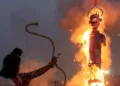




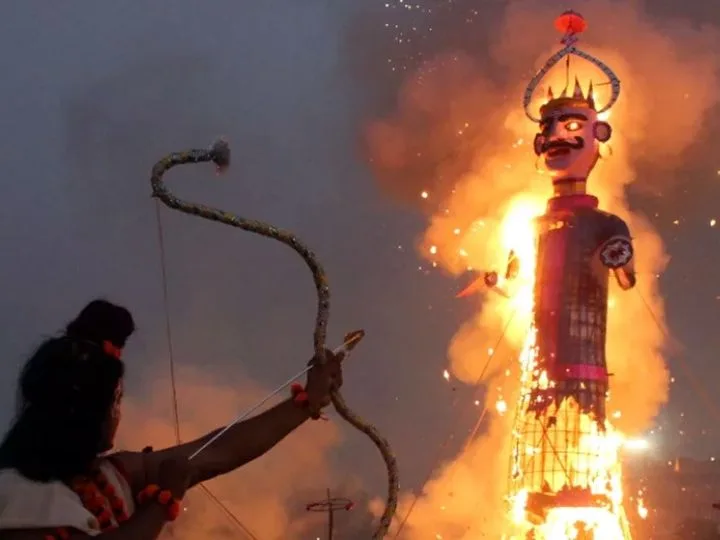
Every year, on Vijayadashami, the burning of Ravan’s effigy forms a prominent part of Dussehra celebrations across India. The ritual is associated with Bhagwan Ram’s victory over Ravan in the Ramayan and the triumph of good over evil. However, the practice has also become the subject of a growing debate involving caste identity, tribal heritage, religious beliefs and competing interpretations of Ravan.
Two principal narratives have emerged among groups opposing Ravan Dahan. The first argues that Ravan was a learned Brahmin, a devotee of Bhagwan Shiv and a figure whose intellectual achievements deserve recognition. Certain groups have consequently opposed the annual burning of his effigy, arguing that it disrespects Ravan and their community’s understanding of his identity.
The second narrative, advanced by some Dalit, Bahujan and Adivasi organisations, portrays Ravan as an indigenous or Moolniwasi king, an ancestor or a cultural hero. These organisations argue that burning his effigy symbolically devalues a figure they revere and marginalises their cultural traditions.
These competing interpretations raise a broader historical question: Was Ravan Dahan originally instituted to humiliate Brahmins or Dalits, or did the practice develop primarily as a religious and theatrical representation of Ravan’s defeat in the Ramayan? Answering this question requires separating historical evidence from contemporary political and cultural interpretations.
Reports from 2016 to 2026 document worship, petitions to government authorities, demands for a ban, public demonstrations, police intervention and legal challenges concerning Ravan Dahan. Incidents in Agra, Mathura, Betul, Pune, Punjab, Chandrapur and Ujjain illustrate how the debate has developed across different regions.
In December 2019, the Supreme Court also dismissed a public interest litigation challenging the practice, observing that religious beliefs and cultural practices vary across India. The detailed incidents, competing narratives, judicial developments and available historical evidence are given below.
1. Agra, Uttar Pradesh: Brahmins oppose Ravan Dahan
On 12 October 2016, India Today reported that a group of Saraswat Brahmins in Agra worshipped Ravan on Vijayadashami and announced plans to establish a temple dedicated to him. The gathering took place at Vrihadeshwar Mahadev Temple near the Yamuna River.
Madan Mohan Sharma, the convenor of the event, described Ravan as a highly learned Brahmin, an outstanding politician and a devotee of Bhagwan Shiv. He argued that Ravan belonged to the Saraswat Brahmin sub-caste and said that members of the community intended to build a temple in his honour. The group also called for an end to the burning of Ravan’s effigies during Dussehra.
The report documented a direct objection to Ravan Dahan based on Ravan’s claimed Brahmin identity. The organisers’ argument was that a figure they regarded as a learned Brahmin and devotee of Bhagwan Shiv should not be represented solely as a villain whose effigy is destroyed annually.
This incident is relevant to the question of caste-based humiliation because it demonstrates that some Brahmin groups interpret the ritual as disrespectful to their community’s understanding of Ravan.
2. Mathura and Agra, Uttar Pradesh: A campaign seeks an end to practice
On 14 September 2017, The Times of India reported that Omveer Saraswat, president of the Mathura-based Lankesh Bhakt Mandal, had written to Prime Minister Narendra Modi and Uttar Pradesh Chief Minister Yogi Adityanath seeking an end to Ravan Dahan.
Saraswat argued that burning Ravan’s effigy was disrespectful to a great devotee of Bhagwan Shiv. He also objected to the use of firecrackers, citing pollution and the risk of injuries to children and other people. He presented the practice as inconsistent with the government’s Swachh Bharat Mission.
The campaign demonstrated that opposition to Ravan Dahan was not confined to organisations identifying Ravan with tribal or Bahujan communities. Some campaigners focused instead on religious reverence, Ravan’s reputation as a learned figure and environmental concerns.
The representations to the Prime Minister and Chief Minister constituted a demand for government intervention, not an official finding that Ravan Dahan was unlawful or historically intended to insult Brahmins.
3. Betul, Madhya Pradesh: Tribal groups describe Ravan as an ancestor
On 30 September 2017, The Times of India reported that tribal community members in Betul district had opposed the burning of Ravan’s effigy and submitted memorandums to district officials. The community members claimed that Ravan and his son Meghnad were figures they revered.
According to the report, the memorandum described Ravan as a great personality, a king and an ancestor. The community argued that burning his effigy as a symbol of the victory of good over evil hurt its religious sentiments and conflicted with its cultural traditions. The memorandum also raised environmental concerns.
On 1 October 2017, The Times of India reported that tribal residents had performed Ravan’s aarti at a temple in Chhatarpur village in Betul district. More than 500 tribal people reportedly visited the temple on Dussehra.
Mukesh Dhurve, a resident of Chhatarpur village, said that the community had worshipped Ravan for generations and regarded the burning of his effigy as disrespectful. Community members warned that they would intensify their movement if the administration failed to respond to their demands.
These incidents provide evidence of an organised cultural and religious objection to Ravan Dahan. However, the participants’ claims about Ravan’s ancestry are their own interpretations and should not be presented as independently established historical facts. The reports also do not establish that every tribal group identifies Ravan as a Dalit or Moolniwasi figure.
4. Mathura, Uttar Pradesh: A lawyer seeks a ban on Ravan’s effigy burning
On 26 September 2017, The Indian Express reported that Mathura-based lawyer Omveer Saraswat had sought a ban on the burning of Ravan’s effigies during Dussehra.
Saraswat, who said he represented the Brahmin community, argued that Ravan was a Saraswat Brahmin and that burning his effigy insulted members of the community and others who worshipped him. He referred to religious traditions that recognise Ravan’s knowledge and wisdom.
The demand illustrates how the disagreement moved beyond community worship and public statements to formal representations seeking government intervention. It also reinforces the distinction between a community’s contemporary interpretation of Ravan’s identity and the historical origins of Ravan Dahan.
The report documented a demand for a ban, not a judicial order prohibiting the practice.
5. Maharashtra: Bhim Army challenges Ravan Dahan on caste grounds
On 16 October 2018, The Indian Express reported that the Bhim Army had opposed the burning of Ravan’s effigy in Maharashtra, describing Ravan as a symbol of humanitarian culture and a respected figure among some Adivasi and Bahujan communities.
The organisation submitted representations to government offices and police officials in several districts. Its Pune unit asked police to refuse permission for Ravan Dahan programmes and argued that the practice hurt the sentiments of members of Scheduled Castes and Scheduled Tribes. The organisation also called for action under the Scheduled Castes and Scheduled Tribes (Prevention of Atrocities) Act against those organising such events.
The report stated that the Bhim Army regarded Ravan as a king who believed in equality and justice and argued that his historical image had been distorted. It also reported that Adivasi Asmita in Palghar district had approached local police seeking a ban on Ravan Dahan.
However, the organisation’s legal demands should not be confused with a judicial finding that Ravan Dahan constitutes an offence under the SC/ST Act. Nor does the report establish that all Dalit or Adivasi communities share the same interpretation of Ravan.
6. Pune, Maharashtra: Fourteen Bhim Army activists arrested during an attempted intervention
In a report published on 20 October 2018, The Indian Express stated that 14 Bhim Army activists had been arrested on 18 October after attempting to disrupt a Ravan Dahan programme in the Lokmanya Nagar area of Navi Peth, Pune.
According to the report, more than 100 Bhim Army members gathered at the location where the effigy-burning event was scheduled. The activists raised slogans in support of Ravan and performed rituals honouring him. The organisation maintained that Ravan had been a king who believed in equality and justice and that his historical image had been distorted.
Police said they had denied permission for the protest and described the gathering as unauthorised. Deputy Commissioner of Police Suhas Bavche said action had been taken under Section 151 of the Code of Criminal Procedure. The arrested activists were subsequently released.
Advocate Ganesh Satpute, the organiser of the Ravan Dahan event, told the newspaper that the protest had not disrupted the ceremony and that the programme proceeded as planned.
This incident represents a documented confrontation between an organisation opposing Ravan Dahan and organisers of a Dussehra event. It demonstrates that the dispute had moved beyond disagreements about history and identity into public demonstrations and law-and-order intervention. The report records arrests and subsequent release, not convictions or a court finding against the activists.
7. Punjab: Organisations demand a complete ban on Ravan Dahan
On 25 September 2019, The Indian Express reported that a group of organisations in Punjab, led by Raavan Sena Bharat, had demanded a complete ban on the burning of effigies of Ravan, Meghnath and Kumbhkaran during Dussehra.
The organisations submitted written representations to deputy commissioners in Ludhiana, Jalandhar, Amritsar, Ferozepur, Kapurthala and other districts. They described Ravan as an intellectual king and sought action against those organising effigy burning. Some representations invoked Section 295-A of the Indian Penal Code, which concerned deliberate and malicious acts intended to outrage religious feelings.
In Kapurthala and Ferozepur, Hindu organisations and Dussehra committees submitted counter-representations to police and district authorities, asking them to ensure that celebrations were not disrupted. Police said they would remain alert to possible tensions and attempt to resolve the dispute amicably.
Lakhbir Lankesh, president of Raavan Sena Bharat, claimed that his organisation had more than 50,000 followers across Punjab, many of them from the Valmiki community. Darshan Raavan, president of Aadi Dharam Samaj, also supported a ban.
The report demonstrates that opposition to Ravan Dahan had developed into an organised campaign involving competing representations to public authorities. However, the arguments made by the organisations do not establish that the practice originated to target a particular caste.
8. Supreme Court rejects a PIL challenging Ravan Dahan
The dispute reached the Supreme Court in 2019. In a report published on 4 December 2019, The Indian Express stated that a three-judge Bench had dismissed a public interest litigation challenging the practice of burning Ravan’s effigies during Dussehra.
The petition had been filed by advocate Bipin Bihari Singh. It argued that the practice was inauspicious and questioned its historical antiquity. The petitioner referred to deaths during Dussehra celebrations, including the Amritsar train tragedy of 19 October 2018, and the 2014 Patna stampede.
The Supreme Court dismissed the petition on 29 November 2019, finding no merit in it. Justice N. V. Ramana observed that Ravan was regarded as a great scholar in religious traditions and that people held different beliefs about him in different parts of India. The Court stated that it could not sit in judgment over people’s beliefs and cultural practices.
The ruling is relevant to the debate because it records judicial recognition of the diversity of beliefs surrounding Ravan. However, the Court’s dismissal did not establish that Ravan Dahan originated as a means of humiliating Brahmins, Dalits or any other community. Nor did it provide a definitive historical account of when the practice began.
9. Chandrapur, Maharashtra: Seventeen tribal organisations oppose Ravan Dahan
On 13 October 2021, The Times of India reported that 17 tribal organisations in Chandrapur district had joined hands to oppose the traditional burning of Ravan’s effigy and planned a rally for 14 October.
Ashok Tumram, president of the organisation Jagar, described Ravan as a respected figure associated with the Gond community. He said tribal people regarded Ravan as a mighty ancestor and argued that the annual burning of his effigy hurt their sentiments.
The organisations planned a rally in honour of Ravan and in opposition to the Dussehra ritual. Their stated position was that the practice failed to respect their cultural and religious traditions.
The report documents coordinated opposition by multiple organisations and shows that the controversy was not limited to isolated individuals or one region. However, it does not establish that all tribal communities regard Ravan in the same way, or that the origins of Ravan Dahan can be conclusively determined from these contemporary objections.
10. Maharashtra: Tribal activists argue that Ravan Dahan marginalises indigenous heritage
On 12 October 2024, BBC Marathi published a report examining opposition to Ravan Dahan among tribal organisations and activists in Maharashtra.
The report profiled Mahananda Tekam of Amravati, who said she had been campaigning against Ravan Dahan for many years. Tekam and other activists argued that Ravan was a respected figure in tribal traditions and that the annual burning of his effigy was inconsistent with their understanding of their cultural heritage.
The report also quoted representatives of tribal organisations who argued that Ravan Dahan had become widespread relatively recently and that the practice contributed to the marginalisation of indigenous cultural narratives. The activists cited tribal traditions, folk songs and literary works in support of their understanding of Ravan.
The report included competing interpretations. Some activists described Ravan as an indigenous hero, while other commentators defended the ritual as a symbolic representation of the defeat of wrongdoing. The article discussed the diversity of Ravan traditions across India and the difficulty of reducing those traditions to one uniform account.
The 2024 report is important because it examines the broader argument that the ritual symbolically devalues a community’s cultural hero. However, the claim that Ravan Dahan was deliberately instituted to suppress tribal communities remains an allegation advanced by some activists rather than a conclusively established historical finding.
11. Ujjain, Madhya Pradesh: A temple priest challenges organisers to a scriptural debate
On 15 October 2026, NDTV India reported that Mahesh Pujari, a priest associated with the Mahakaleshwar Temple in Ujjain, had sent legal notices to four organisations involved in organising Ravan Dahan and challenged them to a scriptural debate.
According to the report, Pujari argued that although the killing of Ravan is described in the Valmiki Ramayan and the Ramcharitmanas, the practice of burning Ravan’s effigy is not explicitly described in those texts. He sought a discussion based on religious scriptures and said he would reconsider his opposition if convincing textual evidence were presented.
The development brought the controversy back into public discussion in October 2026, showing that objections to Ravan Dahan continue to be raised on religious and scriptural grounds as well as through caste and community identity.
However, a legal notice and a challenge to debate are not judicial findings. The report establishes that the notices were issued and that the challenge was made; it does not establish that a court has ruled the practice unlawful or that one interpretation of Ravan’s identity has been legally validated.
Was Ravan Dahan originally intended to humiliate Brahmins or Dalits?
The documented incidents establish that some Brahmin groups regard Ravan Dahan as disrespectful to Ravan’s claimed Brahmin identity, while some Dalit, Bahujan and Adivasi organisations interpret the practice as an affront to their ancestral or cultural heritage. The central historical question, however, is whether these interpretations establish the original purpose of the ritual.
The evidence reviewed for this report does not establish that Ravan Dahan was originally created to humiliate Brahmins. The fact that certain Saraswat Brahmin groups object to the practice does not prove that its original purpose was caste-based hostility towards Brahmins.
Similarly, the existence of tribal and Bahujan movements that identify with Ravan does not independently prove that the ritual was instituted to demean Dalits or indigenous communities. The historical relationship between caste identity, regional religious traditions and the development of Ravan Dahan requires separate investigation.
The Supreme Court’s 2019 decision also did not resolve this historical question. It recognised that beliefs about Ravan vary across India and declined to intervene in the cultural practice through the petition before it.
The available reporting therefore supports three distinct findings. First, opposition to Ravan Dahan is real and has produced documented public campaigns. Second, the reasons for opposition vary, ranging from Brahmin identity and religious reverence to tribal ancestry and Bahujan cultural representation. Third, the claim that the ritual was originally instituted to humiliate a particular caste remains unproven by the incidents and sources cited in this report.
Ravan Dahan as a Symbol of the Victory of Righteousness over Evil
The religious narrative associated with Dussehra is rooted in the Ramayan, which recounts the battle between Bhagwan Ram and Ravan. In the Valmiki Ramayan, the account of Ravan’s defeat forms a central episode in the narrative. In the traditional interpretation of Dussehra, this victory represents the triumph of righteousness over wrongdoing and the restoration of moral order.
The tradition of Ramlila brings the Ramayan narrative to life through dramatic performances, songs, narration, recitation and dialogue. UNESCO inscribed Ramlila on its Representative List of the Intangible Cultural Heritage of Humanity in 2008. Its description explains that Ramlila performances recall the battle between Bhagwan Ram and Ravan and involve collective participation by local communities, including activities associated with preparing costumes, masks, effigies and stage settings.
A historical analysis published by Smarthistory describes the burning and destruction of Ravan’s effigy as part of Ramlila performances, particularly those based on the Ramcharitmanas. It explains that the effigy is burned during Dussehra to mark Bhagwan Ram’s victory over Ravan and the symbolic victory of good over evil. This provides documented context for understanding the ritual within the tradition of religious performance. It does not, however, establish the precise date or circumstances in which effigy burning first emerged.
Ravan’s Lineage and the Complexity of His Identity
The Valmiki Ramayan also presents a more complex account of Ravan’s ancestry than a simple description of him as either a Brahmin figure or an indigenous community’s ancestor. In the Uttara Kanda, the narrative traces his paternal lineage through Vishrava to the sage Pulastya. It also describes his maternal ancestry through Kaikasi, who belongs to the Rakshasa lineage in the epic’s account.
These descriptions belong to the religious and literary framework of the Ramayan. They should not automatically be equated with modern caste classifications or contemporary Adivasi, Dalit, Bahujan or Moolniwasi identities. Such identifications require separate historical and cultural evidence. The fact that a modern organisation identifies with Ravan, or regards him as an ancestor or cultural hero, should therefore be reported as that organisation’s belief unless independent evidence substantiates a broader historical claim.
Dussehra Traditions Across India
Dussehra is not observed in exactly the same way throughout India. In many parts of northern India, Ramlila performances and Ravan Dahan form a prominent part of the celebrations. In other regions, Vijayadashami is closely associated with the worship of Mata Durga and the narrative of her victory over Mahishasura. These regional traditions demonstrate that the festival has multiple religious and cultural expressions.
Consequently, the meaning attached to Ravan Dahan should be assessed in its specific regional and historical context. A protest against the ritual in one location does not establish that all communities interpret it in the same way. Similarly, the widespread understanding of Ravan Dahan as a symbol of the victory of good over evil does not mean that every community necessarily shares that interpretation.
The available evidence does not establish that Ravan Dahan originated as a deliberate attempt to humiliate Brahmins or Dalits. Establishing such a claim would require historical sources documenting the origin and development of the practice, rather than relying solely on contemporary interpretations or the stated motivations of modern protest groups.