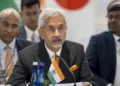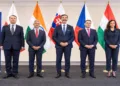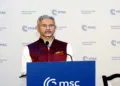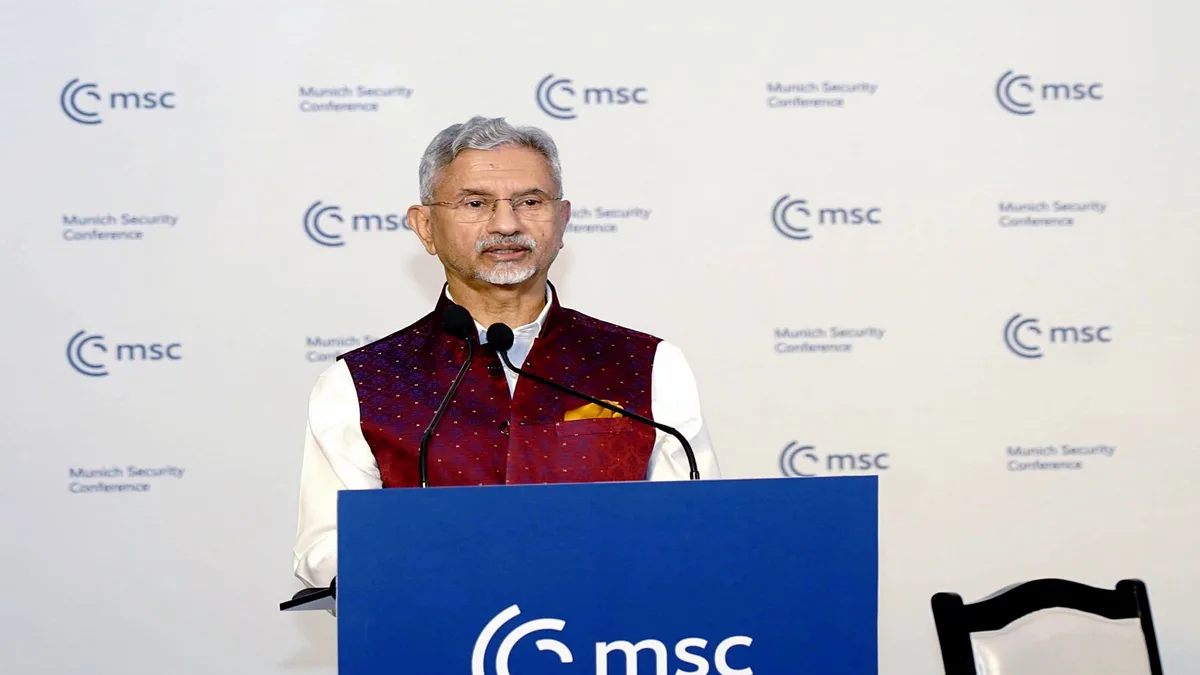
NEW DELHI: External Affairs Minister Dr. S. Jaishankar outlined a broad roadmap for the emerging and middle powers to navigate a rapidly changing global order. He stressed that strategic autonomy, supply-chain resilience, connectivity, technology and agenda-based cooperation are new and prospectiv avenues of cooperation amid changing geopolitical landscape.
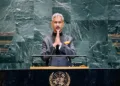
Addressing the Munich Leaders Meeting in New Delhi, EAM Jaishankar said that the repositioning of the US, the China factor and growing interdependence are reshaping international politics, creating greater space for countries such as India to play a decisive role in a multipolar world.
Addressing the opening session of Munich Leaders Meeting 2026, in New Delhi. @MunSecConf #MLMNewDelhi https://t.co/I5M2893oG1
— Dr. S. Jaishankar (@DrSJaishankar) October 4, 2026
Emerging and middle powers must shape the new order
EAM Jaishankar said that the emerging and middle powers from both the Global South and Global North are united by a desire to become more relevant in global affairs. “The world is changing, its agenda is changing, the landscape is changing, the architecture is changing”, he said, arguing that there is now a substantial agenda for these countries to cooperate. He identified international peace and security, resilient supply chains, connectivity, climate action, defence, health, advanced manufacturing and space as key areas for cooperation.
A pleasure to speak at the #MLMNewDelhi today on emerging and middle power (EMP) cooperation. Thank Ambassador @ischinger, Chairman of the @MunSecConf.
Made the following points:
✅ EMPs are from Global South & Global North, united in their goal of being more relevant. They are… pic.twitter.com/Njssvj1nBO
— Dr. S. Jaishankar (@DrSJaishankar) October 4, 2026
De-risking & diversifictaion; Not agenda-oriented rigid alliances
EAM Jaishankar also asserted that the emerging and middle powers are increasingly pursuing de-risking, diversification and agenda-based cooperation rather than rigid alliances. Such an approach, he said, is contributing to the emergence of a new architecture defined by multipolarity, multi-alignment and smaller, flexible groupings.
US industrial policy, China factor reshape global dynamics; Illustrates Goldilocks scenario
EAM Jaishankar described the “radical repositioning” of the United States and the China factor as two defining features of the current geopolitical landscape. He cautioned that Washington’s transformation should not be viewed merely through the prism of one administration, pointing to the continuity of industrial-policy measures from the first Trump administration through the Biden presidency.
“The very idea of the United States having an industrial policy, which historically Americans were very uncomfortable with, actually persisted under Biden”, he said. At the same time, the rise of China and intensifying US-China competition have increased the strategic importance of economic and technological leverage.
EAM Jaishankar argued that in an interconnected world, countries are increasingly asking who controls production, markets, purchasing power and supply chains. Against this backdrop, he advocated a “Goldilocks scenario”—avoiding excessive confrontation while ensuring that no single power dominates the global system.
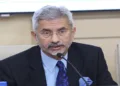
In conversation with @ischinger, President @MunSecConf and Bernard Kotsch, State Secretary, Federal Foreign Office, Germany at the Munich Leaders Meeting #MLMNewDelhi. https://t.co/jZm2FJrPYx
— Dr. S. Jaishankar (@DrSJaishankar) October 4, 2026
India’s strategic autonomy and multi-alignment
EAM Jaishankar also highlighted self-reliance as a common trend among emerging and middle powers, drawing a parallel with India’s Atmanirbhar approach. Rather than demanding complete convergence of interests, he said countries can cooperate wherever they have sufficient “touch points”.
This approach is already visible through platforms such as the Quad, BRICS and other issue-specific coalitions. Connectivity, he noted, is another important pillar, with projects such as the India-Middle East-Europe Economic Corridor(IMEEC), International North-South Transport Corridor(INSTC) and Northern Sea Route(NSR) offering avenues for greater cooperation.
BRICS signals demand for a wider global conversation
EAM Jaishankar cited BRICS as an evidence that countries increasingly want a greater diversity of voices in global decision-making. He noted that BRICS has expanded substantially and said that the interest shown by countries seeking membership demonstrates that nations want “other players in the room” and alternative platforms for cooperation.
The challenge now, he said, is for BRICS to develop a deeper agenda that reflects its growing global weight. The grouping held its expanded summit in New Delhi on September 12–13 under India’s chairship, with the theme “Building for Resilience, Innovation, Cooperation and Sustainability”.
India-EU FTA could be a “real game changer”
EAM Jaishankar also placed strong emphasis on India-Europe relations, arguing that an India-EU Free Trade Agreement could transform the broader relationship. “Having an FTA makes you a serious partner. It is a real game changer in how you perceive each other”, he said.
He identified advanced manufacturing, semiconductors, Artificial Intelligence, life sciences, space, defence and renewable energy as major areas for deeper cooperation. EAM Jaishankar said India and Europe have considerable convergence on AI and highlighted that the growing role of Global Capability Centres in connecting the two economies.
He also pointed to the growing capabilities of Indian defence startups and rising defence exports, saying Indian companies are increasingly finding partners abroad. India and the EU recorded USD 136.54 billion in goods trade in 2024–25, while services trade reached USD 83.10 billion in 2024, underscoring the scale of the relationship.
“AI for Humanity”: India’s human-centric technology vision
On Artificial Intelligence, EAM Jaishankar highlighted India’s approach of using digital capabilities for governance and social transformation. He said that AI should be accessible and affordable and deployed for socio-economic purposes, describing India’s approach as “AI for humanity”.
At the same time, he warned that the safety and security implications of AI are too significant to be left entirely to market forces, underscoring the need for appropriate policy oversight.
India advocates dialogue & peace in Russia-Ukraine conflict
On the Russia-Ukraine conflict, EAM Jaishankar said that India continues to advocate dialogue and diplomacy while increasingly engaging with both Moscow and Kyiv. He said that New Delhi has been discussing issues including Black Sea shipping safety, grain and energy exports and possible non-attack arrangements.
Speaking at the Munich Leaders’ Meeting, EAM Jaishankar said that India has been calling for a negotiated settlement for years but has become more directly involved in recent months. ”We have been advocating it for many years, and in recent months we have got a little bit more involved beyond advocacy. We have conversations with both Russia and Ukraine in this regard. We are trying to be helpful, starting with the Black Sea safety of shipping issue”, EAM Jaishankar further aded.
EAM Jaishankar reiterated that India’s historical relationship with Russia has expanded beyond defence into energy, trade, investment, nuclear cooperation and space.
India’s responsibility will grow with its global standing
Looking ahead, EAM Jaishankar said India’s demographic strength and sustained economic growth give it the potential to remain a major growth engine for decades. He stressed, however, that rising economic weight also brings greater responsibility.
“As our economy grows, our standing grows, our responsibility and contributions also have to grow”, he said. He called for reform of global institutions, including the United Nations, arguing that the objective should not be to discard the existing architecture but to “fix” it.