NEW DELHI: The Union Public Service Commission (UPSC) on October 1 marked a historic milestone as it completed 100 years of its institutional journey, tracing its evolution from a limited colonial-era recruiting body to an independent constitutional institution at the heart of India’s public administration.
The centenary celebrations were held at Bharat Mandapam in New Delhi, with Prime Minister Narendra Modi addressing the gathering. The event brought together chairpersons and members of State Public Service Commissions, along with officials and other dignitaries.
PM Modi called for reforms in the country’s public service recruitment system, stressing the need for faster examination cycles, greater standardisation and wider use of technology to make recruitment more efficient and responsive.
He said the expansion of educational and career opportunities has created a much larger pool of talent seeking to enter competitive examinations. While describing the growing talent pool as a major strength for the country, he also underlined the greater responsibility it places on institutions conducting recruitment examinations.
The Prime Minister said competitive examinations should not be treated merely as isolated events and called for reducing the time taken to complete recruitment processes. Delays, he noted, can impose significant financial and emotional burdens on candidates and their families, who may incur expenses on coaching, accommodation and transportation while waiting for recruitment to conclude.
PM stresses standardisation and technology
PM Modi called for examining whether recruitment processes followed by different public service commissions could be standardised wherever appropriate. He said greater collaboration, technology adoption and sharing of best practices could help make recruitment more efficient.
Highlighting the changing nature of governance, he said emerging challenges such as artificial intelligence, information wars, deepfakes, algorithmic bias and climate justice would require future civil servants to possess stronger problem-solving abilities and long-term thinking. Civil service examinations and training, he said, should evolve accordingly.
‘Citizen First’ approach to public service
Emphasising the role of civil servants, PM Modi said public servants must remain pro-people, proactive and innovative. Referring to the principle of ‘Nagrik Devo Bhava’, he said serving citizens should remain the foremost objective of public administration.
He also identified ‘Nation First’ and ‘Citizen First’ as two principles that should guide the selection of candidates for public service. The Prime Minister said governance must ensure that citizens’ interests remain at the centre of decision-making.
PM Modi also highlighted the increasing participation of women in the civil services, noting that the proportion of women candidates has risen significantly over the years. He pointed to the contribution of women to the UPSC’s history, including women who have served as chairperson of the Commission.
He said the UPSC and State Public Service Commissions have an important role in building effective governance and contributing to the goal of Viksit Bharat.
From colonial recruitment to a constitutional institution
The UPSC traces its origins to October 1, 1926, when India’s first Public Service Commission was established under the Government of India Act framework. Sir Ross Barker became its first chairman, and the Commission initially operated from Metcalfe House in Delhi.
The creation of the Commission followed decades of debate over merit-based recruitment to public services. The Indian Civil Service examination had been introduced in 1855, but for years the examination was conducted in London and remained largely inaccessible to Indians.
Satyendranath Tagore, who cleared the examination in 1863, became the first Indian to enter the Indian Civil Service. His achievement was followed by other Indian candidates, even as restrictions relating to age, location and the examination system continued to pose barriers.
The Government of India Act, 1919 provided for the creation of a Public Service Commission, while the Lee Commission later recommended the establishment of a statutory body. This eventually led to the formation of the Public Service Commission in 1926.
The institution underwent several transformations before becoming the Union Public Service Commission on January 26, 1950, when the Constitution came into force.
▪️On 1 October 2026, the Union Public Service Commission (#UPSC) completes one hundred years
▪️Its institutional journey began on 1 October 1926, when India’s first Public Service Commission was constituted – an advisory body whose Chairman and Members were appointed by the… pic.twitter.com/0n3Weduuxe
— PIB India (@PIB_India) September 30, 2026
Constitutional safeguards
The Constitution placed Public Service Commissions under Part XIV, Articles 315 to 323, providing them with a defined constitutional mandate and safeguards intended to protect their independence.
The UPSC conducts examinations for several key services, including the Civil Services, Indian Forest Service, Engineering Services, Combined Medical Services, National Defence Academy and Naval Academy, Combined Defence Services and Central Armed Police Forces.
Beyond examinations, the Commission advises the government on recruitment rules, promotions, disciplinary matters and appointments to various services.
A century of changing examinations
Over the decades, the Commission has repeatedly changed its examination and recruitment systems in response to the needs of a growing country.
The three-stage Civil Services Examination structure — Preliminary, Main and Interview — was introduced in 1979. Computerisation later transformed application processing, examination management and evaluation.
The Commission has also expanded access and representation. Women, candidates from Scheduled Castes and Scheduled Tribes, and Persons with Benchmark Disabilities have increasingly participated in and been recommended through its recruitment processes.
In 2021, women were admitted to the NDA and Naval Academy examination for the first time, marking another significant step in the evolution of the recruitment system.
From paper applications to AI-enabled security
The UPSC’s modernisation has increasingly focused on technology and examination security.
Recent initiatives include a revamped Universal Registration Number, randomised interview boards, online representations on provisional answer keys and a candidate helpdesk.
The Commission also introduced AI-enabled facial authentication on a large scale during the Civil Services (Preliminary) Examination 2026 to verify candidates at examination centres.
A review of candidate data before the 2026 preliminary examination also resulted in the rejection of hundreds of applications after false information was detected in claims relating to additional attempts.
A growing examination ecosystem
The scale of UPSC’s operations has expanded dramatically. Applications across its examinations and recruitment-by-selection processes rose from 42,727 in 1950-51 to more than 45 lakh in 2022-23.
The number of examination centres also increased from eight in 1950 to more than 80, reflecting the geographical expansion of India’s competitive examination system.
The Commission’s figures show a substantial rise in the representation of women and candidates from historically disadvantaged communities among those recommended for the Civil Services.
Looking ahead
As the UPSC completes its first century, the institution faces a public service landscape increasingly shaped by technology, changing administrative requirements and demands for greater accessibility and transparency.
During the centenary celebrations, PM Modi highlighted the Commission’s contribution to nation-building and its role in identifying generations of public servants. He said that while technology, government systems and examination patterns have changed, the institution’s core values have remained intact.
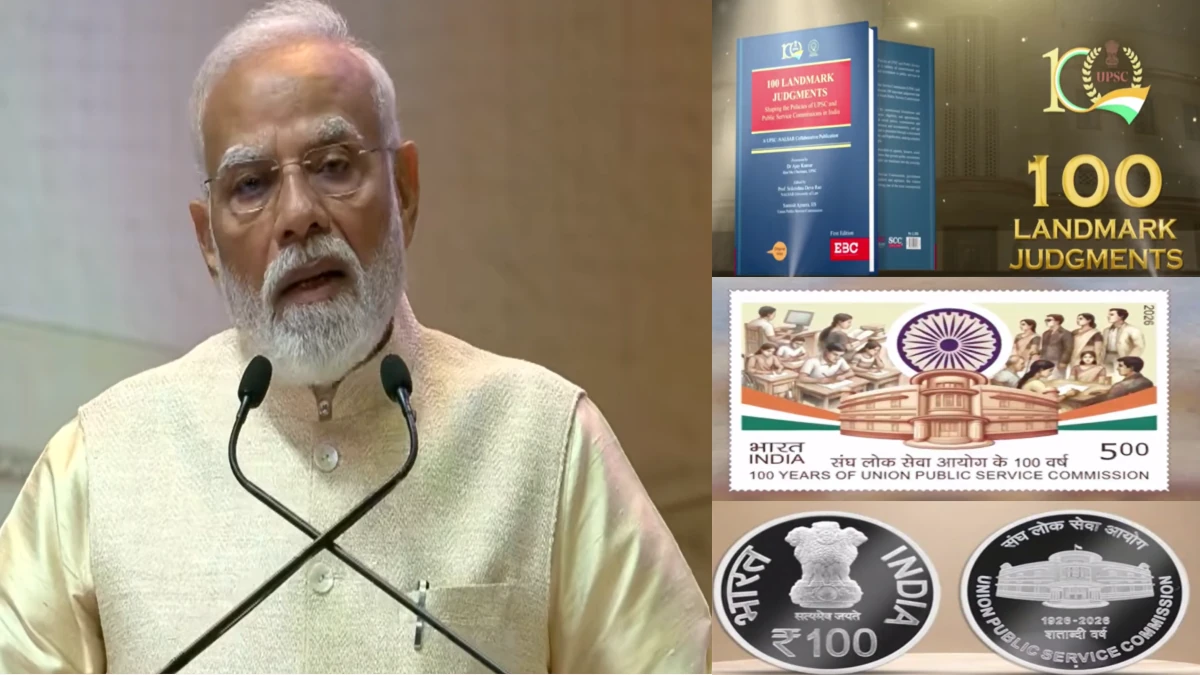
As part of the celebrations, the Prime Minister unveiled a special gallery showcasing the UPSC’s 100-year journey, featuring key milestones and photographs. He also released a commemorative coin and stamp marking the Commission’s centenary and its contribution to public service recruitment.