स्वस्थस्य स्वास्थ्यरक्षणम्, आतुरस्य विकारप्रशमनम्
Protect the health of the healthy, heal the ailment of the sick.
Nearly half of Bharat already uses Ayurveda or an allied Ayush system, often without calling it that. The National Sample Survey on Ayush (July 2022 to June 2023) found that around 46 per cent of rural and 53 per cent of urban Indians had used Ayush for prevention or treatment in the preceding year.
Ayurveda alone accounted for 40.5 per cent in villages and 45.5 per cent in cities. Awareness touched 95 per cent. As the country marked the 11th Ayurveda Day on 23 September 2026 under the theme Ayurveda for a Healthier Tomorrow, the real story lies less in ceremonies and more in a simple question every family asks: where can I get genuine Ayurvedic care, will it be safe, and who will pay for it?
What Ayurveda actually says
The word Ayu means life, and Veda means knowledge. With roots traced to the Rigveda and a history of over 5,000 years, the system rests on two foundational texts, the Charaka Samhita and the Sushruta Samhita. Its purpose, spelt out in the Charaka verse above, is twofold: to keep the healthy well and cure the sick.
Health, in Ayurvedic terms, is balance. The three bio-energies or doshas, the metabolic fire called agni, the bodily tissues or dhatus and the waste channels or malas must work in harmony alongside a calm mind, steady senses and a serene self.
Treatment draws on plants, minerals and animal products, but diet, daily routine and seasonal living carry equal weight. That is why the NSS survey found Ayush being used chiefly for rejuvenation and prevention rather than only for cure, and why around 85 per cent of rural households know at least one medicinal plant or home remedy.
Ayurveda Day was first observed in 2016 on Dhanvantari Jayanti, the Dhanteras festival honouring the divine physician. Because that date follows the lunar calendar, it shifted every year. In 2025, the Centre notified 23 September as a fixed date.
It falls around the autumnal equinox, when day and night are nearly equal, a fitting symbol for a science built on balance, and it gives Ayurveda a steady place on the global calendar.
Where can a citizen get Ayurvedic care today?
For decades, the typical Ayurvedic dispensary was a small rented room with irregular supplies. That picture is changing through two missions working together: the National Ayush Mission (NAM) under the Ministry of Ayush and the National Health Mission (NHM) under the Health Ministry. Between 2014-15 and 2025-26, the Centre released over ₹6,406.99 crore to States and Union Territories through NAM alone.
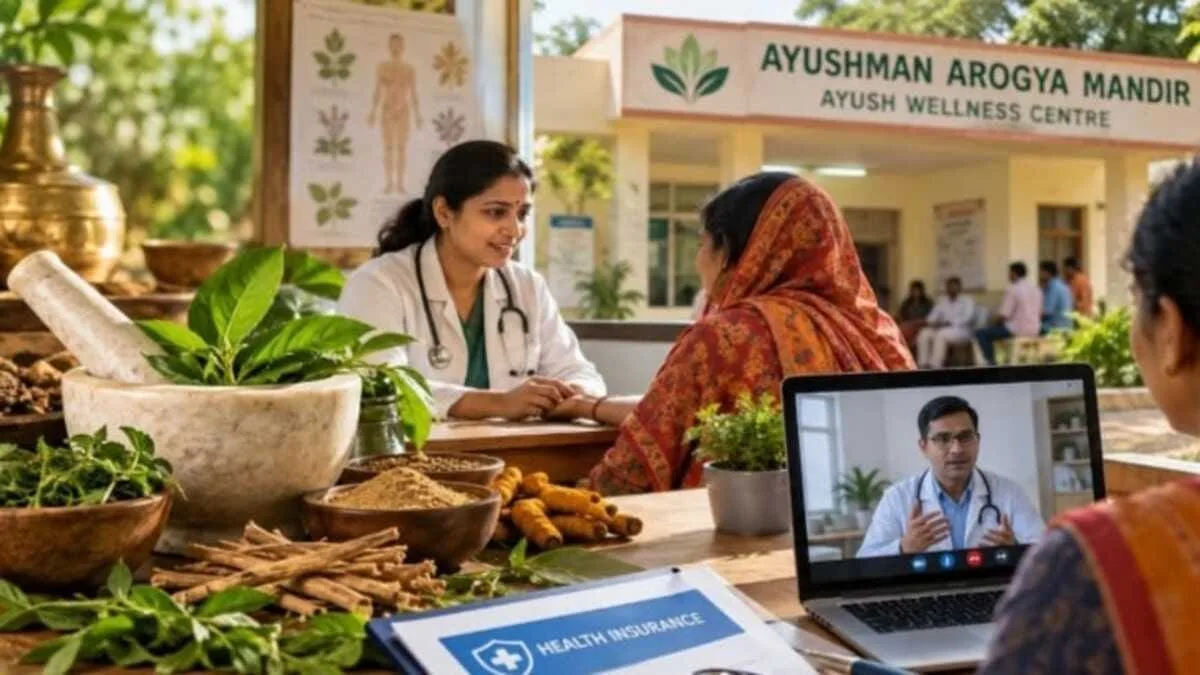
Ayushman Arogya Mandir (Ayush): Old dispensaries are being upgraded into wellness centres. As of 19 September 2026, 12,260 such centres were functional against a target of 12,500. NAM provides buildings, equipment and medicines, while NHM funds and trains the staff.
Ayush counters now sit alongside allopathic care in 13,249 public facilities: 6,302 Primary Health Centres, 3,191 Community Health Centres, 475 District Hospitals and 3,281 other facilities. The government pays salaries for 25,322 Ayush doctors and 5,666 Ayush paramedics. A BAMS graduate can also serve as a Community Health Officer running a village-level centre.
Premier central hospitals such as Safdarjung Hospital with VMMC and Lady Hardinge Medical College now house Departments of Integrative Medicine with working Panchakarma units, while Dr Ram Manohar Lohia Hospital hosts extended OPDs run by the Ayush Research Councils. The new AIIMS also offer Ayush services.
NAM funds new integrated hospitals of 10, 30 or 50 beds, moves clinics out of rented premises and ensures a free supply of essential medicines. Public health drives and awareness campaigns built around preventive care and traditional wellness complete the package, taking the message beyond hospital walls.
For those far from any hospital, the free eSanjeevani telemedicine platform, which has served more than 50 crore patients across all streams, includes Ayush OPDs. A farmer in a remote block can consult an Ayurveda specialist by video without spending a day and a bus fare travelling to the district town, and without losing a day’s wages.
Will Insurance pay after treatment?
This has long been the sticking point. The NSS data show that a rural patient spends around ₹394 a year out of pocket on Ayurvedic care, rising to ₹499 in cities. Three changes aim to ease that burden.
First, in 2024, the Insurance Regulatory and Development Authority of India (IRDAI) directed every insurer to offer products or add-ons covering all systems of medicine, Ayurveda included.
Second, on 10 February 2026, the All India Institute of Ayurveda (AIIA), New Delhi, signed a common empanelment agreement with the General Insurance Council, linking it to all 32 general insurers for cashless treatment. No AYUSH institution had done this before. AIIA has also opened a helpline, 1800-11-0008, for insurance queries.
Third, the World Health Organisation has added Ayurveda, Siddha and Unani terms to a module of the International Classification of Diseases (ICD-11). Doctors anywhere can now record an Ayurvedic diagnosis with a standard code, which makes claims easier to process and data easier to compare.
Is it safe? The checks behind the bottles
Herbal means harmless is a myth, and the law treats it as one. Ayurvedic medicines fall under the Drugs and Cosmetics Act, 1940, and the Drugs Rules, 1945. Manufacturers must follow Good Manufacturing Practices, meet pharmacopoeia standards and establish safety and efficacy.
Drug inspectors sample products routinely, backed by a dedicated Ayush vertical in the Central Drugs Standard Control Organisation. The e-Aushadhi portal tracks manufacturing licence applications online.
Food gets similar attention. The Food Safety and Standards Authority of India, working with the Ministry of Ayush, has notified standards for Ayurveda Aahara, with a list of authentic dietary products drawn from classical texts. For a consumer, the practical lesson is simple: buy from licensed manufacturers and consult a registered practitioner.
Who is training tomorrow’s Vaidyas?
An expanding network needs trained hands. As of 13 March 2026, the country had 593 Ayurveda colleges offering 45,245 undergraduate and 5,673 postgraduate seats. Of 17 new Ayush colleges approved under NAM, 12 focus on Ayurveda.
The Union Budget 2026-27, which allotted ₹4,408 crore to the Ministry of Ayush, announced three new All India Institutes of Ayurveda along with upgraded pharmacies and drug testing laboratories.
Critics often ask for proof, and the answer is being built project by project. The AYURGYAN scheme launched in 2021-22 has committed ₹9.38 crore to 17 Ayurveda projects out of a ₹17.79 crore research pool. The AYUR SWASTHYA Yojana has created 28 Centres of Excellence, 22 of them Ayurveda-focused.
The Central Council for Research in Ayurvedic Sciences works through 30 institutes, and its SPARK studentship has reached students in 289 colleges. Since March 2026, CCRAS has used the AICTE-developed Anuvadini AI platform to translate its research into 13 Indian languages, so a practitioner in Odisha or Assam can read findings in her own tongue.
The research is growing, still modest compared with the system’s reach. Well-designed clinical trials, published and peer-reviewed, remain the surest route to wider acceptance among doctors and patients alike.
From Bharat to the world
The global footprint is widening too. In December 2025, Bharat Mandapam hosted the Second WHO Global Summit on Traditional Medicine, with delegates from over 100 countries adopting the Delhi Declaration on integrating traditional medicine into primary healthcare.
India has signed 27 country-to-country agreements, set up 46 Ayush Information Cells in 43 nations and introduced M-3 and M-4 Ayush visas for foreign patients and their caregivers.
The WHO Global Traditional Medicine Centre at Jamnagar in Gujarat serves as a research and policy hub; the Ministry of Ayush has worked with the WHO on standard training benchmarks for Ayurveda and Unani.
Sixteen agreements have set up AYUSH academic chairs at foreign institutions, and 104 scholarships have been offered to foreign nationals who want to study the system in India.
At the 16th BRICS Health Ministers Meeting in Chandigarh, member nations created a dedicated Expert Working Group on traditional, complementary and integrative medicine. The pattern matters. Ayurveda travels abroad best when it carries standards with it: coded diagnoses, regulated medicines and trained teachers.
That is what separates a respected medical tradition from a passing wellness fad, and it explains why the WHO centre at Jamnagar is being upgraded under this year’s Budget.
Ayurveda no longer needs to prove that people want it; the survey numbers settle that. What it now needs is what any health system needs: trained practitioners, quality-checked medicines, fair insurance cover and a steady flow of evidence.
On all four fronts, the foundations are in place. For the ordinary citizen, the shift is already visible: an Ayush counter in the district hospital, a video consultation on the phone and insurers who must now offer cover for Ayurvedic treatment. The next decade will decide how well this groundwork is built upon, so that the ancient promise to protect the healthy and heal the sick reaches every household.