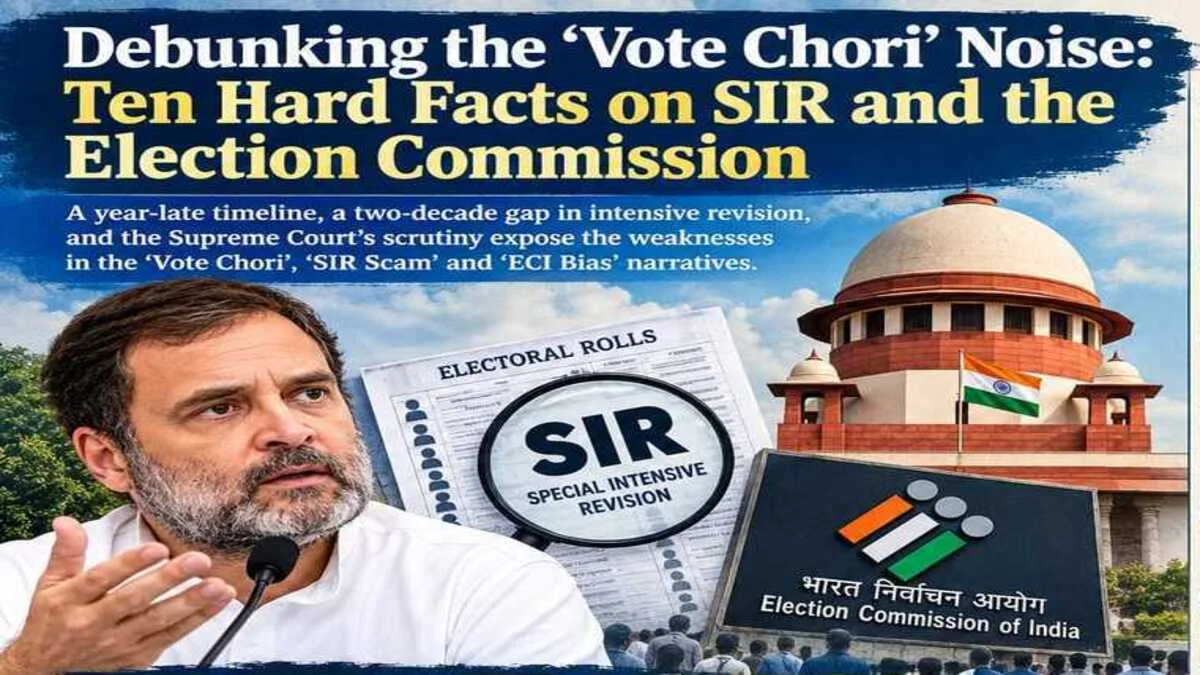
The political rhetoric surrounding the Special Intensive Revision (SIR) of electoral rolls has acquired a familiar vocabulary: “Vote Chori”, “SIR Scam” and “ECI Bias”. Repeated often enough, such slogans can create an impression of settled fact. But electoral controversies are ultimately tested not by the volume of political rhetoric, but by chronology, institutional records, judicial scrutiny and verifiable evidence.
A closer examination of the timeline and the record provides ten important facts.
First, the chronology does not support the claim that 13 crore voters were deleted through SIR to influence the 2024 Lok Sabha election. The general election was held in April–June 2024, whereas the present SIR exercise began only in June 2025.
The names left out of the draft rolls during the revision therefore could not have been removed to influence an election that had already taken place a year earlier. The exercise primarily sought to identify entries relating to deceased, duplicate, shifted and long-absent electors. At the same time, eligible citizens retain avenues to seek inclusion in the electoral rolls. A claim that requires an electoral-roll revision conducted a year after an election to explain the outcome of that election faces an obvious chronological problem.
Second, SIR is not a new political invention. Intensive revision of electoral rolls has been part of India’s electoral-administrative practice for decades. Such exercises were undertaken in 1965–66, 1983–84, 1993, 1995, 2002 and 2003. Their stated purpose has consistently included identifying ineligible, duplicate, deceased and shifted entries and improving the accuracy of electoral rolls. To portray intensive revision as a newly devised partisan instrument therefore overlooks the historical record of India’s electoral administration.
Third, the Supreme Court’s intervention does not amount to a rejection of SIR. On 27 May 2026, the Court recognised the Election Commission’s authority to undertake the exercise while also insisting upon safeguards to protect the voting rights of eligible citizens. The significance of that judicial scrutiny is difficult to reconcile with the claim that SIR is simply an extra-constitutional or inherently illegitimate exercise.
The Court’s approach was not to leave eligible voters without remedy, but to insist that the revision operate with procedural safeguards.
Fourth, the present SIR cannot plausibly be explained as a response to the BJP’s 240-seat tally in the 2024 Lok Sabha election. The previous nationwide intensive revision took place in 2002–04—more than two decades before the present exercise. In the intervening period, India experienced major demographic and administrative changes, including the COVID-19 pandemic and the postponement of the 2021 Census.
Concerns over deceased voters, duplicate entries and voters who had permanently shifted residence have also been raised by political parties and election stakeholders at different points. The administrative issue therefore predates the BJP’s 2024 electoral tally.
Fifth, the theory that SIR was designed as a mechanism to eliminate regional political leaders also runs into the electoral record. In Tamil Nadu, the BJP won one Lok Sabha seat in 2024. In Kerala, it won three. Political outcomes in these states cannot simply be reduced to a single electoral-roll exercise.
West Bengal, meanwhile, has seen intense judicial scrutiny of the revision process. There has been no judicial finding establishing that SIR was responsible for particular electoral outcomes. The broader political record also complicates the theory of an all-powerful electoral “masterplan”. The BJP has itself lost numerous Assembly elections since 2015, including in Karnataka and Himachal Pradesh, while remaining in power at the Centre.
Sixth, the chronology surrounding Gyanesh Kumar makes one particular allegation impossible on its face. Haryana voted in October 2024 and Maharashtra in November 2024. Gyanesh Kumar became Chief Election Commissioner only in February 2025.
Consequently, whatever arguments may be advanced about his tenure as CEC, the electoral outcomes in Haryana and Maharashtra in 2024 cannot logically be attributed to decisions taken by him as Chief Election Commissioner. He did not hold that office when those elections were conducted.
Seventh, the proposition that the BJP invariably defends the Election Commission is contradicted by the party’s own conduct. The BJP has, at various times, raised objections concerning electoral-roll revision and the functioning of the electoral machinery, including in opposition-ruled states. It has also approached the Election Commission regarding alleged irregularities.
Whatever one’s assessment of those complaints, their existence demonstrates that the relationship between a political party and the Election Commission cannot simply be reduced to a permanent alliance or unconditional defence.
Eighth, the constitutional and statutory framework does not make the Chief Election Commissioner a government appointee who can simply be hired or removed at will. The appointment mechanism was changed by legislation in 2023. Under the present framework, the selection committee comprises the Prime Minister, the Leader of the Opposition in the Lok Sabha and a Union Cabinet Minister nominated by the Prime Minister.
Rahul Gandhi, as Leader of the Opposition, participated in the selection process that resulted in the appointment of Gyanesh Kumar. The Constitution also provides substantial safeguards concerning removal of the Chief Election Commissioner, requiring a parliamentary process rather than unilateral executive action.
The institutional framework is therefore considerably more structured than the description of a simple government-controlled appointment would suggest.
Ninth, reported differences within the Election Commission do not establish that the Commission’s final decisions were invalid or institutionally divided. Reports have suggested that two Election Commissioners raised concerns regarding aspects of the SIR process. At the same time, the Commission has stated that the final orders were taken unanimously and signed by all three members.
The distinction matters. Internal discussion or disagreement over aspects of an administrative process is not, by itself, evidence that the final institutional decision was unlawful or partisan.
Tenth, allegations of “Vote Chori” ultimately require evidence capable of being examined. The Election Commission publicly asked Rahul Gandhi to provide his allegations and supporting material in writing so that they could be examined and, where appropriate, investigated. The dispute over whether sufficient material was subsequently supplied has itself become part of the political controversy.
Meanwhile, the Supreme Court has exercised continuing oversight over aspects of the SIR process, including mechanisms for hearing voter grievances in West Bengal and the use of its constitutional powers where considered necessary.
The essential democratic principle is straightforward: allegations concerning electoral integrity should be capable of being tested against evidence, records and due process. Claims may generate political headlines; evidence is what permits an institutional finding.
Taken together, these facts place the SIR controversy in a very different context. Intensive revision is not a new concept in Indian electoral administration. The present exercise follows a gap of more than two decades since the previous nationwide intensive revision, and it has been subjected to judicial scrutiny and procedural safeguards.
That does not mean that every individual exclusion is automatically justified, nor that every administrative decision is beyond scrutiny. Electoral-roll revision must necessarily remain open to correction wherever an eligible voter is wrongly excluded. That is precisely why claims, objections, appeals and judicial remedies matter.
But the larger question should be approached through the documented record rather than political slogans. Political parties of every hue have, at different times, raised concerns about deceased, duplicate and shifted entries in electoral rolls—the very categories that intensive revision seeks to identify.
The credibility of India’s electoral process ultimately depends on transparency, verification, inclusion of every eligible citizen and accountability for every genuine irregularity. The proper test of the “Vote Chori” and “SIR Scam” allegations, therefore, is not how loudly they are repeated, but whether the evidence sustains them when subjected to institutional and judicial scrutiny.