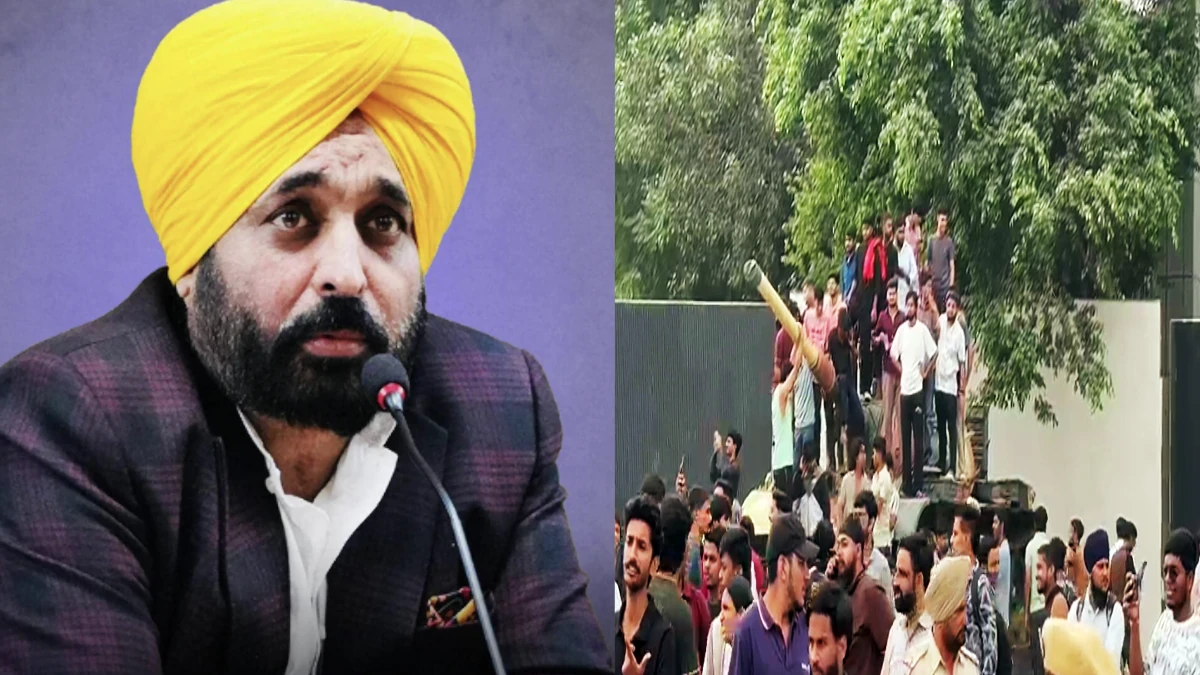
CHANDIGARH: While the AAP’s Bhagwant Mann government in Chandigarh projects an image of order and progressive governance, Lovely Professional University in Phagwara descended into open chaos over the weekend. Students, furious over an alleged rape inside a girls’ hostel, ransacked parts of the campus, set vehicles ablaze, and seized a stretch of National Highway-44 for more than 15 hours. When police finally moved in under the Mann administration’s command, the response was a lathi charge that further inflamed tempers and handed the opposition fresh ammunition.
The spark was a series of unverified claims that a female student in Girls’ Hostel-3 had been sexually assaulted by a plumber or outside worker around September 23, and that hostel authorities had failed to act.
What began as a late-night gathering near the hostel around 1 a.m. on Sunday rapidly escalated. The scenes from LPU in Phagwara are stark. Students damaged administrative buildings and campus shops, set objects and motorcycles on fire, and even climbed onto a decommissioned MiG-23 aircraft and a military tank on display. By early morning they had blocked the busy Jalandhar–Phagwara section of NH-44, creating long traffic jams that stranded commuters for hours.
The situation has clearly shown that the Aam Aadmi Party government is unable to control the crisis. Law and order in the state has now completely collapsed.
The controversy began with claims that a female student had allegedly been sexually assaulted by an outsider on the university campus. The allegation remains unsubstantiated. Police have registered a rape case against an unidentified person and formed a seven-member Special Investigation Team, while LPU has denied that such an incident occurred and described the reports as false and fabricated.
But while the truth behind the original allegation remains to be established, the breakdown of public order is no longer in dispute. And that is where the Mann government’s political and administrative accountability comes sharply into focus.
From campus grievance to complete breakdown
Students initially demanded justice, better security in girls’ hostels and action against anyone found responsible for the alleged incident. Those concerns quickly spilled into a much wider confrontation.
The protest escalated into vandalism, arson and clashes with police. Protesters blocked the Jalandhar-Phagwara highway, while police vehicles were damaged and set on fire. Police personnel were injured as the confrontation intensified.
The university subsequently suspended regular classes for 10 days and postponed mid-term examinations indefinitely. Students were allowed to return to their hometowns, while those remaining on campus were advised to stay inside their hostels or residences.
The consequence is extraordinary, an educational institution with tens of thousands of students has effectively been forced into an emergency shutdown following a violent breakdown on campus.
The question Punjab is asking is simple, How did a student grievance reach the point where thousands of police personnel had to be deployed to restore order?
Mann government faces the law-and-order question
The Punjab government has attempted to present the police response as measured.
DGP Gaurav Yadav has said police initially tried dialogue and deliberately avoided using force against students. He said action was taken after protesters allegedly attacked police and damaged vehicles. Chief Minister Bhagwant Mann subsequently directed the DGP to visit the campus and ordered strict action against those responsible.
A government cannot be judged only by how it restores order after a situation has exploded. It must also answer whether its intelligence, policing and administrative machinery was capable of detecting and containing the crisis before it became an arson-and-riot situation.
The eventual deployment of more than 2,000 police personnel demonstrates the scale of the emergency. For the Mann government, that number itself is politically significant. If the administration was fully prepared, why did the situation spiral so dramatically?
And if officials had information about outsiders entering the campus, why was stronger action not taken earlier?
These are not questions that can be dismissed as partisan politics. Outsiders, walkie-talkies and the questions piling up The most politically explosive element of the LPU crisis is the reported presence of outsiders.
Police have acknowledged that they are examining the presence of people who were not ordinary students. Reports have also emerged about individuals being detained after a walkie-talkie and other items were found.
Police have said questioning indicated that some of those detained were army personnel who had been sent by an army officer whose daughter was studying at LPU. The circumstances of their presence are being investigated.
At the same time, reports have emerged of students claiming that masked outsiders entered the campus during the violence. The government now has an obligation to establish, with evidence, who entered the campus, why they entered, where they went and what they did during the unrest.
The answer must come from CCTV footage, phone records, entry logs, forensic evidence and arrests not political claims.
BJP turns the heat on AAP
The opposition BJP has seized upon the LPU violence to launch a direct political attack on the Mann government.
Former Union minister and BJP leader Ravneet Singh Bittu has alleged that the unrest was part of an “AAP conspiracy”, claiming that the state government wanted to disrupt the political atmosphere in Jalandhar ahead of Union Home Minister Amit Shah’s proposed rally. Bittu has also alleged that political actors attempted to exploit the LPU situation for their own purposes. These allegations have not been established by investigators.
Bittu has further alleged that the police response was deliberately lax and that the unrest was allowed to escalate.
The rape allegation must not become a political weapon
The most sensitive part of the entire controversy remains the alleged sexual assault. The allegation must be investigated with absolute seriousness. At the same time, the absence of established evidence cannot be replaced by political narratives.
Police have registered a case and formed an SIT. Investigators are expected to examine forensic evidence, CCTV footage, call records and other material. That investigation must be allowed to run its course. If a crime occurred, the perpetrator must face the full force of the law.