“I claim to be a democrat both by instinct and training. Let those who are ambitious to serve democracy qualify themselves by satisfying first this acid test of democracy. Moreover, a democrat must be utterly selfless. He must think and dream not in terms of self or party but only of democracy. Only then does he acquire the right of civil disobedience. I do not want anybody to give up his convictions or to suppress himself. I do not believe that a healthy and honest difference of opinion will injure our cause. But opportunism, camouflage or patched up compromises certainly will. If you must dissent, you should take care that your opinions voice your innermost convictions and are not intended merely as a convenient party cry”
– M K Gandhiji, Cultivation of the Democratic spirit: Essential for the Satyagrahi, Harijan, May 27, 1939
As we approach Gandhi Jayanti, it’s another chance to introspect on what has actually happened to Gandhiji’s philosophy and his techniques of Satyagraha. It is all the more relevant when Gandhian ideas of peaceful resistance are combined with the political objectives of Marx and Mao, along with the imagery of Dr Babasaheb Ambedkar.
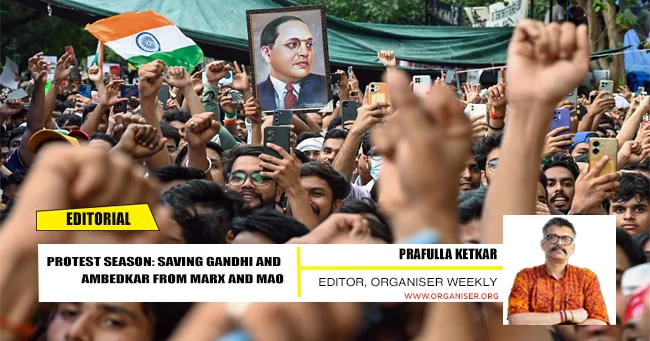
Since the Jantar-Mantar agitation, led by the self-proclaimed sole representative of youth, a new season of protests has started. After a period of hibernation, the one that followed the ‘Constitution under threat’ narrative during the 2024 Lok Sabha elections, which fetched limited success, has new issues and a new template to vitiate the atmosphere. The identity-based machinations are now successfully using youth on the issues of education and caste identities combined. The trend is expected to continue at least until the 2027 Uttar Pradesh Elections, or even until 2029.
In a democracy, protests and agitations are natural expressions to put forth demands. Invoking icons like Gandhiji and Babasaheb Ambedkar is also obvious. The way Gandhi’s ideas of Satyagraha and Dr Ambedkar’s imagery are manipulated by the Communists inspired by Marx and Mao is a problematic thing. Gene Sharp’s method of ‘resistance’ that undermines elections is a worrying trend.
The IIT Bombay suicide case is one such case. Alleged cheating during examination and subsequent disciplinary action turned into a caste-based discrimination issue. Any untimely death, especially suicide, is bad news not just for the family and institution but for every one of us as a society. If IIT students, irrespective of caste, are unable to handle the mental pressure and resort to an extreme step like suicide, it requires introspection, not agitation. Is it due to family and social pressure rather than institutionalised discrimination at IITs? Is our younger generation facing mental health issues due to lack of communication within the family or loneliness syndrome? As the data related to suicides and dropouts do not justify the caste-based allegations, it requires serious multidimensional thinking and correction beyond the politics of protests. Ideological activism in the humanities and law should not be allowed to undermine the IIT brand that symbolises excellence. Competition, social and familial pressures, and focus on marks and package-based success do not prepare students to face harsh realities of life. The pursuit of excellence and a purposeful life is the value that needs to be nurtured, instead of instigating youth on caste lines.
Representing internal conversations between the Election Commissioners to discredit electoral democracy is part of the same machinations. EVMs are questioned. Constitutionally mandated processes like SIR to update the electoral rolls are also used to discredit the institution. The Election Commission of Bharat is an institution that has gained global recognition for training and facilitating elections in many countries. Worldwide, attempts to discredit electoral democracy are prevalent. Is it a coincidence, or a pattern we need to decode?
Eventually, the finance commission recommended MDR rules for UPI transactions – that would incur a cost up to 0.4 per cent for commercial transactions above Rs 2000 for traders – may become another protesting issue. The revival of the MDR clause, which was stopped during the COVID–19 pandemic, will not impact individual-level money transfers. Even for merchandise, the cost is minimal and much lower than ATM withdrawals or credit card payments. Again, UPI is Bharat’s technological brand, accepted and respected worldwide. The people challenging the success of UPI technology in rural Bharat are the same ones instigating certain groups through misinformation. Ultimately, they undermine our national technological achievement.
Undermining brand Bharat in the name of democratic rights and agitations has become a fashion. Fuelling protests, invoking caste sentiments in every issue, creating alienation towards the Government and discrediting institutions is the new modus operandi of a Communist-Islamist cabal. Anti-Bharat forces from outside are encouraging and funding these agitations. Some opposition parties are falling prey to this game for short-term political ends.
The appropriation and manipulation of Ambedkarite philosophy and Gandhian techniques to run the continuous protest industry is another cause for concern. Babasaheb Ambedkar had major differences with Gandhiji on caste-based representation and untouchability. They had different perspectives about the idea of ‘village’ as a self-sufficient unit. Yet both were democratic and non-violent at heart. They denounced Communists and their violent strategies. Dr Ambedkar warned against agitational politics once constitutional methods were available. The Communists, who abused and conspired to defeat Dr Ambedkar in every election, are now appropriating him as a poster boy for their ‘revolution’. Every sane person wants to eradicate the caste-based discrimination in society. Instigating both sides to create social feud and anarchy will only harden the walls that Dr Ambedkar wanted to break.
Gandhiji was also very clear about Satyagraha and the behaviour of Satyagrahis. After independence, he wanted followers to engage in constructive programmes to resolve social problems, with a restrictive use of civil disobedience. For him, ‘The true source of rights is duty. Action is duty; fruit is the right’. Common honesty, discipline, sacrifice, non-violence and respect for the unjust rule or government were the basic assumptions for a successful Satyagraha. Congress abandoned Gandhi’s ideals long ago. Now Rahul Gandhi’s Congress is piggybacking on Marxists and Maoists, along with Islamists, to spread fear, hatred and anarchic conditions through misinformation and disinformation. Can there be a bigger insult to Gandhian ideas of Satya, Ahimsa and Satyagraha than this?
These days, we are witnessing a war against resurgent Bharat, by manufacturing protests to create social fragmentation and political instability. Weaponising caste, linguistic and religious identities to weaken unity and integrity is the modus operandi of this narrative warfare. In chanting ‘RSS-BJP’ day in and day out, harm is being done to the social fabric and democratic institutions. While celebrating Gandhiji’s anniversary, along with his true disciple Lal Bahadur Shastri, our primary concern should be strengthening the ideas of Swadharma, Swadeshi, and Swaraj in the changing global context. Intellectually and politically, saving Gandhiji and Babasaheb Ambedkar from Marxist-Maoist radicalism is a prerequisite for ensuring social transformation through a peaceful and democratic process.