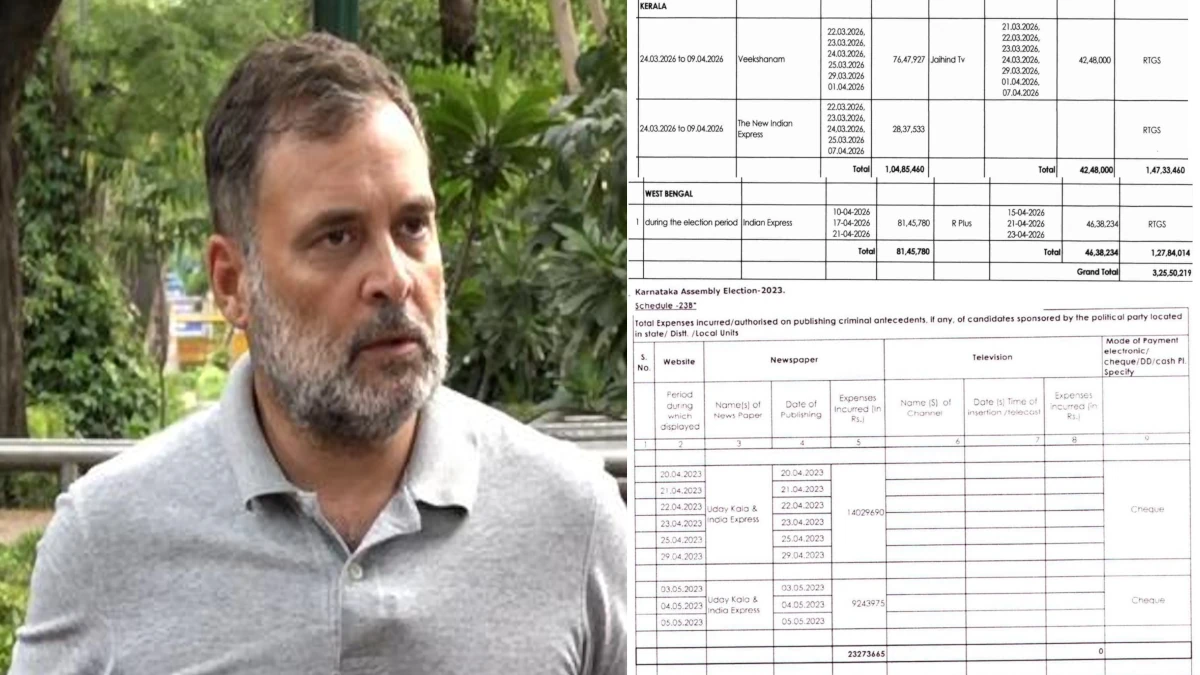
NEW DELHI: A Rs 81.45-lakh election expenditure entry involving The Indian Express has opened a fresh political front over the relationship between political parties, election advertising and media coverage, after Congress expenditure records cited in the ongoing controversy showed a payment of Rs 81,45,780 to The Indian Express during the West Bengal Assembly election period.
The disclosure has come at a particularly contentious moment, with The Indian Express facing sharp criticism from the BJP and other critics over its recent reporting on the Election Commission, the Special Intensive Revision (SIR) of electoral rolls and changes relating to Form 6.
The question being raised is not simply about one newspaper bill. It is about the scale of political advertising expenditure, the timing of the payments and whether readers should examine political-media relationships more closely when newspapers publish reports that directly affect the credibility of constitutional institutions.
And there comes the proof. Congress gave Indian Express INR 81 lakhs during the West Bengal elections. And then in the Karnataka elections. Much more than it gave any other newspaper singularly. Much more to tumble out soon.
It's not done, bro! It's just the tip of the iceberg. https://t.co/RaIt7EKrt1 pic.twitter.com/G6tZ9j3n6E
— Mahesh Jethmalani (@JethmalaniM) September 28, 2026
The expenditure record itself establishes the payment. It does not, by itself, establish that Congress influenced the newspaper’s editorial decisions. Any such conclusion would require additional evidence.
The Bengal Rs 81-lakh entry
The expenditure material cited in the controversy records:
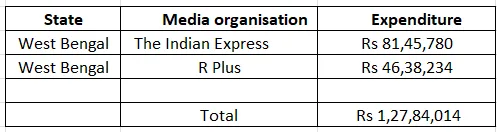
The entry places the Indian Express expenditure during the election period. That figure has assumed significance because the newspaper has simultaneously been at the centre of a fierce public dispute over its reporting on the Election Commission’s handling of the SIR exercise.
The issue is straightforward, why did Congress spend Rs 81.45 lakh on The Indian Express during the Bengal election period, and how should readers interpret that spending when the newspaper’s subsequent reporting has become a major political flashpoint?
The expenditure document does not answer the second question. But it puts the first one firmly on the record.
Kerala: Congress spending across media outlets
The same expenditure material also records substantial Congress payments during the Kerala election period. The entries list:
- Veekshanam: Rs 76,47,927
- Jaihind TV: Rs 42,48,000
- The New Indian Express: Rs 28,37,533
The stated total for these entries is Rs 1,47,33,460. These figures show that Congress election expenditure was spread across newspapers and television outlets.
They also provide context for the Bengal payment, political parties routinely spend significant amounts on media advertising during elections. The existence of such payments, therefore, does not by itself establish editorial influence. But the size and distribution of the payments make transparency an important question.
Karnataka 2023: Another Indian Express expenditure entry
The controversy also points to Congress expenditure during the 2023 Karnataka Assembly election. The material supplied in the expenditure statement records an entry against Udayavani & India Express of Rs 1,40,29,690, followed by another expenditure entry of Rs 92,43,975.
The document shows a combined figure of Rs 2,32,73,665. The figures are now being cited to highlight that substantial Congress election expenditure involving India Express was not limited to one election or one state.
Again, however, the records demonstrate expenditure not an editorial quid pro quo.
Rs 3.25 crore grand total
The expenditure material cited in the controversy gives a grand total of Rs 3,25,50,219 for the listed entries. That transforms the debate from a single Rs 81-lakh payment into a broader question about political advertising expenditure and media organisations.
The issue being raised is whether election-period advertising and subsequent political coverage should always be treated as entirely separate matters—or whether, wherever there is evidence of a relationship, that relationship deserves scrutiny.
The expenditure statements alone cannot answer that question. But they can establish the money trail.
Why has the Rs 81-lakh figure erupted now?
The Indian Express has recently published reports questioning aspects of the Election Commission’s functioning during the SIR exercise, including the handling of electoral rolls, the role of the Commission’s digital systems and the addition of a new SIR-related declaration to Form 6.
One Indian Express report published on September 25 quoted two Election Commissioners as objecting to the Form 6 change and describing it as “illegal” and “unauthorised.”
Another Indian Express explainer examined the additional SIR-related section in the online Form 6 process and raised questions about the procedure through which such changes could be introduced. The reports placed the Election Commission under intense political scrutiny. But the Commission subsequently mounted a strong rebuttal.
Election Commission pushes back
The Election Commission rejected the characterisation of its internal deliberations as a breakdown in unanimity. The Commission’s position is that differing views, observations and suggestions during institutional deliberations are part of the decision-making process and do not necessarily amount to disagreement over final decisions.
It maintained that final decisions relating to SIR were unanimous.
The Commission also rejected suggestions that its digital systems had displaced the statutory election machinery, maintaining that Electoral Registration Officers (EROs) and District Election Officers (DEOs) continue to exercise their statutory powers.
On Form 6, the Commission subsequently said there had been “no change” to the existing Form 6, arguing that the SIR-related material was added as a separate annexure rather than constituting an alteration of the statutory form.
That response goes directly to the heart of the controversy. The newspaper reported concerns raised by Election Commissioners. The Commission responded that those observations and discussions did not amount to a disagreement over final decisions.
BJP launches a detailed fact-check
The BJP then launched its own counter-offensive, challenging what it described as key claims made by The Indian Express regarding the Election Commission’s powers, electoral-roll procedures and Form 6.
The BJP’s fact-check relied heavily on statements attributed to election officials on the ground. One of its central targets was the claim that the Election Commission’s IT department was effectively deciding who remained on or entered the electoral roll and that EROs had been stripped of their authority.
The BJP cited Iti Agarwal, an ERO from Delhi’s Rajouri Garden, to challenge that interpretation. According to the BJP’s account, the ERO remains central to the voter-registration process and continues to exercise the relevant statutory authority.
Indian Express ने चुनाव आयोग पर अपने लेख में वोटर लिस्ट से जुड़ी शक्तियों, आयोग के कामकाज और Form 6 में बदलाव को लेकर कई दावे किए। लेकिन जब इन दावों को तथ्यों की कसौटी पर परखा गया, तो तस्वीर कुछ और ही सामने आई!
सबूतों के साथ पेश है पूरा Fact Check। दावा बनाम सच्चाई, खुद देखिए इन… pic.twitter.com/e7eFkT68vx
— BJP (@BJP4India) September 25, 2026
The administrative hierarchy highlighted in the BJP’s explanation is:
Booth Level Officer (BLO) → Supervisor → Assistant Electoral Registration Officer (AERO) → Electoral Registration Officer (ERO) → District Election Officer (DEO)
The BJP’s argument is that the ERO remains responsible for decisions concerning inclusion of voters in the final electoral roll, while the other officials perform their respective verification and supervisory functions.
Its broader contention is that the electoral-roll system remains decentralised and that EROs have not been stripped of their authority.
The Form 6 battle
The BJP also challenged The Indian Express’s reporting on Form 6. Its argument is that the SIR-related declaration was introduced specifically for the SIR exercise and was temporary rather than a permanent restructuring of Form 6.
The BJP cited ERO Naveen Kumar, who, according to the party, explained that the declaration would cease to apply after the SIR process. The party therefore argued that portraying the addition as an unlawful permanent alteration of Form 6 was misleading.
But this remains a disputed issue.
The Indian Express reported procedural concerns surrounding the new online requirement, while the Election Commission maintained that the SIR-related material was an annexure and not a change to the statutory Form 6.
The difference is important. One side is questioning the manner and authority through which the material was introduced. The Commission is saying that the underlying statutory Form 6 was not altered.
The biggest dispute: Did Election Commissioners object?
The most explosive part of the controversy concerns alleged differences inside the Election Commission. The Indian Express reported that Election Commissioners had raised objections over several decisions connected with SIR, including issues involving voter additions, deletions, restoration and Form 6.
The Election Commission, however, has said that observations, suggestions and notes exchanged during deliberations should not be presented as evidence of a divided Commission.
Its position is that the final decisions were unanimous. That distinction lies at the centre of the political battle. An observation made during deliberations is not necessarily a rejection of the final decision.
A suggestion is not necessarily a dissent. And an internal discussion is not necessarily institutional division. The Commission has therefore rejected the interpretation that its members were ultimately split over the SIR process.
Newspaper’s claims were misleading
The BJP’s response effectively turned the newspaper’s reporting into the subject of a political fact-check. Its central points were that:
- EROs retain authority over voter-list decisions;
- the electoral-roll system remains decentralised;
- the Election Commission’s IT systems have not replaced statutory authorities;
- the SIR-related Form 6 declaration was temporary;
- the Election Commission has constitutional authority to conduct SIR; and
- differences in internal deliberations did not translate into disagreement over final decisions.
The BJP characterised several of the newspaper’s claims as misleading. The Election Commission’s own response overlaps with key portions of this counter-narrative, particularly its insistence that EROs and DEOs continue to perform their statutory functions and that final decisions were unanimous.
At the same time, The Indian Express has reported that concerns were raised by Election Commissioners over aspects of the process, including Form 6.
From Ramnath Goenka to the Congress payment question
The controversy has also reopened the much larger debate over the legacy of The Indian Express and its founder Ramnath Goenka. Goenka’s newspaper became one of the most prominent voices associated with resistance to restrictions on the press during the Emergency imposed by the Indira Gandhi government in the 1970s.
That history is now being invoked by critics who argue that the newspaper’s present-day political positioning is a far cry from the image of an uncompromising watchdog.
The criticism goes beyond the present SIR controversy. The Indian Express has not displayed the same intensity of scrutiny towards the Congress-led UPA that it has shown towards the BJP-led NDA.
They point to major UPA-era controversies including 2G spectrum, coal allocations and the Commonwealth Games, arguing that the newspaper was not sufficiently aggressive in challenging the political establishment of that period.
Critics also cite the 2012 controversy over reports that two Army units had moved towards Delhi, describing the episode as an example of reporting that, in their view, unnecessarily raised questions about the institutional integrity and discipline of the Indian Army.
“Watchdog” versus “handmaiden”
A newspaper once associated with challenging political power is now being accused of operating too close to one political ecosystem. The Rs 81.45-lakh Congress expenditure entry is consequently being presented as another piece of a larger political argument.
But the distinction between advertising expenditure and editorial control remains critical.
The larger Congress money trail
What the expenditure records do demonstrate is the sheer scale and breadth of Congress spending on media during elections. The Congress expenditure includes:
West Bengal
- The Indian Express — Rs 81.45 lakh
- R Plus — Rs 46.38 lakh
Kerala
- Veekshanam — Rs 76.47 lakh
- Jaihind TV — Rs 42.48 lakh
- The New Indian Express — Rs 28.37 lakh
Karnataka 2023
- Udayavani & India Express — Rs 1.40 crore
- Additional entry — Rs 92.43 lakh
- Combined — Rs 2.32 crore
Grand total in the cited material: Rs 3.25 crore.
The question, therefore, is not whether political parties advertise in newspapers. They do. The question is whether voters and readers deserve maximum transparency about who is paying whom, how much is being paid, for what purpose and during which stage of an election.
Who pays for political advertising?
Political parties spend enormous sums on election campaigns advertising, rallies, travel, publicity, television, print and digital campaigns. The Election Commission requires recognised political parties to submit expenditure statements.
The scale of the 2026 election spending also illustrates the size of the ecosystem. According to expenditure statements filed with the Election Commission, the BJP reported Rs 286.99 crore in West Bengal alone, while Congress reported Rs 42.08 crore in Bengal through its central headquarters and state unit. Across five elections in four states and Puducherry, Congress reported Rs 248.55 crore in expenditure.
Those broader figures are important context, the Rs 81.45-lakh payment is only one component of a much larger election-spending system.
What the Rs 81.45-lakh document proves and what it does not
The central fact is difficult to dispute if the cited expenditure record is accurate, Congress’s expenditure statement records Rs 81,45,780 paid to The Indian Express during the West Bengal election period.
The same material records substantial payments to other media organisations in Kerala and West Bengal and expenditure involving India Express in the 2023 Karnataka election.
Those figures establish a financial transaction. They do not, without further evidence, establish that:
- Congress purchased favourable editorial coverage;
- The Indian Express altered its editorial line because of the payment;
- a particular story was commissioned by Congress;
- journalists were instructed by Congress;
- or the newspaper’s reporting was dictated by the party.
The payment raises a legitimate transparency question particularly when the same newspaper’s reporting on a constitutional institution becomes a major political flashpoint.