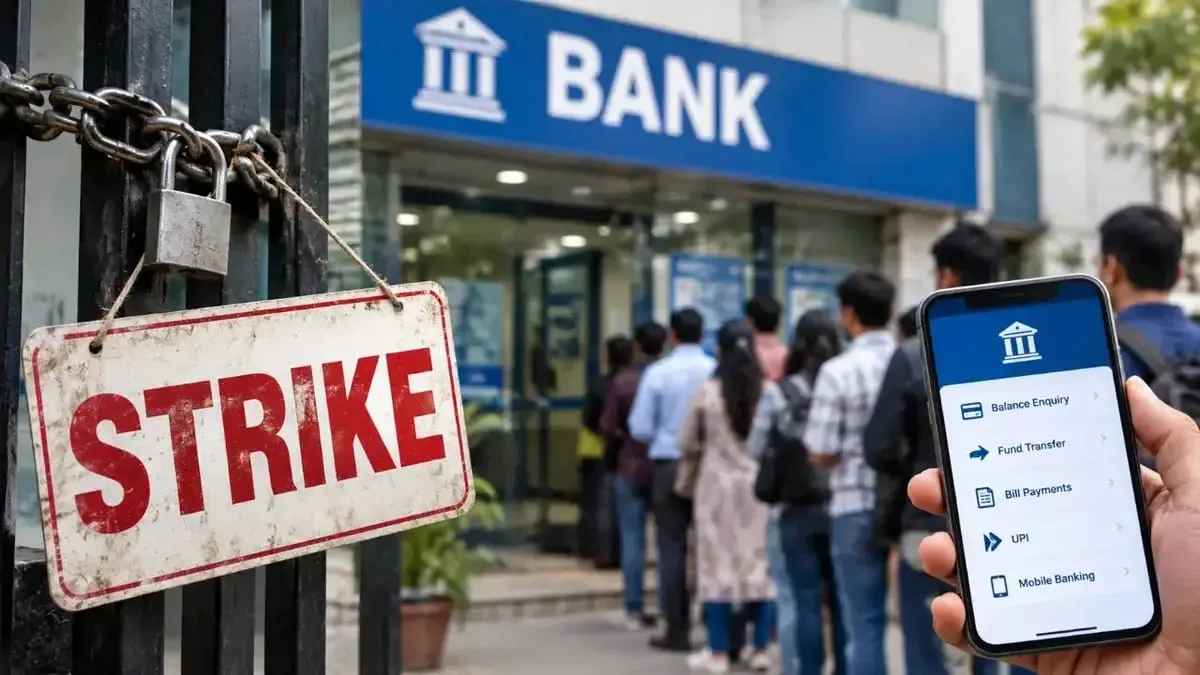
At 9:30 PM on Sunday, barely hours before bank branches across the country were set to shut down for three consecutive days (September 28–30), the United Forum of Bank Unions (UFBU) formally deferred its nationwide strike.
The meeting, held at around 9.30 pm on 27th September, resulted in an agreement to take up the key issues raised by bank employees and officers through structured discussions instead of proceeding with the planned three-day agitation. The most significant development was the decision to immediately constitute a high-level IBA-UFBU committee to examine the demand for declaring all Saturdays as holidays.
The development means that banking services will continue normally during September 28–30 instead of being disrupted by the proposed strike. However, the deferment does not mean that the unions have withdrawn their demands or that the five-day banking week has been approved. The issues will now move into another round of negotiations.
Top 5 Takeaways
-High-level committee on five-day banking
The most immediate reason for the deferment was the agreement to constitute a high-level committee comprising representatives of the IBA and UFBU to examine the demand for declaring all remaining Saturdays as holidays.
The committee will explore possible alternatives, discuss the issue with relevant stakeholders and consider the interests of customers before working out a possible solution. The decision was significant because the demand that had been at the centre of the proposed strike was moved from industrial action into a formal negotiating mechanism.
-Fresh talks on the five-day banking week
The demand for a five-day banking week has been pending for several years and was one of the principal reasons behind the September strike call.
The UFBU has been pressing for a system under which banks would remain closed on Saturdays and Sundays. At present, bank branches generally remain closed on Sundays and the second and fourth Saturdays of every month, while the first and third Saturdays are generally working days. The latest understanding does not amount to an immediate introduction of a five-day banking week. Instead, the issue will now be examined by the newly proposed IBA-UFBU committee.
The committee is expected to consider possible arrangements and their operational implications while consulting stakeholders, including customers. Thus, the key distinction is between discussion and implementation: the five-day banking demand is now formally being discussed, but all Saturdays have not yet been declared bank holidays.
– PLI scheme for scale IV and above officers
The Performance Linked Incentive (PLI) scheme for officers in Scale IV and above was another issue included in the unions’ agitation. Under the latest understanding, discussions on the PLI scheme can begin with government participation. This will allow the concerns raised by the unions and associations to be discussed with the banking association and the government.
The move provides a formal platform for negotiations on the PLI scheme instead of the issue remaining part of the immediate strike action. However, the agreement to discuss the matter does not mean that changes to the existing PLI arrangement have already been approved.
– Other pending issues to be discussed
The understanding between the IBA and UFBU is not limited to Saturday holidays and the PLI scheme. The two sides have also agreed to discuss the residual issues listed in the minutes of their March 8, 2024 discussions, with the stated objective of resolving them expeditiously.
The broader list of union demands has included issues relating to pension updation, the dearness allowance formula for pensioners and matters concerning employees covered under the National Pension System, including the demand for restoration of the old pension system. These issues have not been settled through the latest understanding. Instead, they will be taken up through further discussions between the concerned parties.
– Shift from strike action to negotiations
The overall reason for the deferment was the shift from immediate industrial action to structured negotiations. The UFBU had planned a three-day nationwide strike from September 28 to 30 to press its demands. Following the late-night meeting with the IBA on September 27, the unions decided to defer the proposed agitation in view of the understanding reached on the outstanding issues.
The agreement therefore provides an opportunity for both sides to continue discussions on the key demands instead of proceeding with the planned shutdown. The dispute has consequently entered another phase, with committees and negotiations replacing the immediate strike programme.
The Immediate Reason Behind the Deferment
The central reason for deferring the strike was the understanding reached between the IBA and UFBU to begin formal discussions on the remaining Saturdays as holidays. The UFBU has been pressing for a five-day banking week, under which banks would remain closed on Saturdays and Sundays. At present, bank holidays include the second and fourth Saturdays of every month, while the first and third Saturdays are generally working days.
Following the September 27 meeting, the two sides agreed to form a high-level committee comprising representatives of the IBA and UFBU. The committee will examine the Saturday-holiday demand, consider possible alternatives and consult stakeholders, including bank customers. This was significant for the unions because the issue that formed the centre of the proposed strike was being moved from agitation to a formal negotiating mechanism.
Five-Day Banking Week Demand Moves to Committee
The demand for a five-day banking week has been pending for several years and was one of the principal reasons behind the September strike call. The latest understanding does not amount to an immediate introduction of a five-day banking week. Instead, the committee will examine how the remaining Saturdays could be declared holidays and whether alternative arrangements can be worked out. The UFBU has also agreed to defer the strike while these discussions take place.
The committee is expected to consider the operational implications of any change in working days and consult stakeholders before arriving at a proposal. The UFBU has specifically said that customer interests will also have to be taken into account. Thus, the key distinction is between discussion and implementation: the demand is now formally being discussed, but there is no announcement that all Saturdays have already become bank holidays.
PLI Scheme for Senior Officers Also Taken Up
The Performance Linked Incentive scheme for officers in Scale IV and above was another issue included in the unions’ agitation. Under the latest understanding, discussions on the PLI scheme can begin with the IBA, with government participation to address the observations and concerns raised by the unions and associations. This gives the unions an opportunity to put their objections and proposed changes before the banking association and subsequently the government. The PLI issue therefore became another area where negotiations could replace immediate industrial action.
Other Pending Issues Will Also Be Discussed
The understanding between the IBA and UFBU is not limited to Saturday holidays and the PLI scheme. The two sides have also agreed to discuss the residual issues listed in the minutes of their March 8, 2024 discussions, with the stated objective of resolving them expeditiously.
The broader list of union demands has included issues relating to pension updation, the dearness allowance formula for pensioners and an option for employees covered under the National Pension System to move to the old pension system. These issues were part of the wider dispute between the unions and the banking management, although the immediate breakthrough on September 27 centred on the Saturday-holiday demand and the PLI scheme.
The agreement came just hours before the proposed strike was due to begin. The UFBU had planned the strike from September 28 to 30. It followed the weekend holidays of September 26 and 27, meaning that the proposed action could have resulted in a prolonged interruption of physical banking services. The government had already taken steps to reduce the impact of the proposed strike. The Ministry of Finance announced that Public Sector Banks and Regional Rural Banks would function on Sunday, September 27, after receiving approval from the Reserve Bank of India, specifically to ensure that customers could complete essential banking work before the proposed strike.
The September 30 date was also significant because it coincides with the half-yearly closing period for banks, making uninterrupted banking operations particularly important at the end of the September quarter. Against this backdrop, the late-night understanding between the IBA and UFBU provided a route for the unions to suspend the immediate strike while keeping negotiations alive.
Why BMS Stayed Out
Speaking to Organiser, Girish Arya, BMS Finance Sector In-charge, said that the BMS was earlier part of the broader banking-union platform but was subsequently excluded from the present UFBU process. He said BMS was not consulted while the latest strike programme was finalised.
He questioned the present composition of the UFBU and argued that a forum that no longer includes all the unions that were part of the earlier process cannot automatically claim the support of organisations that were not consulted.
BMS, he said, therefore decided to approach the Government directly on issues affecting bank employees.
A BMS delegation met Union Finance Minister Nirmala Sitharaman on July 9 and again on September 7. Arya said five-day banking, pensioners’ issues, medical facilities, ex-gratia, PLI and grievance redressal were among the matters raised.
National Organisation of Bank Officers (NOBO) and National Organisation of Bank Workers (NOBW), in a September 23 communication, also said they were neither consulted nor invited to any joint deliberation before the proposed strike was announced. They said no formal communication seeking their views or participation was received.
The Demands vs. What Was Actually “Won”
The UFBU entered the negotiations with a long list of grievances, centered around four primary demands:
A Five-Day Work Week: Complete declaration of all remaining Saturdays as official bank holidays, a demand pending for over two years despite central offices, the Reserve Bank of India (RBI), and LIC already operating on five-day cycles.
Scrapping the Performance-Linked Incentive (PLI) Scheme: Rolling back a unilaterally introduced, management-tilted PLI scheme for Scale IV and above officers.
Pension and Parity: Long-pending pension updations, uniform Dearness Allowance formulas for pensioners, and an exit window from NPS back to OPS.
Residual 12th Bipartite Settlement Issues: Implementation of pending operational clauses signed into the minutes on March 8, 2024.
One of the most important points is that the word “deferred” does not mean that the dispute has been permanently resolved.
The UFBU agreed to defer its proposed agitation after the IBA agreed to mechanisms for discussions on the outstanding issues. The five-day banking week has not yet been implemented, and there has been no announcement making all Saturdays official bank holidays. The next stage is therefore negotiations.
The newly proposed IBA-UFBU committee will examine the Saturday-holiday issue, while discussions on the PLI scheme for Scale IV and above officers will also proceed. Other residual matters from the March 8, 2024 discussions will be taken up separately. In other words, the September 28–30 strike has been removed from the immediate schedule, but the underlying demands remain on the negotiating table.
For customers, the immediate impact is straightforward: the proposed three-day nationwide strike will not take place on September 28–30 at this stage, allowing regular banking operations to continue.
The deferment also prevents the disruption that could have followed the preceding weekend holidays. The government had earlier warned about the potential impact on banking services and had asked unions to reconsider the strike. However, customers should distinguish between the deferment of the strike and the resolution of the banking unions’ demands. The latter remains subject to negotiations between the IBA, UFBU and, where required, the government.
The immediate next step will be the formation of the high-level IBA-UFBU committee on Saturday holidays. The committee is expected to examine possible arrangements for a five-day banking week, consult relevant stakeholders and consider the implications for customers and banking operations. At the same time, discussions will begin on modifications to the PLI scheme for Scale IV and above officers, with government participation in the process. The remaining issues listed in the March 8, 2024 minutes will also be discussed. The September 27 understanding therefore changes the immediate course of the dispute: instead of a three-day nationwide strike, the focus now shifts to negotiations.
For bank employees and officers, the key issues remain five-day banking, the PLI scheme and other service-related demands. For customers, the immediate consequence is that the planned September 28–30 shutdown has been deferred.