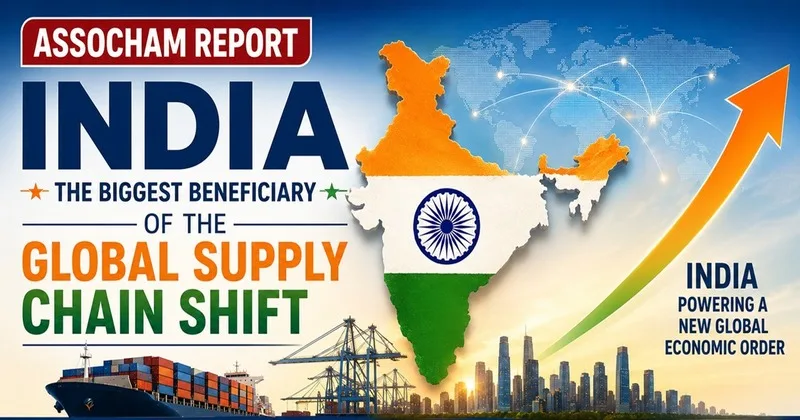
There was a time when the West and China were considered the epicentres of the global economy; however, the world’s economic geography is shifting rapidly today. The period leading up to 2026–27 signals the emergence of a new economic landscape, a trend corroborated by a steady stream of reports from major global institutions, rating agencies, investment banks and industry bodies.
Indeed, these reports indicate that India, currently the world’s fastest-growing major economy, is rapidly advancing toward becoming a premier hub for investment, global manufacturing, supply chains and consumption. A recent report by the industry body ASSOCHAM (The Associated Chambers of Commerce and Industry of India) reinforces this broad global trend, identifying India as the primary beneficiary of the post-COVID restructuring of global supply chains. This report joins a series of international assessments that view 2026 and 2027 as pivotal years for India’s economic role.
India on the Path to Becoming the World’s New Factory
According to the ASSOCHAM report, the post-COVID-19 pandemic era has witnessed a historic shift in the global manufacturing landscape. Multinational companies are moving beyond sole reliance on China; instead, they are adopting strategies such as “China+1,” “friend-shoring,” and “near-shoring” to expand production into reliable nations like India.
The report highlights that, in an analysis of the world’s ten largest manufacturing economies, India has emerged as one of the fastest-growing manufacturing nations in the post-pandemic period. While India’s average manufacturing growth rate stood at 3.44 per cent during 2016–19, it rose to 4.15 per cent during 2022–25, a performance significantly better than the global average. The report’s findings not only highlight the growth in production but also clearly state that initiatives such as robust domestic demand, the PLI scheme, improved infrastructure, industrial corridors, logistics reforms and PM Gati Shakti have positioned India among the most attractive manufacturing destinations for global investors.
IMF and World Bank Echo Similar Views
The ASSOCHAM report aligns with the broad global consensus consistently expressed by the International Monetary Fund (IMF) and the World Bank. Both institutions have projected India to be the world’s fastest-growing major economy for 2026 and 2027. While many developed economies are grappling with sluggish growth, high inflation and geopolitical uncertainties, India has maintained a steady growth rate of approximately 6 to 6.5 per cent.
These institutions believe that India’s economic strength is not solely dependent on government spending or exports but is instead built on the balanced growth of domestic consumption, investment, the digital economy and the services sector, making its growth trajectory more sustainable.
Confidence from Morgan Stanley and S&P
Global investment bank Morgan Stanley has described India as the “world’s next growth engine” in its recent reports. The bank assesses that India will become a prime destination for global investment over the next decade and is on track to become the world’s third-largest economy, surpassing Japan and Germany.
Similarly, S&P Global Ratings notes that India’s robust banking system, rising investment, fiscal discipline and structural reforms are driving steady growth even amidst global economic volatility. According to the agency, India’s growth potential remains significantly stronger compared to other major economies.
Growing Confidence from JPMorgan and Global Capital
A significant development in this context was the inclusion of Indian government bonds in JPMorgan’s global bond index in 2025, a major financial milestone for the country. This move also signalled India’s growing credibility in global capital markets. Consequently, foreign investor confidence strengthened and prospects for long-term investment in Indian markets improved.
Professor S.K. Singh, an Economics professor at Jiwaji University, believes India is likely to attract a substantial share of global investment flows during 2026 and 2027, as global companies prioritise nations offering political stability, vast markets, and a skilled workforce.
Prof. Singh states, “The Unified Payments Interface (UPI), digital public infrastructure, Aadhaar, digital commerce and AI-driven services have provided India with a new model of growth. This combination of digital and manufacturing sectors sets India apart from countries that rely solely on either production or services.”
Biggest Beneficiary of the ‘China+1’ Strategy
The global strategy to reduce over-reliance on China has emerged as a major opportunity for India. The country is rapidly increasing its share in sectors such as electronics, semiconductors, defence production, automobiles, pharmaceuticals, textiles, mobile manufacturing and the production of renewable energy equipment. The ramp-up of production in India by numerous global companies, including Apple, is seen as evidence of this shift.
Visible Impact of Economic Reforms
According to ASSOCHAM, various structural changes underpin the improvement in India’s competitiveness. Initiatives such as the Production-Linked Incentive (PLI) scheme, industrial corridors, PM Gati Shakti, the National Logistics Policy, the expansion of ports and highways, railway modernisation, and improvements in the ease of doing business have reduced industrial costs and boosted production capacity. The industry believes these reforms have strengthened investor confidence. Consequently, global companies have begun to view India not merely as a vast market but also as an export-oriented manufacturing hub.
Thus, when the latest ASSOCHAM report is viewed alongside assessments from S&P Global, Morgan Stanley, the IMF, the World Bank, JPMorgan and other global institutions, a clear picture emerges: India is evolving beyond being a high-growth economy to become a central player in global manufacturing, investment attraction, digital innovation and supply chain restructuring.