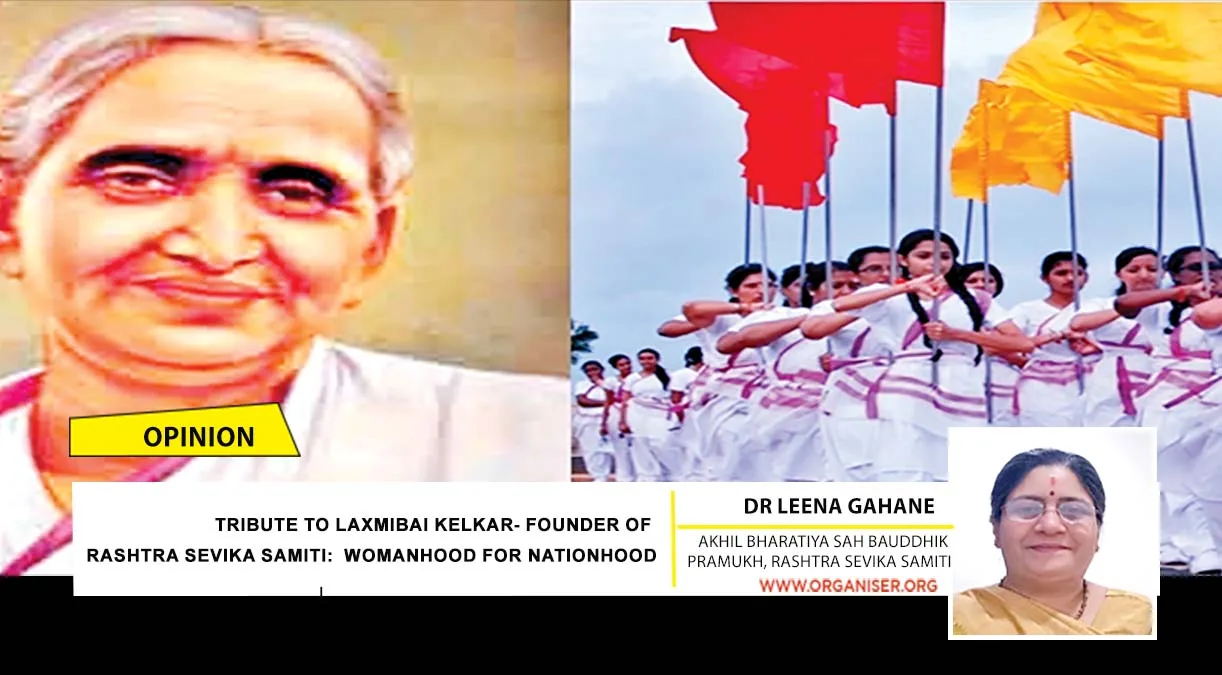
People may come and go, but a rare few leave behind a legacy that continues to inspire and guide generations. Among such remarkable personalities was Laxmibai Kelkar, affectionately remembered as Vandaniya Mausiji, visionary founder of the Rashtra Sevika Samiti, which has completed nine decades of its historic journey. In the story of social transformation, some individuals build institutions, while a rare few kindle movements that transcend their own lifetime. Mausi ji belonged to this exceptional league—her vision, dedication, and pioneering work gave rise to a movement that continues to shape the lives of women and contribute to the larger cause of nation-building.
Nearly nine decades ago, she recognised a profound truth: the strength of Bharat lies in awakening its five Swa—Swarashtra, Swasanskriti, Swadharma, Swabhasha and Swabhiman—and in nurturing a society where women stand with confidence, rooted in values, organised in purpose, and actively engaged in nation-building.
In 1936, she founded Rashtra Sevika Samiti, an Hindu women organisation dedicated to the social, cultural and national awakening of women. What began as a response to the needs she observed around her, gradually developed into a long-standing women’s organisation with activities extending across India and beyond in nearly 40 countries of the globe.
Understanding Society’s Pulse
Born in 1905, Laxmibai Kelkar lived in a period when Bharat was under British rule and Bharatiya society was undergoing profound political and social changes. Women were entering new public spaces, but many still faced limitations imposed by social circumstances, lack of education, economic dependence and restricted opportunities for organised participation. Van. Mousiji’s approach was not simply to speak about women’s self-awakening as an abstract idea. She believed that women themselves had to become confident, disciplined, socially conscious and capable of contributing to family and society- पिता-पुत्र-भ्रातृंश्च भर्तारमेवम्,सुमार्गं प्रति प्रेरयन्तीमिह. She was moved by thoughts of Swami Vivekananda – If an eagle wants to fly high in sky, then its both wings must be strong enough; similarly, if Bharat wishes to rise high (to its place of Vishwa Guru), then its both wings (Stree and Purush-Women and men) have to contribute equally. She recognised the Indian family as an important institution of social life and saw women as significant contributors to its cultural and moral foundations- Mata, a central pillar of the family. At the same time, she envisioned women stepping beyond the boundaries of the home to participate actively in community life. This combination—tradition with organised social participation became an important characteristic of her work.
From Awakening of One to Organisation of Many
One of Laxmibai Kelkar’s significant contributions was her emphasis on organisation. She understood that individual enthusiasm, however sincere, could not by itself produce sustained social change. Women needed opportunities to meet, learn, train, discuss social issues and work together. Rashtra Sevika Samiti, therefore, developed regular activities aimed at cultivating qualities such as self-confidence, discipline, physical fitness, leadership, social responsibility and a sense of national belonging. The idea was not merely to create participants in an organisation, but to develop women who could become active contributors in their families and communities. To awaken a mother, daughters, sister, wife to share responsibility in National Re-generation. Over the decades, this approach enabled the Samiti to establish a network of Sevikas and Karyakartas in different parts of Bharat.
A Journey of Nine Decades
The story of Rashtra Sevika Samiti is also a story of continuity. From its beginnings in 1936, the organisation has passed through India’s freedom struggle, Independence, social and economic transformation, urbanisation, technological change and the changing aspirations of Indian women. Across these decades, its activities have included -Shakha a model of Vyakti nirman, Varga –training camps ,Dharmik upkram, Women’s Education through the Bharatiya lens , cultural activites, Seva karya, projects to make women self-reliant, community engagement and relief work, and many other initiatives.Its karyakartas and supporters view the organisation as an important platform for nurturing women’s leadership while remaining rooted in Bharatiya cultural traditions. Like many long-standing social organisations, its philosophy and methods have also been interpreted differently by different observers. Understanding its nine-decade journey therefore requires attention both to its stated objectives and to its work on the ground.
At the core of Mousiji’s vision was a profound conviction: the edifice of nation-building rests upon the foundation of character-building. (Charitra Nirman Se Rashtra Nirman).
She believed that an empowered woman could influence several circles simultaneously—her family, neighbourhood, educational environment and wider society. A woman who is nurtured with confidence and a sense of social responsibility becomes more than a recipient of change—she becomes a conscious and active force in shaping society-सुशीलाः सुधीराः समर्थाः समेताः,स्वधर्मे स्वमार्गे परं श्रद्धया.
This idea remains relevant in contemporary discussions about women’s leadership. Empowerment is not limited to economic independence or representation in institutions. It can also involve self-realisation, self-confidence, education, physical and mental preparedness, social awareness, leadership and the ability to take responsibility
for the larger community.
A Legacy Beyond One Individual
Vandaniya Laxmibai Kelkar’s greatest legacy is the organisational culture she helped initiate: women coming together, learning together, serving society and accepting responsibility for the future -सं गच्छध्वं सं वदध्वं सं वो मनांसि जानताम् .Nine decades after the founding of Rashtra Sevika Samiti, her life invites us to reflect on an enduring question: What happens when a woman understands not only the challenges of her own time but also the deeper needs of society?
In Mousiji’s case, the answer is an institution that outlived its founder and continued to evolve across generations. Her story is therefore not simply about one woman or one organisation. It is about the power of vision, organisation, perseverance and collective action. She listened to the concerns of her time, understood the pulse of society, and transformed that understanding into a movement. The landmark of Laxmibai Kelkar’s nine-decade legacy: she did not merely ask what society could do for women; she envisioned what organised, confident and socially responsible women could do for society.