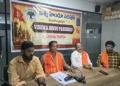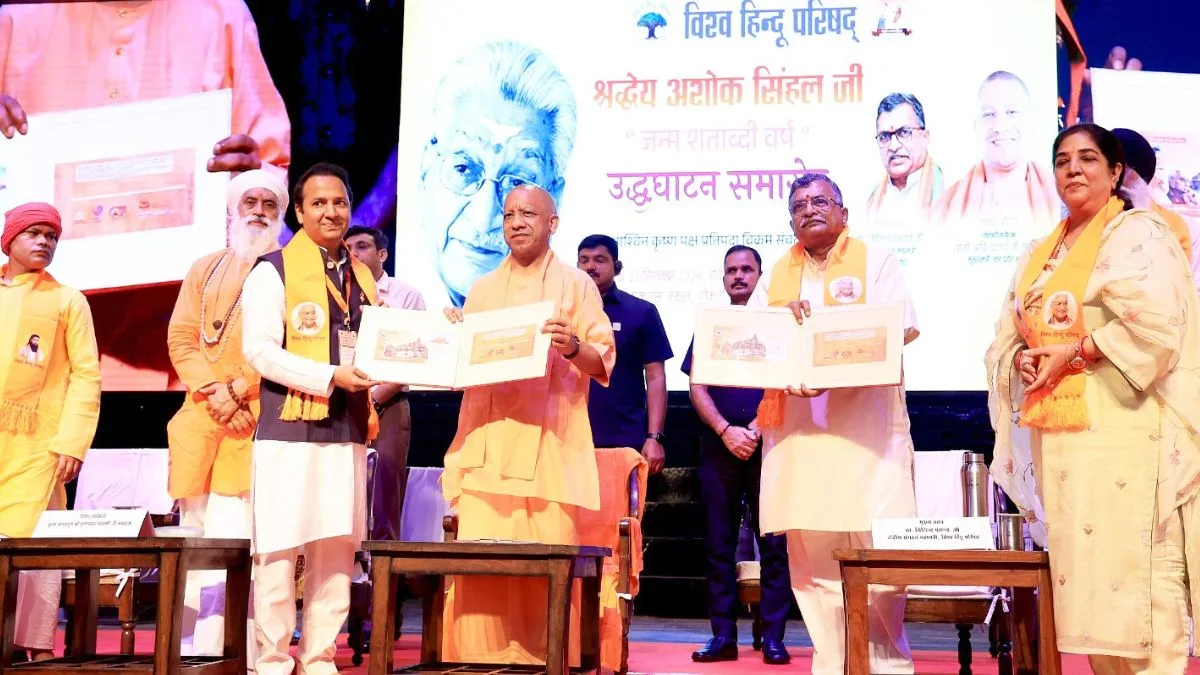
LUCKNOW: Ashok Singhal ji devoted his entire life to fulfilling the centuries-old aspiration of the Hindu society to see a grand temple dedicated to Bhagwan Shri Ram at his birthplace in Ayodhya, said Vishwa Hindu Parishad (VHP) General Secretary Milind Parande at the birth centenary year programme of former VHP International President Ashok Singhal, organised in Lucknow.
Parande said that although Ashok Singhal ji did not live to see the construction of the Ram Temple, his efforts played a major role in bringing together the contributions and sacrifices of countless people who worked for the construction of the temple at Shri Ram Janmabhoomi. He said the significance of the Shri Ram Janmabhoomi movement went beyond the construction of the temple. According to Parande, before the movement, many Hindus did not feel proud of identifying themselves as Hindus. However, the movement brought together crores of people across caste, community, language, sect and tradition, leading to a renewed sense of Hindu identity and pride in India and across the world.
Parande said the movement also brought a change in the country’s political discourse. He said that before the Shri Ram Janmabhoomi movement, politics could be pursued even by insulting Hindus, but the movement changed this situation and brought Hindutva to the centre of public discourse. Recalling Ashok Singhal’s views on political leadership, Parande said Singhal believed that those occupying positions of political authority should be committed to considering the interests of the Hindu society. He said the awakening of this sentiment and the subsequent changes in the country’s political landscape were among the major contributions of the Ram Janmabhoomi movement.
Parande also highlighted Ashok Singhal’s efforts towards social harmony. He said that centuries of struggle had resulted in several social distortions and practices that were contrary to the fundamental philosophy of Hindu Dharma. Singhal worked throughout his life to create an atmosphere of social harmony and to remove such inequalities from Hindu society. He said Singhal regarded members of Scheduled Castes and Scheduled Tribes as heroic communities who had made sacrifices and endured hardships to protect the country’s Dharma and culture without abandoning their faith.
According to Parande, Singhal also initiated efforts through senior VHP workers to trace the gotras of different Scheduled Caste and tribal communities. He said these efforts demonstrated the common ancestral and gotra links between various sections of Hindu society and reinforced the message that all Hindus are part of the same social family.
Parande further said that Singhal strongly believed that the knowledge of the Vedas should be accessible to everyone. He credited his efforts for the expansion of Vedic schools and centres of Vedic education run by the VHP. He also highlighted the training of priests from communities other than Brahmins, including tribal communities, in different parts of the country. Referring to Tamil Nadu, he said thousands of non-Brahmin priests have been trained as part of such initiatives.
Parande said these efforts reflected Ashok Singhal’s broader vision of strengthening Hindu society through social harmony, religious education and greater participation of different sections of society. Uttar Pradesh Chief Minister Yogi Adityanath who was the Chief guest at the programme said that the flame lit by Ashok Singhal in the 1980s has today become a powerful force working continuously for the protection and advancement of Hindu society.
CM Yogi said Ashok Singhal dedicated his entire life to the nation, Sanatan Dharma and the protection of Hindu society. He described Singhal’s life as a yajna devoted to serving the nation and society.
Yogi Adityanath recalled that Ashok Singhal pursued engineering studies at Kashi Vidya Peeth and later became an RSS pracharak. He said Singhal’s life had one central resolve, to ensure that Sanatan Dharma remained protected. Recalling the Shri Ram Janmabhoomi movement, the Chief Minister said that after the Ram Janmabhoomi structure was demolished by a foreign invader, generations of people continued to carry the aspiration of restoring the birthplace of Bhagwan Shri Ram. He said Bharat’s youth and women came forward with determination for the Ram Janmabhoomi cause.
According to the CM Yogi, society was divided and there was a lack of leadership at the time, but Ashok Singhal filled that leadership vacuum and dedicated his entire life to the movement for the liberation of Shri Ram Janmabhoomi.
Yogi Adityanath recalled his own association with the Ram Janmabhoomi movement, saying that he had taught children at Gorakhnath Temple during that period. He referred to the firing on Ram devotees under the government of that time and said that Ashok Singhal’s voice continued to be heard during the movement.
Yogi Adityanath said Ashok Singhal’s life continues to inspire dedication to the nation and the protection of Sanatan Dharma. He said Singhal placed the interests of the nation and society above personal interests and worked throughout his life for their service.
The Chief Minister said the birth centenary year provides an opportunity to remember Ashok Singhal’s life and thoughts and to carry forward his ideals. He added that the year-long commemoration would help preserve his contribution to the nation and society and take his ideas to future generations.