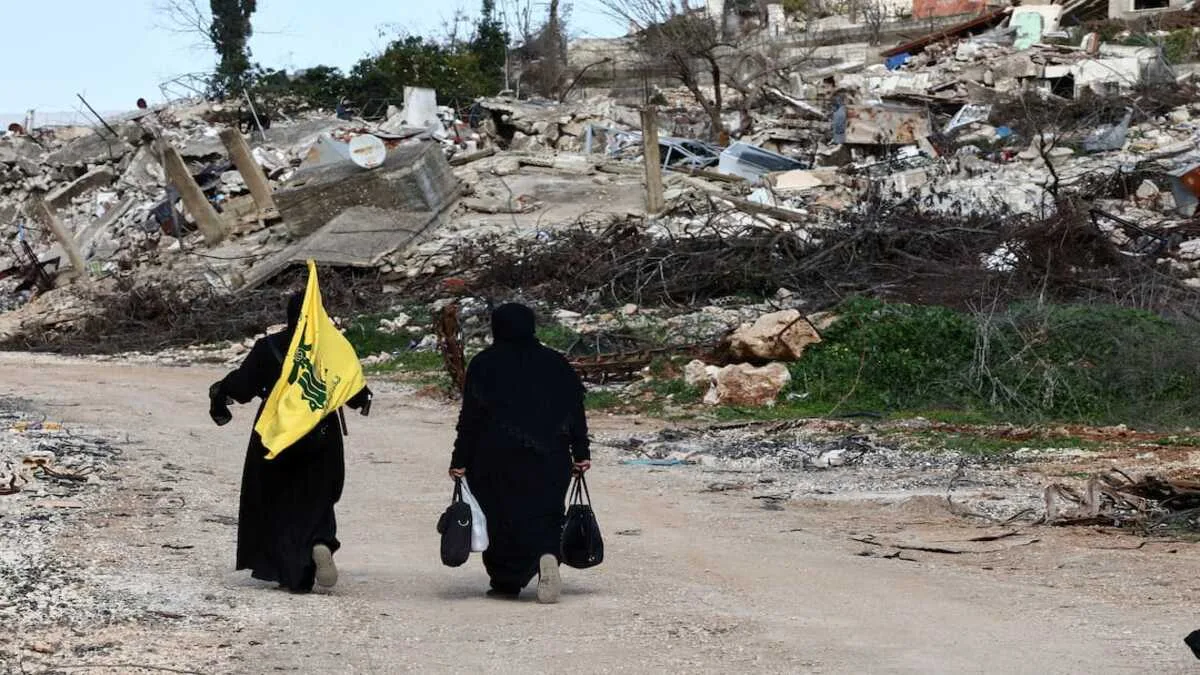
A new Lebanese opinion poll has revealed growing support among the country’s Shia community for disarming Iran-backed Hezbollah and pursuing a peace agreement with Israel, signalling a potential shift within the terrorist organisation’s traditional support base.
The findings come as Hezbollah refuses to surrender its weapons despite mounting pressure from the Lebanese, Israeli and US governments to restore state authority and advance a broader ceasefire framework. The survey, conducted nationwide in September 2026 by the Statistics Lebanon Institute among 800 Lebanese Shia citizens aged 18 and above, found that 66.4 per cent support transferring Hezbollah’s weapons to the Lebanese state, while 29.6 per cent believe the Iran-backed Shia group should retain its arsenal.
Significantly, 63.3 per cent support some form of agreement with Israel, including direct negotiations, mediation or a comprehensive regional settlement. The findings suggest that sections of Hezbollah’s traditional Shia constituency are increasingly open to alternatives to continued confrontation with Israel.
Growing Shia support for state authority and peace with Israel
The poll found that 71.1 per cent of respondents believe the Lebanese government should exercise exclusive authority over decisions concerning war and peace. Only 5.9 per cent support granting Hezbollah’s leadership a greater role in determining Lebanon’s future.
Confidence in the Lebanese Army also substantially exceeds confidence in the Iran-backed Shia group. While 78.5 per cent expressed confidence in the army, 51.1 per cent identified it as the institution best equipped to guarantee long-term security, compared with 16.5 per cent who selected Hezbollah.
The survey further revealed dissatisfaction with Hezbollah’s military performance. As many as 67.4 per cent believe the Iran-backed terrorist group failed to achieve some or all of its objectives during the war with Israel. Additionally, 42.1 per cent expressed disappointment, anger or concern about Hezbollah’s leadership and conduct.
However, the Shia group retains a considerable support base. While 37.1 per cent reported substantial trust in Hezbollah and another 22.4 per cent expressed some trust, 38.5 per cent reported varying degrees of distrust. Regarding Hezbollah’s future, 34 per cent favoured restricting the organisation to a political party, while 9.4 per cent supported a political and social role. Meanwhile, 10 per cent wanted Hezbollah to retain both political and military activities, and 10.6 per cent supported keeping its armed wing outside state control.
A separate survey conducted by Information International and published by Lebanese broadcaster Al-Jadeed in May 2026 similarly indicated growing support for disarmament and greater openness to peace with Israel. The latest findings are particularly significant because Lebanese Shia have historically formed the core of Hezbollah’s domestic support.
Ceasefire stalemate raises fears of renewed Israel-Hezbollah war
Earlier in 2026, Israel and Lebanon agreed to a US-backed framework aimed at disarming Hezbollah, gradually withdrawing Israeli forces from southern Lebanon and deploying the Lebanese Armed Forces in designated pilot areas. However, implementation has largely stalled.
Israel continues to maintain troops in a security zone extending approximately 10 kilometres into southern Lebanon, citing the need to protect northern communities, prevent terrorist attacks and dismantle Hezbollah’s infrastructure. The Iran-backed group began attacking Israel in early March 2026, days after joint US-Israeli military operations against Iran commenced.
Although Israel and Lebanon have technically remained at war since 1948 and lack formal diplomatic relations, recent US-brokered negotiations have opened channels for dialogue. Lebanon’s government has declared Hezbollah’s military operations illegal and indicated willingness to pursue peace with Israel.
Israeli officials warn that Beirut has failed to fulfil its disarmament commitments. Reports have suggested Israel could impose an air, land and sea blockade as tensions escalate. Negotiations have reportedly considered deploying military personnel from Italy, Switzerland and Jordan to oversee weapons removal.
Hezbollah has accused President Joseph Aoun and Prime Minister Nawaf Salam of betraying the “resistance” and collaborating with Israel, branding them “traitors”. On October 10, EU foreign policy chief Kaja Kallas called for extending UNIFIL’s mandate beyond its December 2026 expiration to prevent a security vacuum. Critics accuse the peacekeeping mission of failing to prevent Hezbollah’s military expansion, while Israeli officials allege Hezbollah positions weapons and assets near UN facilities and uses peacekeepers as human shields.
The poll underscores mounting pressure on Iran-backed Hezbollah as demands grow for disarmament, stronger Lebanese state authority and a negotiated settlement with Israel.