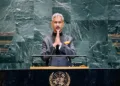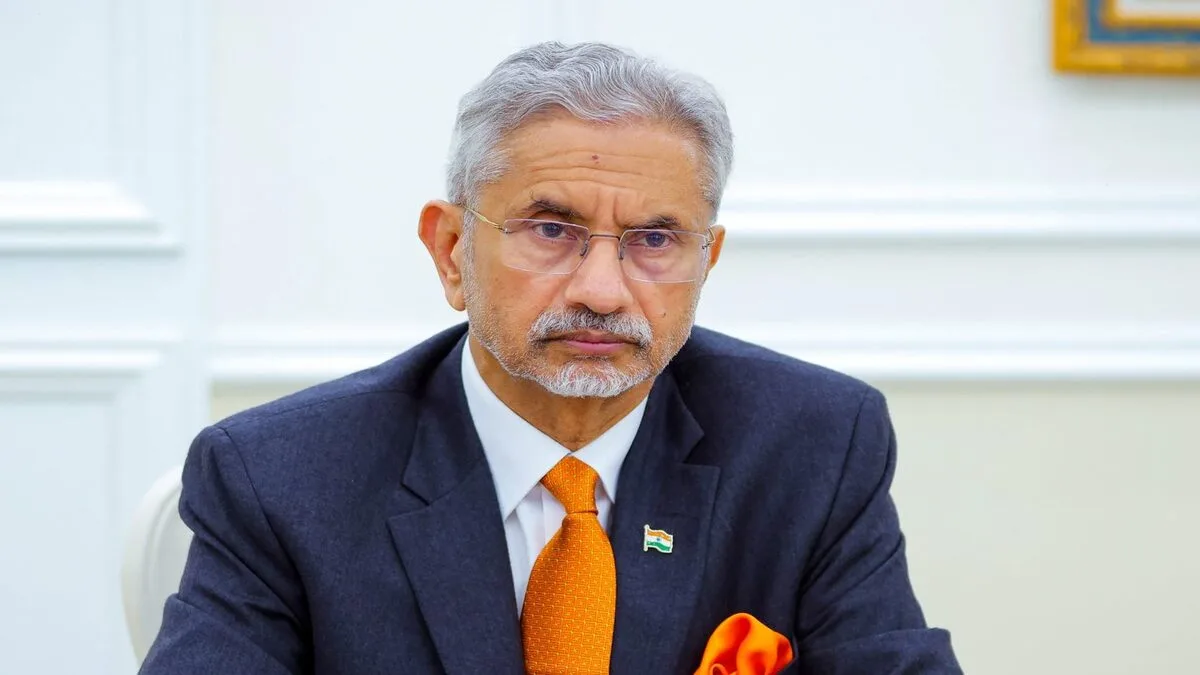
NEW YORK: On the sidelines of UNGA High-level Week and 81st session of the General Assembly, India under the leadership of the External Affairs Minister Dr. S. Jaishankar has launched an intensive diplomatic campaign & outreach to foster a multilateral and inlusive world-order. From maritime security and Artificial Intelligence to cybercrime, trade, terrorism and UN reforms, New Delhi has unveiled a responsible statecraft, to articulate national security, regional peace & stability and the prosperity of Global South amid escalating geopolitical upheavals & weaponisation of strategic tools.
AI for international peace & maritime security
One of EAM Jaishankar’s key interventions came at a high-level event on “AI in the Context of International Peace & Security, with an Emphasis on Maritime Security”, which he co-chaired with Greek Foreign Minister George Gerapetritis. EAM Jaishankar underlined that countries must harness AI’s possibilities while anticipating its consequences and mitigating its risks. The challenge, he said, is to promote innovation while remaining conscious of its security implications.
He highlighted how the New Delhi Declaration, adopted during India’s BRICS chairship emphasises democratic access to AI resources, secure and trustworthy systems, investment in human capabilities and the use of AI for economic growth and social good.
Pleased to co-chair the event on ‘AI in the Context of International Peace & Security, with an Emphasis on Maritime Security’, alongside FM George Gerapetritis of Greece.
➡️ Emphasized the need to harness the possibilities offered by AI, anticipate its consequences and mitigate… pic.twitter.com/9Wumfq5e8p
— Dr. S. Jaishankar (@DrSJaishankar) September 26, 2026
He also illustrated, how the maritime domain poses both the opportunities and risks of the technology. AI can strengthen maritime domain awareness, search and rescue operations, disaster response, detection of suspicious activity and the resilience of ports and critical infrastructure. However, the same technology can lead to vulnerability, unauthorised mapping and cyber targeting of vessels along with weaponisation of communications networks and undersea infrastructure.
EAM Jaishankar also flagged concerns arising from the greater autonomy in maritime systems, including attribution, accountability and escalation, particularly as AI could compress the time available for human decision-making and escalate risks, as AI can be used as a geopolitical weapon to disrupt systems & seal edge over the adversery.
India thus, stressed that the UN Charter and international law, including the law of the sea, must remain central frameworks governing State conduct. Transparency, confidence-building, technical cooperation, capacity building and exchange of best practices, EAM said, are essential for responsible AI deployment, to ensure maritime security.
India advocates safety of ships, seafarers and global trade
Maritime security emerged as a major component of India’s UNGA diplomacy. At the inaugural meeting of the Group of Friends on Safety and Security of Shipping and Seafarers, promoted by India and Liberia, EAM Jaishankar drew attention to recent attacks on commercial vessels in the Gulf of Oman, Strait of Hormuz and Black Sea.
He highlighted the attacks that resulted in the deaths of Indian seafarers and said that such incidents could no longer be treated as isolated occurrences. “From the Black Sea to the Red Sea to the Gulf, attacks on civilian shipping have become a growing cause of concern”, EAM Jaishankar said, stressing that disruptions to maritime commerce & blocking of strategic chokepoints have consequences extending beyond the individual shipping routes.
Glad to co-chair the inaugural meeting of Group of Friends on Safety & Security of Shipping & Seafarers, along with Liberia FM Sara Beysolow Nyanti #GoFonS4 #UNGA81
✅ Highlighted that commercial shipping and mariners have been subjected to repeated attacks in the Gulf, the Red… pic.twitter.com/9PuTWNorWR
— Dr. S. Jaishankar (@DrSJaishankar) September 25, 2026
The Group of Friends on Safety and Security of Shipping and Seafarers initiative brings together countries with major shipping registries, ship-owning nations and countries supplying large numbers of seafarers. India during the BRICS Summit, also proposed a Seafarers’ Emergency Support Network linking maritime authorities and embassies to facilitate swift distress alerts, medical assistance, communication with families and emergency evacuations.
EAM Jaishankar thus, reiterated India’s commitment to freedom of navigation and the safety of seafarers and commercial shipping.
India-GCC FTA talks add economic weight
Another key highlight of India’s diplomatic outreach at UNGA is, EAM Jaishankar co-chaired the India-GCC Troika Ministerial Meeting, where both sides reviewed progress under the India-GCC Joint Action Plan 2024–28. A key development was the launch of India-GCC Free Trade Agreement negotiations, opening another channel for expanding the economic relationship.
EAM Jaishankar said that India and the Gulf countries would seek to deepen cooperation in trade, investment, energy, food security, healthcare, new technologies, culture and people-to-people exchanges. He also thanked GCC leadership for its support to the Indian community and reiterated India’s commitment to maritime security.
Glad to co-chair the India-Gulf Cooperation Council Troika Ministerial Meeting in New York on the margins of #UNGA81.
Reviewed the progress of the India-GCC Joint Action Plan 2024–28 and discussed ways to further advance our partnership.
Welcomed the launch of India-GCC FTA… pic.twitter.com/e5MGzOPb59
— Dr. S. Jaishankar (@DrSJaishankar) September 25, 2026
The discussions took place amid heightened tensions in West Asia & disrupted trade, supply chains & energy security. In this direction, an FTA with the gulf economies would facilitate greater trade & economic security to India. EAM Jaishankar separately met Iranian Foreign Minister Abbas Araghchi to discuss developments linked to the Gulf conflict and held talks with Omani Foreign Minister Badr Albusaidi as well on the regional situation.
Cybercrime pact strengthens digital diplomacy
India signed the United Nations Convention against Cybercrime, thus reiterated its commitment to fight cybercrime and other digital frauds, thereby carve a responsible & secure digital public infrastructure, for the welfare of humanity. EAM Jaishankar said the convention would strengthen international cooperation and contribute to a safer digital future.
The move complemented India’s broader push for secure digital infrastructure and responsible technology governance, particularly as emerging technologies increasingly intersect with economic development, national security and international stability.
Signed the UN Convention against Cybercrime today on the sidelines of #UNGA81.
This Convention strengthens international cooperation for a safer digital future. pic.twitter.com/HlsakvWMiI
— Dr. S. Jaishankar (@DrSJaishankar) September 25, 2026
Stronger India-Russia ties; IBSA backs UNSC reforms
EAM Jaishankar also met Russian Foreign Minister Sergey Lavrov, with the two sides exchanging views on the ongoing international issues and reviewing India-Russia bilateral ties and cooperation under BRICS. The meeting reaffirmed the importance of sustained India-Russia engagement within both bilateral and multilateral frameworks.
A good meeting with FM Sergey Lavrov of Russia today #UNGA81.
Exchanged views on a number of ongoing issues. Also took stock of our bilateral and BRICS cooperation.
🇮🇳 🇷🇺 pic.twitter.com/8WpYhfhEJF
— Dr. S. Jaishankar (@DrSJaishankar) September 25, 2026
At the IBSA Foreign Ministers’ Meeting, EAM Jaishankar joined South African Foreign Minister Ronald Lamola and Brazilian Foreign Minister Mauro Vieira in adopting a joint media statement covering multilateralism, global security, economic governance, digital infrastructure, AI, climate action and sustainable development. The three countries backed comprehensive reform of the UN Security Council, calling for a more democratic, representative and legitimate institution reflecting contemporary realities.
IBSA also expressed concern over the impact of conflicts on the Global South, particularly through energy and food insecurity, inflation and fiscal pressures. The grouping also strongly condemned the April 22, 2025 Pahalgam terror attack, which killed 26 people and reaffirmed its opposition to terrorism.
Participated in the IBSA Foreign Ministers’ Meeting today with FM @RonaldLamola of South Africa and FM Mauro Vieira of Brazil. #UNGA81
Our Joint Media Statement underscored:
✅ Commitment to the UN Charter, international law and a stronger multilateral system.
✅ Support for… pic.twitter.com/8pc2Q2KwwZ
— Dr. S. Jaishankar (@DrSJaishankar) September 25, 2026
The statement, post the IBSA meeting also backed balanced and mutually beneficial trade, greater representation for developing economies in global economic governance and wider access to digital infrastructure. On climate and energy, IBSA supported increased renewable energy capacity in the Global South, faster energy-efficiency improvements and wider use of sustainable fuels.
50th annual meeting of G77; India vows greater representation for Global South
India’s call for the reforms of global institutions was reinforced at the 50th Annual Meeting of Ministers for Foreign Affairs of the Group of 77. Delivering India’s national statement, Foreign Secretary Vikram Misri stressed the relevance of people-centric and development-oriented multilateralism and called for urgent reform of the UN Security Council. The meeting took place on the sidelines of the UNGA session.
He also stressed the need for developing countries to move from being “rule-takers to rule-shapers”, reflecting India’s broader advocacy for greater representation of the Global South in international decision-making. The G77, comprising 134 developing countries, remains an important platform for coordinating the economic and developmental interests of the Global South within the UN system.
A diplomatic outreach spanning continents
EAM Jaishankar’s UNGA engagements extended across regions and strategic groupings. He held meetings with UK Foreign Secretary Ed Miliband, Australian Senator Penny Wong, Egyptian Foreign Minister Badr Abdelatty, Jordanian Foreign Minister Ayman Safadi, Tajik Foreign Minister Sirojiddin Muhriddin, Armenian Foreign Minister Ararat Mirzoyan, Iraqi Foreign Minister Fuad Hussein, Ghanaian Foreign Minister Samuel Okudzeto Ablakwa, Singaporean Foreign Minister Vivian Balakrishnan and Estonian Foreign Minister Margus Tsahkna.
He also met Panama President Jose Raul Mulino, Uruguay President Yamandú Orsi and Antigua and Barbuda Prime Minister Gaston Browne. The discussions covered bilateral ties, development partnerships, energy and food security, climate cooperation, regional conflicts, technology and multilateral affairs. EAM Jaishankar’s intensive UNGA81 outreach, thus reflects India’s foreign policy priorities & the goal of multi-alignment to foster national security, regional stability and Global South prosperity.